

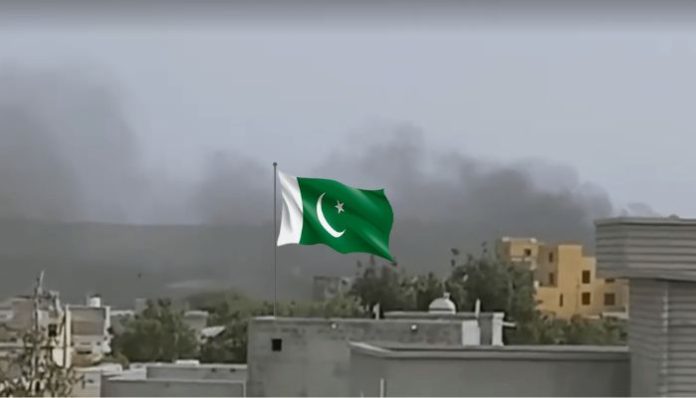
On Wednesday (20th March), Pakistan’s Gwadar port, which falls on the China-Pakistan Economic Corridor (CPEC), came under attack with reports of gunfire and blasts. According to Makran Commissioner Saeed Ahmed Umrani, armed assailants forcibly entered the Gwadar Port Authority Complex and opened firing while multiple blasts have also been reported, Pakistani outlet Dawn reported.
According to Pakistani media, the armed assailants carried out blasts before opening gunfire. A statement from the United Nations Department for Safety and Security said, “Several explosions followed by continuous firing” were reported during the attack on the complex. It added that the facility hosts several government and paramilitary offices.
Dawn reported that Pakistani security forces have killed eight attackers (casualty later updated at seven) in the exchange of gunfire. Speaking with Dawn, Gwadar SSP Captain (retd) Zohaib Mohsin said, “Eight armed assailants have been successfully gunned down by the police and security forces.” The Pakistani police official added that the firing had completely stopped.
A large contingent of police and security forces had reached the scene when the intense firing was ongoing, port officials said.
According to Pakistani media reports, the Majeed Brigade of the Balochistan Liberation Army (BLA) has claimed responsibility for the attack on Gwadar port.
Notably, Gwadar lies in a strategic location as it is close to the Strait of Hormuz, an important route for shipping oil in the Arabian Sea. The seaport is a part of the China-Pakistan Economic Corridor (CPEC), the flagship project of Chinese President Xi Jinping. China has invested heavily under its Belt and Road Initiative in mineral-rich Balochistan, including in the development of the Gwadar Port.
However, Balochistan advocacy groups have opposed the development as they view it as an exploitation of their resources by the Chinese and the Pakistani army. Several armed groups seeking liberation from Pakistan have also targeted Chinese assets in the region to derail or completely stop the CPEC project.
In August last year, armed assailants attacked a convoy of Chinese workers in Gwadar. BLA had also claimed responsibility for that attack.
Additionally, various ethnic-separatist and terrorist organisations, including the Tehreek-e-Taliban Pakistan (TTP), Lashkar e-Tayyiba, Lashkar e-Jhangvi, Daesh, and the Balochistan Liberation Front have been active in this region.
Pakistan has experienced an increase in terrorist activities in the past year, particularly in KP and Balochistan following the cessation of the ceasefire between the banned militant group Tehreek-i-Taliban Pakistan and the government in November 2022.


