

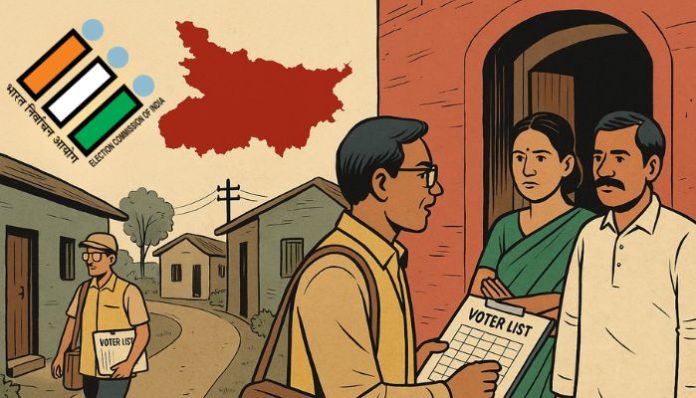
On 3rd August, the Election Commission of India (ECI) revealed that it has received 941 claims and objections related to Bihar’s draft electoral roll. However, not a single complaint out of the 941 has been filed by any political party including the Indian National Congress and Rashtriya Janata Dal (RJD). The bulletin issued on Sunday by the ECI showed that all objections so far have come from individual electors alone.
BIHAR SIR 2025: DAILY BULLETIN
— Election Commission of India (@ECISVEEP) August 3, 2025
?️1st Aug (3 PM) till 3rd Aug (3 PM)
Read in detail: https://t.co/Qitu7DZBVd pic.twitter.com/s8LHbIWihJ
The three-day report covered the period from 1st August to 3rd August (3 PM). It revealed that apart from Congress and RJD, parties including BJP, JD(U) and others have not registered any formal claims or objections regarding the integrity of the draft rolls. The Congress has deployed 17,549 Booth Level Agents (BLAs) while RJD has 47,506 BLAs. Bharatiya Janata Party (BJP) has the maximum, 53,338 BLAs in the field. However, the number of complaints filed remains zero.
What is the SIR electoral roll?
The ongoing Special Intensive Revision (SIR) of the electoral rolls is part of a unique drive initiated by the ECI to ensure a clean and accurate voter list ahead of Bihar Assembly elections due in October-November this year. Under this process, the ECI has opted for a complete ground-up enumeration, house-to-house verification by officials without referencing the previous electoral rolls.
This form of revision is adopted when the Commission suspects significant errors in existing data or after major administrative events such as constituency delimitation. The objective of the drive is to ensure that no eligible citizen is left out while no ineligible person is included in the Electoral Roll.
The first phase, which started on 1st July, involved physical enumeration. The deadline for new voter registration through Form 6 was 25th July, and the draft list was published on 1st August. The window for filing claims and objections will remain open till 30th August, after which the final electoral roll will be released on 30th September.
Final list only after scrutiny and investigation
Despite political pushback, particularly from the I.N.D.I. Alliance, the Supreme Court has greenlit the process. Notably, the I.N.D.I. Alliance has dubbed the exercise a “vote ban” targeting its support base.
Interestingly, the ECI found several foreign nationals from Nepal, Bangladesh, and Myanmar in possession of Indian documents like Aadhaar, ration cards, and domicile certificates during the enumeration. These individuals had reportedly entered their names into previous voter lists. The Commission has now pledged a detailed investigation from 1st to 30th August to weed out any illegals from the final roll.
Conclusion
With over 1 lakh Booth Level Officers (BLOs), 4 lakh volunteers, and 1.5 lakh booth agents deployed across Bihar, the SIR revision has become the largest electoral roll exercise in recent years. The political heat around the SIR may continue, but so far, only citizens, not any political party, have chosen to file objections.


