

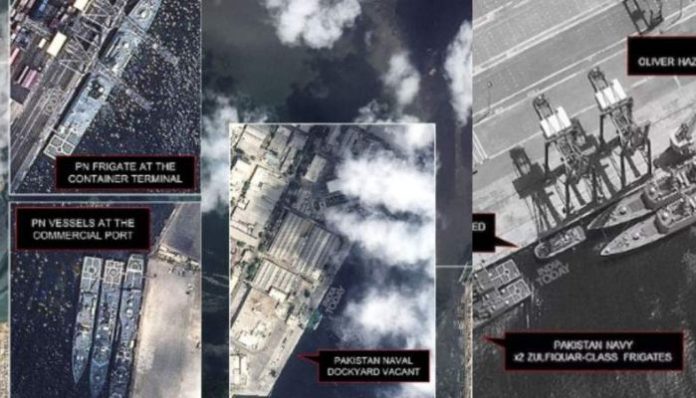
For the first time, satellite images have come out that show Pakistan’s Navy pulling back during India’s attack as part of Operation Sindoor in May. According to a report by India Today, these images provide rare proof of how Islamabad was forced to reposition its naval fleet after India’s strikes.
The pictures reveal that several Pakistani warships were shifted from their main naval bases. Some were moved to Karachi’s commercial docks, while others were pushed further west, closer to the Iran border. The retreat was significant, as it happened right when India was carrying out precision strikes against the terror state between 7th and 10th May.
This new evidence directly challenges Pakistan’s earlier claims of giving a “strong response” to India. The images suggest that Islamabad had to retreat to even protect its naval assets. On 8th May, just a day after India’s strikes, key warships were found missing from their usual berths. Instead, three were spotted together at Karachi’s commercial port, while another had been relocated separately.
Notably, on the intervening night of 7th and 8th May, India carried out a major retaliatory strike following the Pahalgam terror attack that killed 26 people. The operation was a joint effort by the Indian Army and the Air Force.
Within a span of 25 minutes, between 1:05 am and 1:30 am, Indian forces conducted 24 precision missile attacks on nine terror locations within Pakistan and Pakistan-occupied Kashmir (PoK). Targets included Muridke and Bahawalpur—locations that are the centers of Lashkar-e-Taiba and Jaish-e-Mohammed.
New Delhi said clearly that the action was a “measured” step, meant to punish those responsible for the Pahalgam attack, not to escalate tensions further.
The satellite imagery, however, speaks for itself. They amply illustrate how Pakistan’s navy had to relocate its frontline warships almost 100 km away from Karachi to Gwadar on the Iranian border. For Islamabad, which had proclaimed resilience, this withdrawal is an abject acknowledgment of just how forcefully India’s Operation Sindoor rattled its defenses.


