

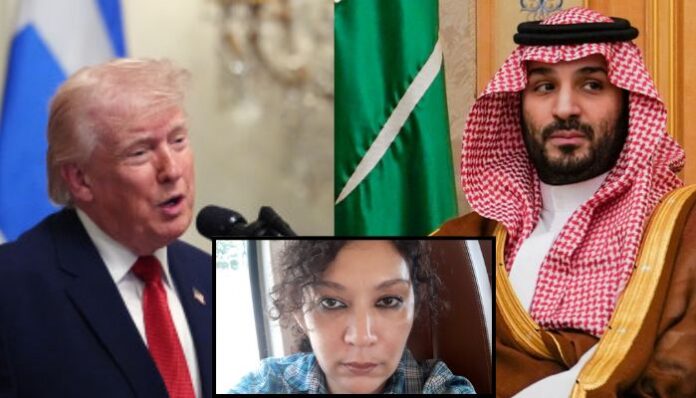
The complex world of the Middle East took another sharp turn, following some highly unfiltered remarks from President Donald Trump. Speaking at the Future Investment Initiative conference in Florida, Trump didn’t hold back when describing his relationship with Saudi Arabia’s de facto ruler, Crown Prince Mohammed bin Salman, widely known as MBS. In a statement that has since gone viral, Trump claimed that the Saudi leader was effectively “kissing my a**” while describing the current power dynamics between Washington and Riyadh.
US President Donald Trump has claimed that Saudi Arabia's Crown Prince, Mohammed bin Salman, is "kissing his ass" during a speech at an investment summit in Miami pic.twitter.com/V3uwkSd1nX
— Middle East Eye (@MiddleEastEye) March 28, 2026
According to media reports, Trump recounted a conversation regarding the US resurgence under his presidency. He claimed that MBS hadn’t expected such a strong American comeback. “He didn’t think this was going to happen… he didn’t think he’d be kissing my a**… he thought it’d be just another American president that was a loser… but now he has to be nice to me,” Trump said. While these words were biting, Trump did balance them with praise, calling the Crown Prince a “fantastic man” and a “warrior,” suggesting that Saudi Arabia should be proud of his leadership.
These comments didn’t happen in a vacuum. They come at a time when the US and Israel are engaged in a significant military campaign against Iran, which began on 28th February. Reports from the New York Times suggest that behind closed doors, MBS has been encouraging Trump to stay the course, calling the war a “historic opportunity” to weaken the Iranian government. However, publicly, Saudi Arabia has maintained a more cautious stance, calling for a peaceful resolution while focusing on defending its own borders. Despite this official neutrality, Trump’s public mockery has struck a sensitive nerve across the globe, particularly within the Muslim community of the Indian subcontinent.
The outrage of the Indian Subcontinent Muslims
The reaction from the muslims of the Indian subcontinent was swift and deeply rooted in the concept of the “Ummah.” One of the most prominent voices to react was journalist Saba Naqvi. On Saturday, 28th March, she shared a lengthy and provocative post on X. In her post, Naqvi invoked the name of Al-Qaeda terrorist Osama bin Laden and referred to the Saudi monarchs by their religious title, the “custodians of the two holy mosques in Mecca and Medina.”
She wrote, “Osama bin Laden emerged from Saudi Arabia, first for Jihad against the Soviets and then raging against his own country’s proximity to the US. The 9/11 operation had many Saudis involved.” By referring to the horrific 9/11 terrorist attacks as an “operation” and a sharp attempt to legitimise it, she seemed to be drawing a parallel between past Saudi-US tensions and the current perceived insult.
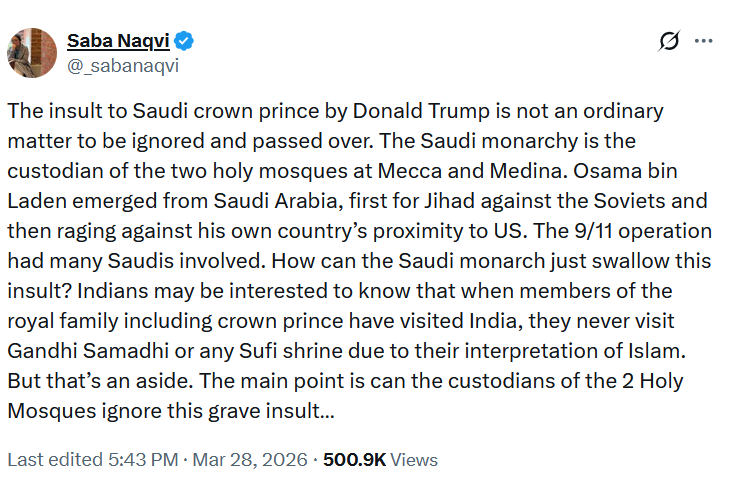
Naqvi didn’t stop there. She touched upon the Saudi royal family’s visits to India, noting that they rarely visit the Gandhi Samadhi or Sufi shrines due to their specific interpretation of Islam.
However, her main objective was clear: to provoke a religious reaction. “The main point is, can the custodians of the 2 Holy Mosques ignore this grave insult…” she questioned. Her choice of words appears to be a calculated attempt to stir the “Ummah” into not accepting Trump’s remarks, essentially suggesting that as an Indian Muslim, her loyalty lies with the dignity of Islamic leadership over diplomatic nuances.
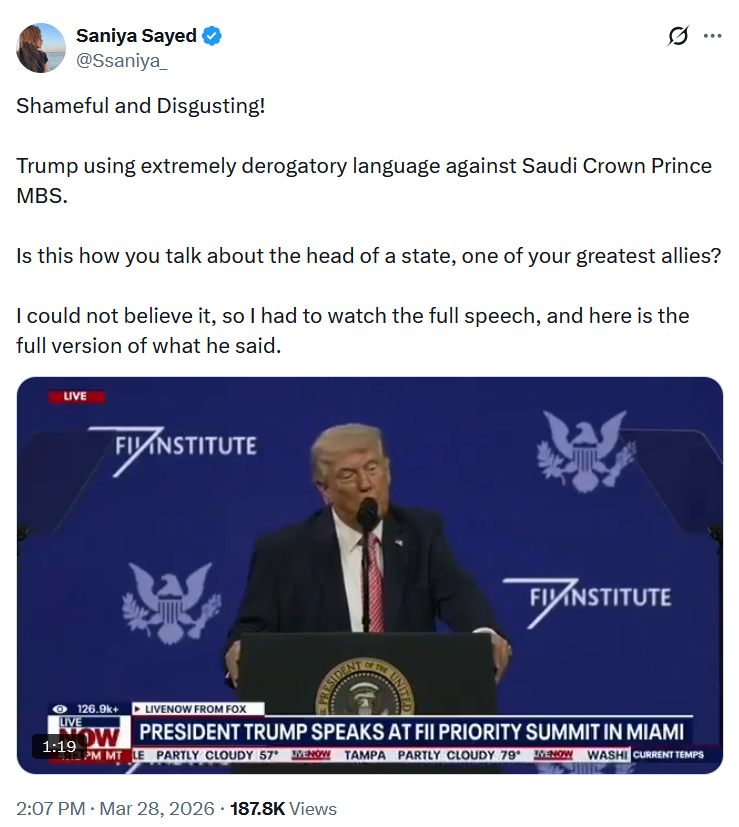
The outrage spread quickly beyond Naqvi’s circles. Saniya Sayed, another vocal user on X, expressed her disgust quite clearly. She wrote, “Shameful and Disgusting! Trump using extremely derogatory language against Saudi Crown Prince MBS. Is this how you talk about the head of a state, one of your greatest allies?” Her reaction mirrors a sentiment of deep-seated hurt, where an insult to a Saudi leader is viewed as a personal affront to Muslims everywhere.
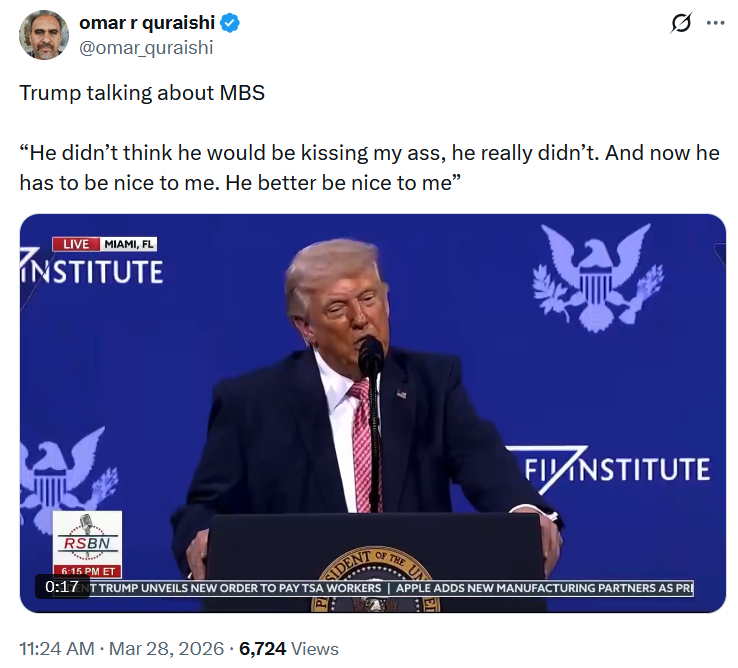
The sentiment was equally strong in Pakistan. A prominent Pakistani journalist shared the video of Trump’s comments, highlighting the specific part where Trump said, “He didn’t think he would be kissing my ass, he really didn’t. And now he has to be nice to me. He better be nice to me.” This sharing of the video wasn’t just for news; it was to highlight the perceived humiliation of a leader who represents the heart of the Islamic world.
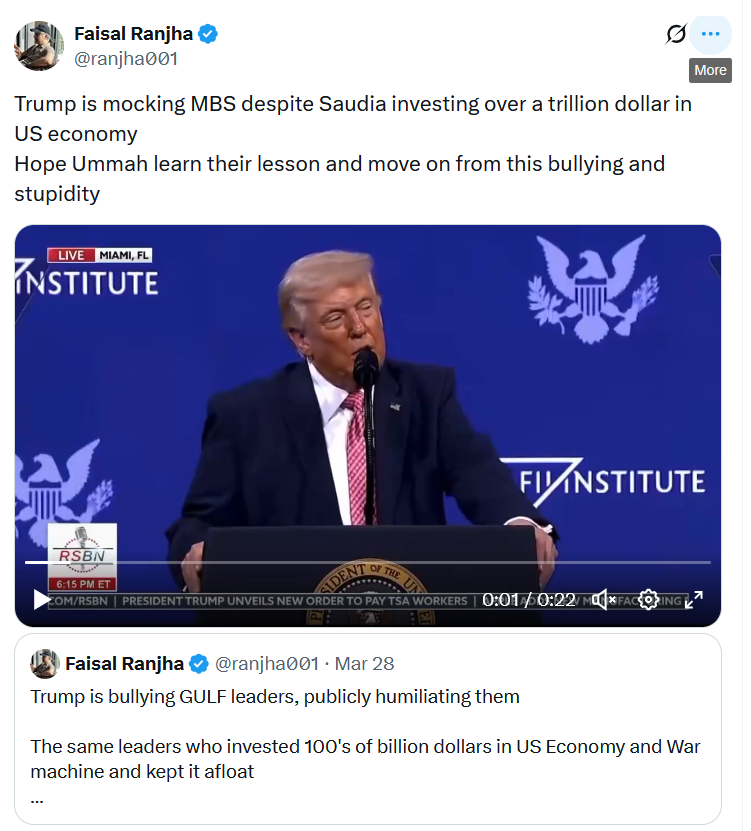
Another Pakistani voice, Faisal Ranjha, took a more direct stance by bringing up the economic angle. He noted that Trump was mocking MBS despite Saudi Arabia investing over a trillion dollars into the US economy. He wrote, “Hope Ummah learn their lesson and move on from this bullying and stupidity.” By using the word “Ummah” and suggesting they “learn their lesson,” Ranjha was effectively calling for a collective religious and economic pushback against what he perceives as American bullying. This reinforces the idea that for these individuals, the religious identity of the “Ummah” comes before any national or diplomatic pragmatism.
Crying for Khamenei: Loyalty beyond borders
This trend of showing extreme loyalty to global Islamic leaders, not national interests, can be seen in an even stronger form after the death of the Supreme Leader of Iran, Ayatollah Ali Khamenei. Khamenei was a figure who frequently criticised India, yet the news of his death saw massive outpourings of grief from Indian Shia Muslims. From Jammu and Kashmir to Uttar Pradesh, Mumbai, the roads saw people mourning the death, protesting against the killing of the Supreme Leader.
"खामेनेई मेरा शेर था, शेर…"
— News24 (@news24tvchannel) March 1, 2026
◆ लखनऊ में ईरान के सुप्रीम लीडर आयातुल्लाह अली खामेनेई की हत्या पर महिला प्रदर्शनकारी ने कहा#AyatollahAliKhamenei | Ayatollah Ali Khamenei | #Iran | #Khamenei | #Netanyahu | #Israel | Israel | #Tehran | Tehran | Iran | #Iran pic.twitter.com/BvNvzRnESp
In Kashmir’s Lal Chowk, protesters described him as “a lion” and claimed many more like him would be born. Black flags were waved at imambaras, which is usually done only during the highest form of religious mourning, like the tragedy at Karbala.
Even in Aligarh Muslim University, students held funeral prayers in absentia. Activist SM Tahir Husain noted that for many, the Ayatollah was not just a leader for Shias but a symbol for all Muslims. This reaction highlights a significant trend: when a figure associated with the global “Ummah” is affected, the emotional and physical response from certain sections of the Indian Muslim community is overwhelming, often overshadowing domestic concerns.
Gold for Iran, silence for Pahalgam
The most striking evidence of this “Ummah-first” loyalty can be seen in the financial contributions made by Kashmiri Muslims toward Iran following the outbreak of the recent conflict. Reports have emerged of youth in the Kashmir valley going door-to-door to collect donations. People have been pledging gold, cash, and even livestock to support Iran. One woman reportedly donated gold she had kept for 30 years in memory of her late husband, while a young man in Ganderbal sold his Royal Enfield bike to contribute to the Iranian relief efforts.
“There is huge devastation caused by this illegal war imposed on Iran. The least the civilised world can do is send aid,” said one resident of Rainawari. While this humanitarian impulse is notable, it stands in stark contrast to the local response to domestic tragedies. For instance, when the Pahalgam terror attack occurred on 22nd April last year, where the victims were all Hindus, there was no such door-to-door collection, no selling of personal vehicles, and no mass outpouring of “hard-earned money” to support the victims’ families, not even the basic donations to the families of the victims.
A question of allegiance
The overall reaction to Trump’s comments on MBS, the mourning of Khamenei, and the large donations to Iran shows a common theme. For people such as Saba Naqvi and almost all Muslims, their true allegiance appears to be to their global Muslim community, or “Ummah,” rather than to their country of residence.
When a Saudi Arabian leader is disrespected, or an Iranian leader is assassinated, it elicits a personal, religious outrage. However, when their countrymen are murdered in a terror attack such as the one in Pahalgam, there is a deafening silence. This suggests a hierarchy of loyalty where religious identity and the concept of a borderless “Ummah” take precedence over national solidarity. By provoking MBS and the wider Muslim world over Trump’s remarks, these individuals are not just commenting on a news story; they are reinforcing a religious divide that places global sectarian ties above the unity of their own country.


