

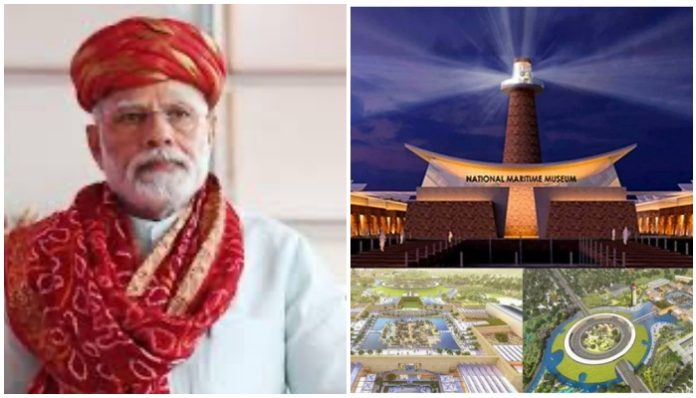
PM Modi on 20 September is scheduled to visit Gujarat. Among other engagements, the Prime Minister will also oversee the construction of the National Maritime Heritage Complex at Lothal, in the Ahmedabad district.
PM Modi will check the progress of the project and will hold a review meeting to track the NMHC project.
What is the NMHC project at Lothal?
Lothal in Gujarat, a 4000 year old Indus site is the world's oldest known dock. The National Maritime Heritage Complex (NMHC) here will showcase India's rich maritime history from the Indus Valley Civilisation to date. pic.twitter.com/65pLFexAKz
— Sarbananda Sonowal (@sarbanandsonwal) September 12, 2022
The National Maritime Heritage Complex (NMHC) at Lothal, Gujarat, is an initiative by the Modi government to honour the maritime and engineering achievements of the Indus Valley Civilisation, or, the Sindhu Saraswati Civilisation.
Lothal was a key port city of the IVC around 2400 BCE. The NMHC, a ₹4,500 crore project spanning over 400 acres allocated by the Gujarat government, aims to preserve and showcase this ancient site’s historical significance while promoting tourism and education for future generations.
World's Largest Maritime Museum, Lothal
— The Index of Gujarat (@IndexofGujarat) October 24, 2023
?Area : 400 acres
?Cost : 4,500 cr
?To showcase India’s 5,000-year-old maritime History
?12 states to set up their galleries
?The 77-meter-tall lighthouse being constructed here will be visible even from Ahmedabad
?1st phase is… pic.twitter.com/X74VX8ja2K
The NMHC, approved by the Union Cabinet in October 2024 under the Sagarmala Programme, seeks to highlight this legacy as an ancient maritime engineering marvel. It aligns with the government’s focus on balancing development and heritage preservation, and the reinvigorated focus in highlighting India’s ancient maritime trade.
Bringing Lothal and India’s rich maritime history back to life… pic.twitter.com/2k8rycWWMD
— Narendra Modi (@narendramodi) October 18, 2022
The complex, developed in two phases, includes a National Maritime Heritage Museum with 14 galleries covering India’s maritime history from the IVC to modern times. Phase 1A, over 60% complete and set to open by year-end, features six galleries, including an Indian Navy and Coast Guard exhibit with artefacts like the INS Nishank missile boat, a Sea Harrier, and a UH-3 helicopter. It also includes a recreated Lothal township and a jetty walkway.
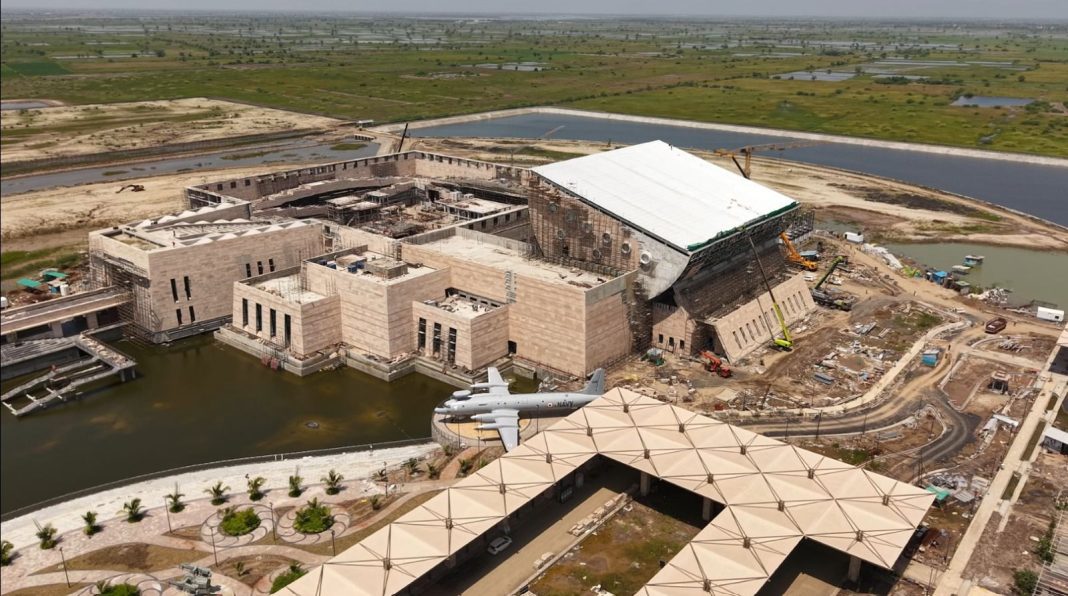
Phase 1B will add eight galleries, a 77-meter Lighthouse Museum, planned to be the tallest in the world, a 5D dome theatre, and the Bagicha Complex with parking for 1,500 vehicles, food courts, and medical facilities. Phase 2, funded through public-private partnerships, will include coastal state pavilions, eco-resorts, a fully recreated model of the Lothal city, a Maritime Institute, and four theme parks focusing on maritime history, climate change, monuments, and adventure.
4500 years of maritime brilliance, soon coming alive at Lothal.
— Gujarat Tourism (@GujaratTourism) September 17, 2025
The National Maritime Heritage Museum will take you on a journey through India’s rich oceanic legacy, with live exhibits and rare artifacts.
Stay tuned to explore the seas of stories. pic.twitter.com/DdC0ZpPqKQ
The project is supported by the Ministries of Ports, Shipping & Waterways and Culture, with funding from major ports, defence, the National Culture Fund, and ₹3,000 crore in private investment. The Lighthouse Museum will be funded by the
Directorate General of Lighthouses and Lightships (DGLL).
India’s leadership in maritime is rooted in a legacy older than 4 millennia! Lothal Dockyard is where Harappan merchants perfected tidal-lock basins.
— India Maritime Week 2025 (@imw_gov) September 15, 2025
India Maritime Week 2025 celebrates this timeless legacy, reinstating India as a maritime powerhouse, now and forever.… pic.twitter.com/THjjtwpg7y
Economically, the NMHC is expected to attract 25,000 daily visitors, generating 22,000 jobs directly and indirectly, while boosting local industries in the region. It aims to position Lothal as a major tourism destination, comparable to India’s top heritage sites.
The significance of Lothal: How it is the testament of India’s rich maritime history
Lothal is a key site on the map of Sindhu Saraswati Civilisation that traces how the rich civilisation of ancient Indians spread from the Sindhu river, flourished along the Saraswati and progressed over North-Western India, marking the continuity in our legacy through trade, craft, city planning and culture.
Located in Gujarat’s Bhal region near the Gulf of Khambhat, it features the world’s oldest known man-made dockyard, a 214 metre long and 36 metre wide trapezoidal basin with vertical brick walls, connected to the Sabarmati River via inlet and outlet channels.
The people of the Sindhu Saraswati Civilisation possessed sophisticated knowledge of water management and planning. The dockyard of Lothal was engineered to manage the region’s high tides, with a spill channel to prevent silt buildup.
The initial excavations at Lothal happened between 1955 and 1962. The excavation project was led by SR Rao, the man credited with discovering 30 Harappan sites in his lifetime. Rao had written about Lothal in Penn Museum’s Expedition Magazine, describing the significance of Lothal.
“The largest structure of baked bricks ever constructed by the Harappans is one laid bare at Lothal, to serve as a berth for docking ships and handling cargo….Originally, the dock was designed to sluice ships 18m to 20m in length, and 4 to 6m in width… At least two ships could pass through the inlet simultaneously…”
Some Western experts were unconvinced with the idea that Lothal could have been a dockyard. However, a recent study by IIT Gandhinagar used satellite imagery to explain why the dockyard and port theories are more accurate. Satellite imagery revealed the old channels of the Sabarmati which flew right next to Lothal, reported Indian Express. The river gradually shifted course and moved away from the site, leaving the dockyard at Lothal at an odd orientation. When the old channels flew, boats could have easily sailed via Lothal to as far as Dholavira, another key IVC site on the Rann of Kutch.
The IIT Gandhinagar study, by Professor VN Prabhakar, Professor Vikrant Jain and Ekta Gupta, concurred with what Rao had written. The old flow of channels of the Sabarmati put Lothal at a convenient geographical position, at the heart of a thriving trade network, extended from the Indian ports on the Arabian Sea, especially on the Gulf of Khambhat, all the way to ancient Mesopotamia.
This theory is further bolstered by the sheer number of ancient seals that have been excavated in the general area, more than any other site in Saurashtra, the Indian Express report added. The seals could have been used to mark cargo packages, and trade documents and letters.
Lothal saw settlements and resettlements in several phases. The gradual decline of the area was mainly due to catastrophic floods on the Sabarmati and the river changing course eventually, leaving the dockyard dry. Rao had written that after a major flood somewhere around 2000 BCE, the flourishing city was levelled, and what remained was an ill-planned village with a few people living. Then in 1900 BCE, another major flood destroyed the settlement for good.
The NMHC will preserve the legacy of the Indus Valley Civilisation’s maritime and engineering prowess while fostering economic growth and cultural awareness. To a population that has largely grown detached from its own maritime past, the NMHC will be a portal to our rich heritage of shipbuilding and maritime trade. Through state-of-the-art technology and thoughtful design, the NMHC will ensure that Lothal’s historical significance remains accessible to future generations of Indians, the descendants of the Sindhu Saraswati people.


