

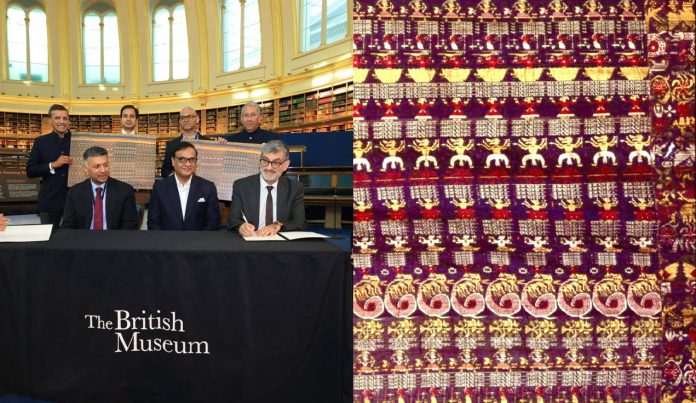
In a major cultural milestone for Assam, Chief Minister Himanta Biswa Sarma on Monday, 17th November, signed a historic agreement with the Victoria and Albert Museum in London to bring the sacred Vrindavani Vastra to the state on loan. The document, which was signed during Sarma’s ongoing visit to the UK for the purpose, will allow the centuries-old tapestry to be exhibited in Assam for the first time in history.
The CM described the moment as deeply emotional for the people of the state. “It feels like the homecoming of an ancestor,” Sarma said during the signing ceremony. Calling the Vastra a part of Assam’s “collective memory,” he said that generations of Assamese people had heard stories about it in their homes and temples but never seen it in person.
The Vrindavani Vastra is not just a textile, it is a symbol of Assam’s rich spiritual and cultural heritage, reflecting the devotion and vision of Mahapurush Srimanta Sankardev.
— Himanta Biswa Sarma (@himantabiswa) November 17, 2025
The signing of the Letter of Intent with London British Museum to bring it back home under a… pic.twitter.com/OnxT5See3r
“The return of the Vrindavani Vastra, although for a short time, signifies the return of a beloved about whom we have read only in books and scriptures. Every Assamese, irrespective of religion and ethnicity, feels that they have a stake in this heritage,” the CM said.
Generations have sung about it in kirtans, many have heard stories about it, read about it but have never seen it.
— Himanta Biswa Sarma (@himantabiswa) November 17, 2025
This is why bringing the Vrindavani Vastra to Assam, even if for a limited period of time, feels like one of our ancestors returning home. pic.twitter.com/0OM7UuZjB7
Sarma also thanked Prime Minister Narendra Modi for encouraging him to pursue the effort to bring the Vastra back. “Grateful to Adarniya Shri Narendra Modi Ji for his guidance that inspired us to bring the Vrindavani Vastra home,” he posted on ?. He added that a state-of-the-art museum is already being planned in Guwahati to house the sacred textile during the period it will remain in Assam for exhibition.
Grateful to Adarniya Shri @narendramodi Ji for his guidance that inspired us to bring the Vrindavani Vastra home.
— Himanta Biswa Sarma (@himantabiswa) November 17, 2025
A state-of-the-art museum in Guwahati is taking shape to honour this sacred treasure. pic.twitter.com/QHMQfgjEsx
According to Sarma, the JDW Foundation, an arm of the JSW Group, has agreed to fund the construction of this upcoming museum. The British Museum has set strict preservation conditions for the delicate fabric, and once the facility is ready, the Vastra is expected to be displayed in Assam sometime in 2027. The loan will be for 18 months, after which the textile will return to the UK.
Himanta Biswa Sarma shares video on Vrindavani Vastra’s Journey
A few days after the agreement, on Friday, 21st November, Chief Minister Sarma posted a video on his X account (formerly Twitter) explaining the historical journey of the Vrindavani Vastra. The video traces how the textile travelled from Assam to Bhutan, then to Tibet, and eventually ended up in Europe.
From the sacred hands of Mahapurush Srimanta Sankardev to different parts across the world and BACK to Assam!
— Himanta Biswa Sarma (@himantabiswa) November 21, 2025
This video traces the remarkable journey of the sacred Vrindavani Vastra. Its return is not just the homecoming of a textile, but the revival of Assam’s cultural soul. pic.twitter.com/cvBOVVOONV
“From the sacred hands of Mahapurush Srimanta Sankardev to different parts across the world and BACK to Assam! This video traces the remarkable journey of the sacred Vrindavani Vastra. Its return is not just the homecoming of a textile, but the revival of Assam’s cultural soul,” he wrote.
The post received widespread attention, with many people expressing pride that an important symbol of Assam’s cultural and religious identity would finally be exhibited in the state.
What is the Vrindavani Vastra?
The Vrindavani Vastra is one of the most treasured pieces of Assamese heritage and a unique creation in India’s cultural history. It is a large silk tapestry woven between 1567 and 1569, during the time of the Vaishnav saint and reformer Srimanta Sankardev. The Vastra was woven as a gift for Koch King Nara Narayan, the last ruler of the undivided Koch dynasty. Notably, Nara Narayan had sheltered Sankardeva after the Vaishnav saint was targeted by the Ahom kingdom on the instigation of Brahmin priests in the state.
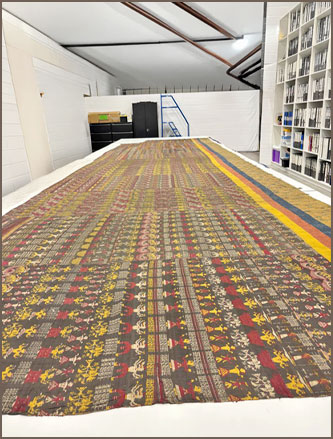
The Vastra is famous for its artistic, spiritual and historical importance. It depicts scenes from the Mahabharata, the Bhagavata Purana, and especially the childhood stories of Lord Krishna during his days in Vrindavan. Each section of the textile is woven with intricate detail, showing various episodes from Krishna’s life, him playing with friends, dancing with gopis, and performing various acts, including the triumph over the serpent demon Kaliya Naag.
The most remarkable aspect of the Vrindavani Vastra is that it was not painted but woven, which makes it one of the finest examples of textile art in India. The weaving technique and visual storytelling represent the core values of the neo-Vaishnavite movement led by Sankardev, which shaped large parts of Assam’s culture. It was created by 12 weavers under the supervision of Mathura Das Burha Ata, a disciple of Sankardev.
Over the centuries, the Vastra travelled far from its home. It was first taken from Cooch Behar to Bhutan and later to Tibet. European collectors eventually acquired pieces of it, leading to fragments being stored in museums across London, Paris, and Philadelphia. The most prominent section is preserved at the Victoria and Albert Museum (V&A) in London, which once displayed it as part of the popular exhibition titled “Krishna in the Garden of Assam.” Another major fragment is in the Guimet Museum in Paris.
The vastra was very large, to accomodate the stories of Krishna in Vrindavana, however it has been cut into pieces over time. The part of the fabric kept at the London museum is approximately 9.5 meters in length and two meters in width, making it one of the largest surviving devotional silk textiles of its era.
On the other hand, the piece kept at Musée Guimet in Paris is approximately 2.34 metres long and 1 meter wide. It is exhibited at L’Association pour l’étude et la documentation des textiles d’Asie at Musee Guimet. Around 20 fragments of Vrindavani Vastra survive today, some stitched together into larger pieces.
The Paris museum has another piece of such vastra woven much later. Several such vastras were woven after the first one during the Sankardev, and these fabrics are on display at various museums across the world, as they were collected and sold by European collectors during the British Raj.
Some of these vastra pieces were used to make textile items, like the Chepstow Coat on display at the Chepstow Museum in Wales. The lining of this garment was made from strips of Vrindavani Vastra textile. Notably, as the vastra was made to make linings for this coat which has remained closed over time, the colours are remarkably vibrant.
Today, due to its fragile condition, the London portion of the Vastra is kept in a restricted, climate-controlled environment, and people can view it only by taking a prior appointment with the museum. Its age, over 450 years, and its delicate silk fabric make it extremely sensitive to humidity, temperature fluctuations and light exposure.
The Assam government had previously tried to bring the Vastra to the state, including in 2013, but the British Museum had declined due to concerns about Assam’s hot and humid weather. However, after fresh negotiations led by CM Himanta Biswa Sarma, the museum has now agreed to loan the Vastra for 18 months in 2027, provided a world-class museum with specific climate-control standards is built.
CM highlights the Vastra’s significance
On Wednesday, 19th November, Chief Minister Sarma posted another update on X, providing a brief explanation of the Vrindavani Vastra’s cultural importance. He wrote, “From Assam to the world and back! The Vrindavani Vastra is a sacred textile depicting Lord Krishna’s life. Crafted under the guidance of Mahapurush Srimanta Sankardev, reflecting our rich heritage & devotion.”
From Assam to the world and back!
— Himanta Biswa Sarma (@himantabiswa) November 19, 2025
The Vrindavani Vastra is a sacred textile depicting Lord Krishna’s life. Crafted under the guidance of Mahapurush Srimanta Sankardev, reflecting our rich heritage & devotion.
Know about this timeless symbol of faith, heritage & art. pic.twitter.com/2ENFgxGDwR
The post basically highlighted how the Assam government’s renewed efforts helped break the long diplomatic deadlock, leading to the signing of the Letter of Intent in London to bring the Vastra home.
A new Museum in Assam: Preparing for the Vastras’s arrival
After agreeing to loan the fabric to Assam for a temporary duration, Representatives of the museum London visited two existing museums in Guwahati, the Sankardev Kalakshetra Museum and the Assam State Museum. However, they concluded both lacked facilities needed to protect the Vastra from Assam’s climate, and said that a new museum with their set standards must be built for it.
Another condition is that the Union government of India will have to give a sovereign guarantee that the Vrindavani Vastra will be return to London after the contacted period of 18 months. The President of India will have to sign that guarantee.
To ensure that the Vrindavani Vastra can be safely displayed in Assam, the state government and the JSW Foundation will build a world-class museum in Guwahati. According to an official statement issued on 11th November, the museum will be constructed on a 45,000-square-foot site at the location of sericulture farm in Khanapara. The land has been allotted by the state government, while the JSW Group will take full responsibility for funding and constructing the entire facility. JSW Group is building it as part of their CSR activity, and they will hand over the museum to Assam govt once it is ready.
The upcoming museum is expected to become a major cultural landmark in the Northeast. It will serve not only as a space to exhibit the Vrindavani Vastra but also as a centre for cultural exchange, hosting national and international artefacts, travelling exhibitions, cultural shows and heritage displays, after the Vastra’s exhibition concludes.
Its first major exhibition will be the display of the Vrindavani Vastra in 2027, once the textile is brought from the British Museum. After that, the Assam government will attempt to bring the piece of the Vastra kept at Musée Guimet in Paris.
Chief Minister Himanta Biswa Sarma said the project would be a matter of great pride for Assam. “The museum will not only bring the sacred Vrindavani Vastra home but also provide a world-class facility to showcase Assamese art, history, and heritage alongside global cultural exhibits,” he said.
Sangita Jindal, Chairperson of the JSW Foundation, said her organisation was honoured to support Assam in building a museum that would celebrate India’s artistic legacy. “This museum will stand as a testament to our shared history and artistic devotion. We believe in the power of art and culture to inspire communities,” she said.
The museum will include advanced climate-control and security systems as demanded by the British Museum. These include 24×7 humidity and temperature management, restricted lighting, special storage cases, and trained conservators who can monitor the condition of delicate artefacts. Apart from these specific conditions, standards rules for touring exhibitions of museum artifacts will also apply to the arrangement. The aim is to create a facility that meets international museum standards and can safely house fragile textiles like the Vrindavani Vastra.


