

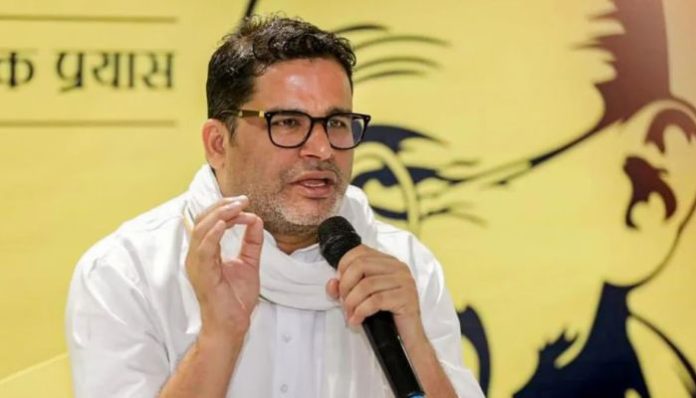
The Bihar Assembly election results turned out to be a disappointing reality check for Prashant Kishor and his Jan Suraaj Party (JSP). The party had contested 239 out of 243 seats, but could not win even a single one. As per the poll results on Friday, 14th November, Jan Suraaj could manage only around 2–3% of the total votes. Across the state, it polled roughly 3.4% of the vote share. Not a single JSP candidate won; only one candidate reached second position, 115 candidates came in third, and 122 finished below third place.
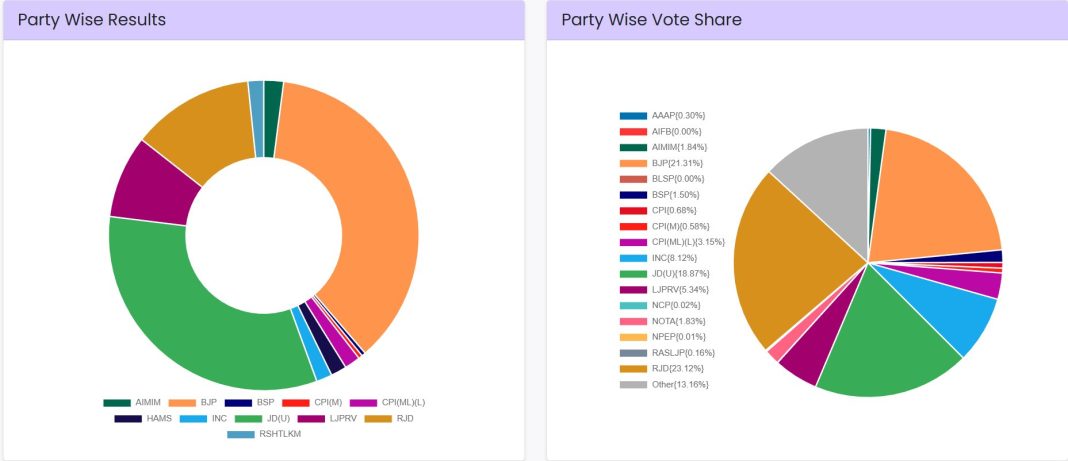
In simple words, the party did not emerge as a winner, the runner-up, or even the “vote cutter” that some analysts imagined it would be. Many expected that Kishor’s aggressive campaigning and statewide yatra might, at the very least, eat into someone’s vote share.
But that also didn’t happen. The party’s overall performance placed it just slightly ahead of NOTA, which got 1.8% of votes. For someone who spent more than two years touring Bihar and building momentum, always making headlines, being constantly interviewed, the final numbers were nowhere close to the hype.
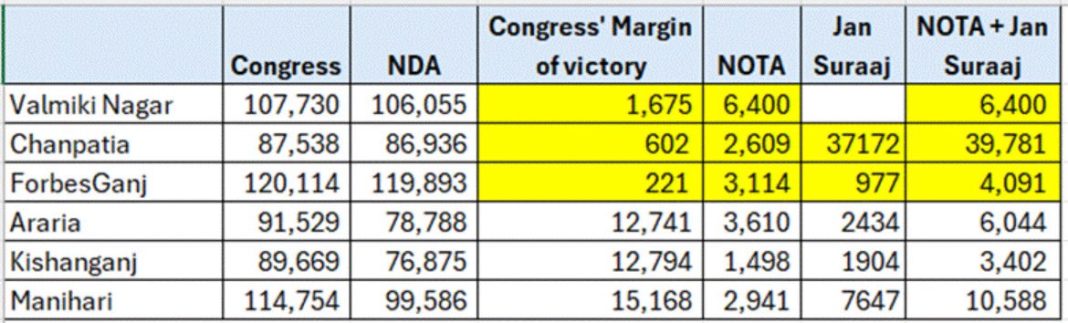
The hype PK enjoyed never converted into votes
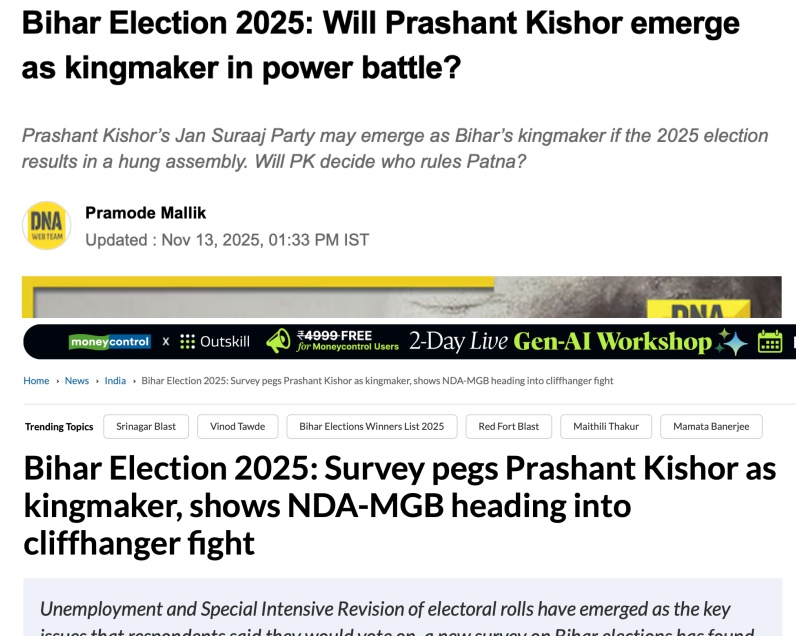
Right after the results, one thing became clear, the way the media hyped Prashant Kishor did not translate into votes on the ground. For months, TV channels, YouTubers, and commentators treated him like a strong challenger with the ‘kingmaker’ image, someone who might change the election dynamics in Bihar. Much of this came from Kishor’s past reputation as a successful poll strategist who had helped various parties win elections across India.
However, the Bihar Assembly results proved that popularity in media interviews and online conversations does not automatically mean popularity among actual voters. The energy around Jan Suraaj was mostly driven by discussions, podcasts, social media clips, and PK’s own sharp statements. On the ground, when the votes were counted, the hype simply did not match reality.
“Debut election” can’t be an excuse: PK has been in politics for years
Some Jan Suraaj supporters will try to defend the poor performance by saying that this was the party’s debut election. But this argument does not hold much weight in Kishor’s case. PK wasn’t entering politics for the first time. In fact, he has been a known name in Indian politics for more than a decade.
Prashant Kishor shot to prominence after helping Narendra Modi‘s successful Gujarat campaign in 2012. His work also played a significant role in the BJP’s massive 2014 Lok Sabha win. Later, he changed sides to help the Mahagathbandhan in Bihar sweep the 2015 Assembly election. He also guided Captain Amarinder Singh in Punjab, Jagan Mohan Reddy in Andhra Pradesh, MK Stalin in Tamil Nadu and Mamata Banerjee in West Bengal – all of whom won big.
He even joined the JD(U) in 2018, served as its national vice president, and helped the party revive its Lok Sabha fortunes in 2019. So, it is clearly not a “debut” when one has been deeply involved in Indian politics, helped leaders win elections across the country, and held a high post in a ruling party. Bihar voters did not see him as a newcomer at all.
Other parties did much better in their first election
Many new parties have performed far better in their debut elections in other states. The biggest example is the Aam Aadmi Party (AAP), which had a historic entry into Delhi politics. In its very first Assembly election in 2013, AAP won 28 seats, shocking both the BJP and the Congress.
In smaller states too, regional parties like the Sikkim Democratic Front (SDF) showed strong performances early on, dominating state politics for years. These parties proved that good debut performances are possible if the public truly trusts a new political force. Compared to them, Jan Suraaj’s failure to win even one seat shows that Bihar voters were not convinced enough to give Kishor a chance.
Why the media hype around Kishore didn’t work
For more than two years, Prashant Kishor travelled across Bihar, held meetings, spoke about unemployment, migration, and education, and gave hundreds of interviews to national media, regional media, and YouTube channels. His padyatra drew crowds, and many people online saw him as a serious contender. He projected himself as a wisened ‘Kingmaker’ who understood Bihar at the grassroots and would offer long-term solutions.
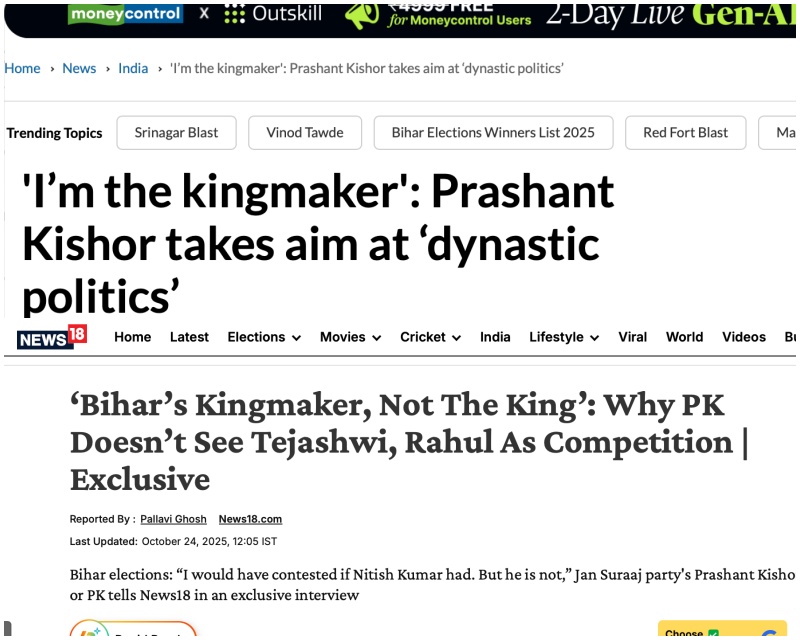
But despite the noise, voters did not choose him on polling day. Political analysts say this is because Kishor’s campaign created more attention than trust. Many expected him to contest the election himself, but when he refused to enter the fray, people started questioning his seriousness. His big claims, like saying Nitish Kumar would not return to power, or promising to quit public life if JD(U) crossed 25 seats, also backfired. These bold statements angered many JD(U) supporters and even fence sitters, who then voted even more strongly for their party.
#WATCH | Patna: Jan Suraaj founder Prashant Kishor says, "We won't relent until we defeat the BJP and uproot the NDA. The results will be out on the 14th November and the truth will be revealed. They're trying to create an atmosphere that we're scared. Prashant Kishore, along… pic.twitter.com/efAFWM0yOp
— ANI (@ANI) October 21, 2025
Another issue was PK’s habit of constantly giving interviews and making big promises. While this kept him in the headlines, it may have made voters feel that he was trying to build his image more than to build a political organisation.
A campaign full of promises, and no impact on poll day
The Jan Suraaj campaign had several big ideas. One of Kishor’s most talked-about promises was that he would scrap Bihar’s liquor ban “within an hour” of coming to power. He argued that the ban had only encouraged black markets and illegal supply chains. His team claimed that lifting the ban could bring in ₹28,000 crore every year, which they would use to improve education, welfare, and administration in Bihar.
Will remove Liquor Ban within 1 hour of forming government in Bihar
— Megh Updates ?™ (@MeghUpdates) September 14, 2024
– Prashant Kishor pic.twitter.com/bmwh8oLeHG
He also spoke about giving loans to women, increasing pensions for the elderly, creating jobs for the youth, and bringing merit-based politics instead of caste-based politics. His candidate list also included Bhojpuri singers, retired officers, teachers, and experienced leaders.
But when the results came out, all this talk failed to convert into even a single win. The voters simply did not see Jan Suraaj as a practical alternative to the parties they already knew.
Counting day gives the final blow to the JSP
In the end, the counting day showed a completely different picture from the confident interviews and claims made during the campaign.
Jan Suraaj could not open its account. Its candidates remained far behind in most seats. The JD(U), which Kishor had confidently predicted would do badly, actually performed much better, winning 42 more seats than it did in the 2020 election. The exact opposite of Kishor’s predictions happened.
When he was asked earlier what he would do if his party failed, Kishor had said that he had committed 10 years of his life to Bihar and that he would continue to work for the next five years even if the results were disappointing. Now that the verdict is out, his real test begins: whether he will continue his political journey with patience or whether Jan Suraaj’s future will fade like many other overhyped political experiments.


