

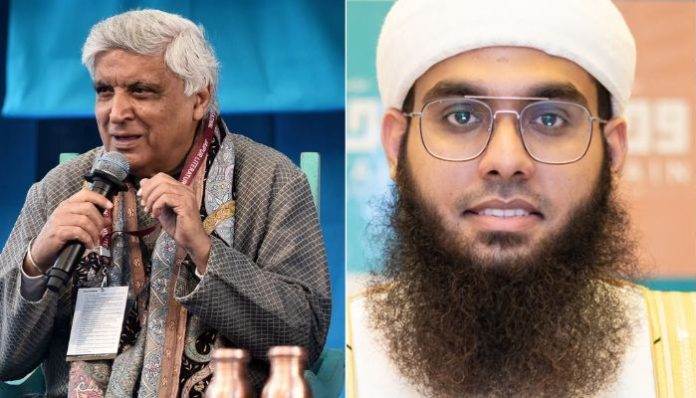
Mufti Shamail Nadwi recently sparked national controversy after a high-profile public debate with veteran poet and lyricist Javed Akhtar on the topic, “Does God exist?” The discussion took place at the Constitution Club in New Delhi on Saturday, 20th December, and quickly became one of the most talked-about intellectual events of the month.
Moderated by journalist Saurabh Dwivedi, editor of The Lallantop, the nearly two-hour-long debate drew a packed audience and soon spilt beyond the hall onto social media, where clips and quotes were widely shared. While supporters on both sides praised the exchange as a rare face-off between faith and reason, critics argued that it exposed deeper ideological divides, especially given Nadwi’s past statements and public positions.
Nadwi, an Islamist and online preacher, began by arguing that neither science nor religious scripture alone could be used as a common yardstick to prove or disprove God’s existence. Science, he said, is limited to studying the physical world, while God is by definition beyond physical measurement. Religious texts, he added, cannot convince those who do not already accept revelation as a source of knowledge.
Instead, Nadwi relied on philosophy, presenting what he called the “contingency argument.” According to him, the universe depends on causes and therefore cannot explain its own existence. This, he claimed, logically points to the existence of a “necessary being” that is eternal, independent, intelligent and powerful.
Using examples of design and order in nature, Nadwi argued that the precise laws governing the universe suggest intention rather than random chance. He rejected the idea that scientific discoveries eliminate the need for God, saying science explains how the universe works, not why it exists.
Javed Akhtar’s sharp counter and a heated exchange
Javed Akhtar, known for his outspoken rationalist views, pushed back strongly. He questioned the durability of religious belief and pointed out that many gods worshipped by ancient civilisations, Greek, Roman and Egyptian, were once believed in with absolute certainty, yet are now seen as mythology.
“Gods change with time,” Akhtar said, arguing that belief systems evolve as human understanding grows. He cited the decline of organised religion in parts of Europe as evidence that faith is not fixed or eternal.
Akhtar drew a clear line between belief and faith. Belief, he said, rests on evidence, reason and testimony, while faith demands acceptance without proof. “When there is no evidence, no logic and no witness, and you are still asked to believe, that is faith,” he said, adding that unquestioning faith discourages critical thinking.
The exchange grew more intense when Akhtar raised the issue of suffering and violence. Referring to children dying in Gaza, hunger and disease, he questioned the idea of an all-powerful and benevolent God. “If such a being exists and allows this, I find it difficult to respect it,” he said, adding sarcastically that “compared to that, our Prime Minister Narendra Modi is better, “kuch to khayal karte hai.”
खुदा से ज्यादा तो हमारे प्रधानमंत्री है खयाल रखते
सीधी बात मोदी ही इनका अल्लाह है
पूरा डिबेट देखो इसने खुद मोदी को अल्लाह
और खुदा से बड़ा बताया ..मुफ्ती को खूब धोया
जावेद अख्तर का सॉफ्टवेयर अपडेट हो गया ? pic.twitter.com/pD5I0zMS7l— Amrendra Bahubali ?? (@TheBahubali_IND) December 20, 2025
Nadwi responded by arguing that evil exists to define good and that human beings are tested through free will. Acts like violence and oppression, he said, are the result of human choices, not divine failure.
Akhtar rejected this, citing philosopher Bertrand Russell’s famous analogy of an invisible teapot orbiting the Earth. “The one who makes the claim must prove it,” he said.
Early life and ideological shaping
Born and raised in Kolkata, Mufti Shamail Nadwi, whose full name is Mufti Shamail Ahmad Abdullah Nadwi, grew up in a deeply religious environment. According to his own accounts and public profiles, the Qur’an and classical Islamic texts were a central part of his daily life from a very young age.
The Qur’an, by his description, was not just recited but “lived.” Classical religious texts were introduced early, shaping his ideology from childhood. This early immersion laid the foundation for a rigid, regressive and exclusionary mindset that later became visible in his public speeches and online activity.
Today, Nadwi is associated with academic work as a doctoral researcher at the International Islamic University Malaysia. However, alongside his academic identity, his public statements and videos have repeatedly sparked controversy.
Promoting the ‘Bhagwa Love Trap’ conspiracy
One of the most criticised episodes linked to Nadwi is his promotion of the “Bhagwa Love Trap” conspiracy theory, a narrative that is outright sinister as it puts the lives of Hindu men in love with Muslim women in danger.
In a video shared on his X account, Nadwi addressed Muslim women and warned them against marrying non-Muslims, particularly Hindus.
A polite message for those girls who left #Islam for a non-muslim by Mufti Shamail Nadwi#Bhagwalovetrap#Hindutva pic.twitter.com/vwqDx8QpBU— Mufti Shamail Nadwi (@muftishamail) May 28, 2023
In the video, he said, “Don’t give your Muslim daughters to Hindus. Surely, a Muslim slave is better than these Hindus… I am talking to my sisters who are trapped in the love trap of these polytheists and have deviated from Islam.”
He framed interfaith relationships as a choice between “temporary worldly love” and “the fire of hell” versus “the paradise of Allah,” urging women to return to Islam and abandon such relationships. He claimed that Allah invites believers to heaven, while non-believers invite them to destruction.
Why the ‘Bhagwa Love Trap’ narrative is dangerous
The “Bhagwa Love Trap” theory emerged as a counter-narrative to documented cases of identity fraud and forced religious conversion, “love jihad.” Unlike those cases, experts and civil rights groups say the Bhagwa Love Trap narrative lacks evidence and is built on suspicion rather than facts.
In recent months, videos have surfaced across social media showing Muslim mobs harassing Hindu men seen with Muslim women in public places, roads, cafes, restaurants and even hotels. These mobs often accuse the men of trying to “trap” Muslim women into Hinduism, even when no deception is involved.
OpIndia earlier reported that at least 30 such incidents have been documented across different states. In Patna and Muzaffarnagar, Hindu men were abused, threatened and even physically assaulted, while Muslim women were publicly shamed and pressured to leave.
Numerous inconsistencies exist in the “Bhagwa Love Trap” narratives propagated by Islamists who aim to frame it as “love jihad.” However, their assertions appear to lack substantial evidence. The Hindu boys have not been accused of hiding their identity in any of the cases brought up by them.
On the contrary, Hindu boys are being recognised through the sacred thread or other religious markers. The Hindu boys whose social media profiles have been disclosed have also accurately represented their names on those platforms. They did not obscure any aspect of their identity.
“Only Islam is true”: Another supremacist claim.
Nadwi has also drawn criticism for openly declaring the superiority of Islam over all other religions, an archetype of a Maulvi intoxicated on the supremacism of Islam. In one of his statements, he said, “Islam is the only true religion. All other religions and theories are false. No person can be successful until he enters Islam.”
देखिये कैसे हिन्दू ईसाई बौद्ध नास्तिक के खिलाफ जहर उगल रहा है ये नींच / आतंकवादी
मुफ़्ती कह रहे अपने दिमाग़ मे बैठा लो
सिर्फ इस्लाम सत्य है
बाकी सारे धर्म झूठे है. pic.twitter.com/wtBfGAewKU— chandan (@chandan_stp) December 23, 2025
Such remarks go beyond theological belief and promote exclusion, intolerance and disrespect toward other faiths.
He has also made statements declaring music to be “haram,” reinforcing perceptions of a rigid and authoritarian worldview.
Provocative speech in Kolkata
While he is known for peddling hate, Nadwi delivered a clearly provocative speech in Kolkata, West Bengal. In one such speech, he was seen saying, “Allah will do what He wills. No one can interfere in His Shariah… People say they will erase Islam and Muslims from this country.”
He further said, “There is no woman in the world who has given birth to any son who can erase Muslims and Islam from this land (Hindustan).”
There is no woman in the world who has given birth to any son who can erase Muslims and Islam from this land (Hindostan). : Mufti Shamil Nadwi Sahab.
pic.twitter.com/q82cZj1A3r— Osman Alamgir ? (@ibn_Ghazi_) December 22, 2025
He went on to glorify martyrdom, invoking historical Islamic figures and framing sacrifice and death as honourable outcomes. “This is not the end,” he said repeatedly. “This is the beginning.”
This kind of rhetoric, delivered in an emotionally charged tone, risks radicalising audiences and normalising confrontational attitudes toward the state and society.
Taken together, the debate with Javed Akhtar did not merely pit belief against disbelief; it pulled back the curtain on the ideological worldview Mufti Shamail Nadwi represents. While the event was projected as an intellectual exchange on God and philosophy, Nadwi’s public record, marked by supremacist claims, exclusionary theology and incendiary rhetoric, raises serious questions about the real-world implications of such ideas when amplified on mainstream platforms.
At a time when India is grappling with rising social tensions, figures like Nadwi blur the line between theological discourse and ideological provocation. His statements, far from remaining confined to abstract belief, risk legitimising intolerance and hostility under the guise of faith, making scrutiny not just justified, but necessary. No wonder, his supporters see in him as the next Zakir Naik, the Islamist preacher who fled the country after video of his supremacist claims went viral. While his supporters and Mufti himself might claim he is an ‘Islamic scholar’, if that is the case, then bigotry and contempt toward other faiths seem to be an integral part of the theology that Mufti proclaims to champion.


