


The Supreme Court of India has decided to formulate fresh guidelines to promote sensitivity among judges when the courts are dealing with cases that involve sexual offences and vulnerable victims. According to media reports, there is unease within the judiciary over a previous attempt to address gender stereotypes in courtrooms.
On 10th February, the apex court set aside the Allahabad High Court’s judgment in a POCSO case. In that matter, the High Court had drawn a distinction between “preparation” and “attempt”. The Court took a broader view of the case and asked the National Judicial Academy in Bhopal to constitute a committee of experts to prepare a comprehensive report on developing such guidelines. A three-judge bench headed by Chief Justice of India Surya Kant, along with Justice Joymalya Bagchi and Justice N V Anjaria, passed the judgment.
The committee will be chaired by former Supreme Court judge Justice Aniruddha Bose. It will include domain experts including practitioners, academicians and social workers. The committee will study earlier attempts and propose draft guidelines for how judges and the judicial system should approach cases involving sexual offences and other sensitive situations involving vulnerable victims or witnesses.
According to the Indian Express report, the move comes amid internal discomfort over a 2023 Supreme Court publication titled “Handbook on Combating Gender Stereotypes” that was introduced during the tenure of former Chief Justice of India DY Chandrachud.
Case that triggered the discussion
The directions from the apex court came during proceedings in a suo motu case initiated by the Supreme Court after an Allahabad High Court ruling that drew a distinction between “preparation” and “attempt” to commit rape in a POCSO case. The High Court had concluded that the actions of the accused did not amount to an attempt to rape and had therefore modified the charges accordingly.
However, the Supreme Court did not agree. It held that the allegations clearly indicated that the accused had moved beyond preparation and had begun executing their intent. It restored the original charges and set aside the High Court’s judgment.
In the broader context, the court accepted the concerns raised by counsel regarding insensitivity that sometimes seeps into judicial reasoning in sexual offences, specifically when minors and vulnerable victims are involved.
The court acknowledged that compassion and empathy must accompany the application of legal principles when courts deal with such cases.
Judges reportedly uneasy about 2023 gender handbook
The 2023 handbook was introduced as an effort to help judges recognise and avoid gender stereotypes in court proceedings and judgments. However, reports suggest that several judges expressed dissatisfaction with both the process and parts of the content of the handbook.
On the procedural side, some judges reportedly felt that a document meant to guide the judiciary should ideally have been discussed before the full court before being adopted. On the substantive side, certain portions of the handbook were viewed as problematic by some members of the judiciary.
The Indian Express cited unnamed sources familiar with the matter and noted that a section discussing stereotypes about sexual violence and caste is among the points of contention. The handbook states that a stereotype exists suggesting that “dominant caste men do not want to engage in sexual relations with women from oppressed castes” and therefore accusations of rape by such women against dominant caste men may be false.
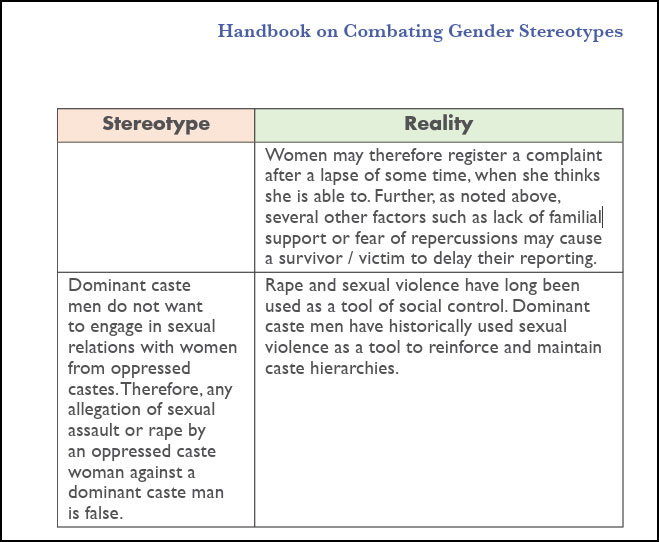
It then argues that historically, sexual violence has been used as a tool of social control and that dominant caste men have used such violence to reinforce caste hierarchies. According to sources quoted in reports, some judges felt that the Supreme Court should avoid making sweeping generalisations that could appear to attribute wrongdoing to entire communities.
‘Too Harvard oriented’ – CJI calls for practical guidance
During the hearing on 10th February, CJI Kant also criticised the technical language of the handbook and described it as overly academic and “Harvard oriented”. The court observed that assigning complex or forensic meanings to aspects of sexual offences could make such documents inaccessible to survivors, their families and ordinary citizens who interact with the legal system.
In its order, the bench emphasised that any future guidelines should be framed in language that is simple and easily understood by laypersons. The court also noted that many victims and complainants come from vulnerable backgrounds and may not have legal training or linguistic proficiency. Hence, guidelines must be accessible and grounded in practical realities rather than complicated academic terminology.
The Supreme Court has also stressed that the guidelines should reflect India’s social realities and linguistic diversity. The committee has been encouraged to identify offensive or insensitive expressions used in different regional contexts so that victims are better able to articulate their experiences before courts.
Furthermore, the court has directed that the guidelines should avoid heavy and complicated expressions drawn from foreign legal frameworks. They should instead be rooted in the ethos and social fabric of India. The committee has been asked to submit its report within three months.
A recalibration before the debate snowballs
While the 10th February order of the apex court does not explicitly criticise the 2023 handbook, the developments surrounding it suggest that the judiciary has recognised the need to revisit the exercise before it evolves into a wider institutional controversy.
The 2023 Handbook on Combating Gender Stereotypes was introduced with the stated objective of helping judges identify and avoid stereotypical assumptions in cases involving sexual violence. However, parts of its content appear to have generated unease among some members of the judiciary.
The concerns reportedly centred on certain sociological formulations in the handbook, including references to caste hierarchies and sexual violence. Reportedly, some judges felt these amounted to sweeping generalisations about entire communities.
For a document that has been issued by the Supreme Court, the language and formulation carry institutional weight. Courts are expected to adjudicate disputes involving individuals from diverse social backgrounds. However, broad sociological assertions within official material issued by the judiciary can sometimes be interpreted as institutional positions instead of academic observations.
In recent times, there have been discussions around institutional documents that have escalated quickly and taken the form of controversies. A recent example that should be considered here is the controversy surrounding the University Grants Commission’s (UGC) Promotion of Equity in Higher Education Institutions Regulations, 2026.
The guidelines, which were stayed by the apex court in the last week of January this year, structurally presume the General Category as perpetrators in matters of caste discrimination.
While the two issues are not related, both illustrate how institutional texts dealing with sensitive social questions can generate intense debate when the language used in these documents gives sweeping generalisations about social hierarchies. Against that backdrop, the Supreme Court’s move appears to reflect a cautious recalibration rather than a direct repudiation of the earlier handbook.
Another point raised during the hearing was the accessibility of the text. CJI Kant remarked that the handbook appeared “too Harvard oriented”. His remarks suggested that the language and conceptual framing were overly academic and difficult for laypersons to understand.
The bench emphasised that guidelines meant to shape judicial behaviour should ultimately serve the needs of litigants and victims who interact with courts, many of whom may not be familiar with technical legal or academic terminology.
The court’s order therefore signals a shift in approach. Instead of allowing the debate around the handbook to deepen, it has chosen to restart the exercise through a consultative mechanism. With this order, the Court has effectively pressed pause on the earlier framework while trying to build a more widely accepted one.
The move can be seen as an institutional course correction. The judiciary understands the need for sensitivity and empathy while dealing with sexual offence cases. However, the court has also indicated that the tools used to promote such sensitivity must have carefully drafted notions. Such documents should be discussed within the judiciary and should not trigger any controversy.


