

It has become a predictable routine for the leftist media outlet The Wire to prioritise narrative-building over objective reporting, especially when it involves heinous crimes committed by members of the Muslim community. For years, the organisation has consistently worked to whitewash such incidents, often flipping the script to portray the perpetrators as victims and the actual victims as the aggressors.
This pattern is not new; from downplaying the 2002 Godhra carnage and the 2020 anti-Hindu Delhi Riots to the brutal murder of Kanhaiyalal in Udaipur, The Wire has a track record of framing reactionary Hindu outrage as a greater threat than the Islamist attacks that caused the outrage in the first place.
This trend has continued with their coverage of the Tarun Kumar murder case in Uttam Nagar, where they have published multiple articles aimed at softening the reality of a brutal lynching.
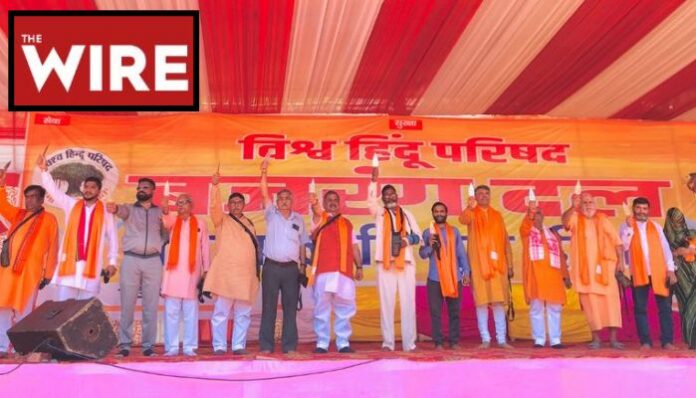
Most recently, on Monday, April 13th, the organisation released a fresh piece of propaganda targeting an event organised by the Vishwa Hindu Parishad (VHP) at Ayyappa Park in Hastsal, Uttam Nagar. The event, held on Sunday, April 12th, was a “Trishul Deeksha” program, yet The Wire chose to report on it with a heavy dose of fearmongering. The article titled, “In Delhi Locality Where Tarun Kumar Was Killed on Holi, VHP Swoops In With 1,700 Trishuls”
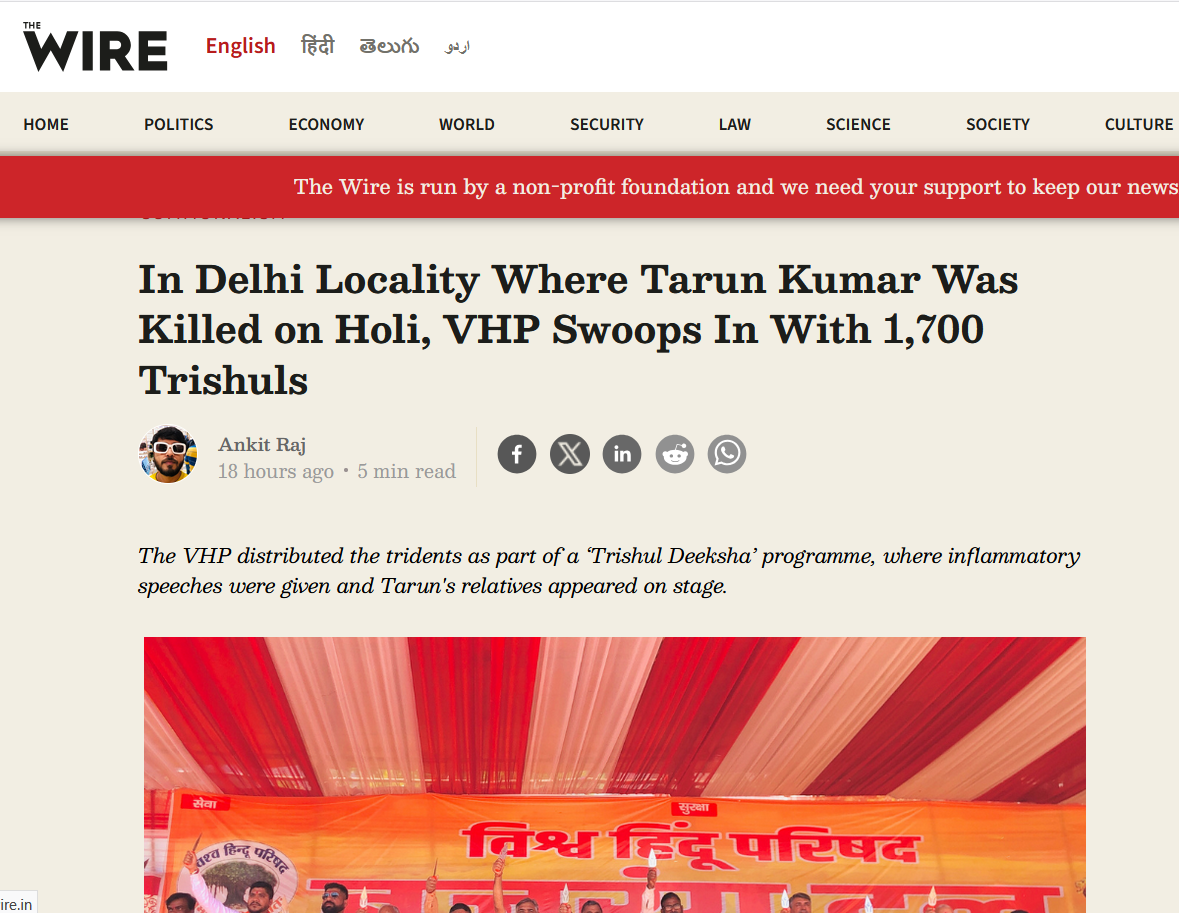
The article attempted to paint a dark picture of the gathering, stating, “The VHP distributed 1,700 trishuls among the cadres of its youth wing, the Bajrang Dal. The organisation has consistently referred to this initiative as ‘Trishul Deeksha [initiation]’. According to them, the programme is intended to administer a pledge focused on sanskar (values), seva (service) and suraksha (security); however, on the ground, its implications appear far more complex.” By adding the phrase about “complex implications,” the outlet clearly tried to cast a shadow of doubt and danger over a traditional organisational activity.
Labelling a brutal murder as a ‘Minor Dispute’
What is truly jarring about The Wire’s reportage is how it handled the murder of Tarun Kumar. While knowing full well that VHP programs are common across the National Capital, the outlet went out of its way to link this specific event to Tarun’s death.
Delhi: A large Trishul Diksha event was organized by the Vishwa Hindu Parishad at Ayyappa Park, Hastsal, Uttam Nagar
— IANS (@ians_india) April 12, 2026
State President Kapil Khanna says, "First of all, this is not a large or special event; it is a regular programme. In the Bajrang Dal, there is a process where… pic.twitter.com/VQLvlrVrrC
The article shamelessly referred to the brutal lynching of Tarun as a “minor dispute.” It portrayed the location of the event as a tactical move to target the local Muslim community, despite the VHP state president, Kapil Khanna, clearly stating, while talking to the reporter of The Wire: “Uttam Nagar was chosen simply because it was this district’s turn; there is no other reason.”
Instead of focusing on the loss of a young life, the article pivoted to “Muslim victimhood.” It read, “What began as a minor dispute soon took on the character of communal tension. A Muslim family stands accused of the murder – a family whose home was first vandalised by unidentified individuals and subsequently subjected to a demolition drive by the municipal corporation, and who have now fled the area.”
This framing is a classic example of shifting the focus from a murder to the subsequent administrative action against the accused. The article expressed more concern for the “fled” family of the accused than for the justice of Tarun, who was killed by a mob simply because some Holi colours accidentally splashed a woman.
The vilification of grieving parents and calls for security
The Wire didn’t stop at whitewashing the crime; it also targeted the inclusion of Tarun’s parents at the VHP event. The report failed to mention that the parents were there seeking justice and a sense of security after their son was murdered by people in their own neighbourhood, even after Tarun’s family had apologised for the accidental splash of colour.
Instead of sympathising with their grief, the outlet criticised speeches that urged the Hindu community to “stand firm” against “jihadi aggression”, the very aggression that resulted in Tarun’s death.
The article labelled these calls for self-defence and resilience as “hate speech.” It even expressed discomfort with the chanting of the “Hanuman Chalisa” at the event, framing it as an act of extremism. By calling the ground reality and downplaying the fear of the local Hindu residents, The Wire showed its complete detachment from the actual suffering of the community.
This is a common tactic seen in their previous coverage, whether it’s dismissing the migration of Hindus from areas like Tri Nagar due to fear or justifying the inflammatory rhetoric of leaders like Akbaruddin Owaisi as a mere “reaction.”
Distorting history to project perpetrator guilt
The Wire earlier published an op-ed titled “In Delhi’s Uttam Nagar, Hate is Free, But Muslim Safety Isn’t,” in which author Apoorvanand took the propaganda even further. He accused the Delhi Police of cooperating with what he called a “violent Hindu mob.” He argued that the administration was only tolerating Hindu protests because “After all, has not a Hindu died? Would the blood of other Hindus not boil?”
He twisted the natural outrage of a community whose son was lynched into a desire for a “massacre.” While “Sar Tan Se Juda” (beheading) mobs often get a pass or a nuanced explanation in such leftist rags, Hindus demanding justice are portrayed as bloodthirsty.
The article even made a desperate attempt to bring up the 1984 anti-Sikh riots to vilify Hindus, even though those riots were a Congress-orchestrated political massacre, not a communal Hindu-vs-Sikh conflict. By bringing up the Hashimpura massacre and the 1984 riots, Apoorvanand tried to suggest a historical pattern of Hindu-police complicity.
Ultimately, The Wire’s coverage of the Uttam Nagar incident serves as a textbook example of how to flip the victim-perpetrator dynamic. By refusing to name the perpetrators, like Umardeen and Muzaffar, who assaulted Tarun Kumar to death, and instead focusing on the “victimhood” of the accused’s family, the outlet has once again shown that its primary motive is to protect a specific narrative at the cost of the truth. For The Wire, a Hindu youth’s life is a “minor dispute,” but a community’s call for security is an existential threat to the nation.


