

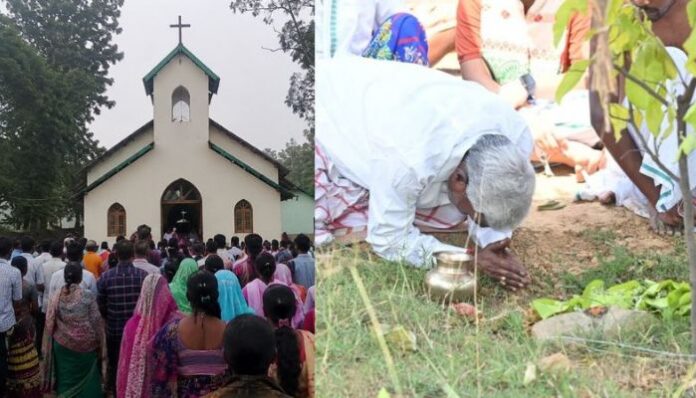
The discussion around religious conversion, tribal identity, and demographic changes in Jharkhand has once again come into focus after concerns were raised about the rapid changes taking place in several tribal-dominated regions of the state. The issue has gained attention, particularly in border districts, where questions are being raised about the growing influence of Christian missionaries, the increasing number of conversions, and the settlement of illegal infiltrators.
Former Jharkhand Chief Minister Champai Soren has spoken openly on the matter, saying that the issue is not merely political but directly linked to the future of tribal culture, traditions, and identity.
According to him, tribal communities have been given constitutional safeguards, including reservation benefits, to protect their social and cultural identity. He questioned how people who voluntarily convert to Christianity or Islam can continue to enjoy benefits meant for tribal communities when they also receive the protections and facilities available to religious minorities under the Constitution. He argued that this issue needs a serious discussion because it affects the future of Jharkhand’s indigenous communities.
Centuries-old bond between tribals and Sanatan traditions
Champai Soren pointed to the long historical relationship between Jharkhand’s tribal communities and followers of Sanatan Dharma. He said that for thousands of years, nature-worshipping tribal communities and Sanatan followers have lived side by side in the same villages, sharing the same environment and social space. According to him, differences in worship practices never became a reason for conflict between the two communities.
झारखंड के आदिवासी इलाकों में चर्च की बढ़ती संख्या पर मेरे बयान से काफी हंगामा हुआ। अपना धर्म बदल चुके कई लोग इस बात से परेशान हैं कि मैने सिर्फ चर्च की बात की, मंदिरों की नहीं। चलिए, आज इस मुद्दे पर विस्तार से बात करते हैं।
— Champai Soren (@ChampaiSoren) May 30, 2026
झारखंड के अधिकतर गांवों में आदिवासी-मूलवासी एक साथ… pic.twitter.com/lrKz5FgEwK
He said tribal customs, traditions, and religious practices survived because they were never forced to abandon their identity. Tribal people continued to worship at places such as Jaherthan, Sarna sites, Deshawli, and Manchi Than, while preserving their own unique rituals and beliefs. He argued that if there had been attempts to erase tribal identity in the past, these traditions would have disappeared long ago.
He further stated that this close relationship can still be seen today. Members of the Sanatani community often visit tribal religious sites with faith and respect, while tribal people participate in festivals celebrated by Sanatan communities. Festivals such as Sarhul and Karma are celebrated together in many villages. Similarly, tribal communities participate in celebrations held by Sanatan families.
Many famous religious sites in Jharkhand are also cited as examples of this shared heritage. Temples such as the Diuri Temple and the Rankini Temple near Ranchi continue to have strong tribal connections. In many cases, the chief priests belong to tribal communities themselves, including Pahans and Mundas, showing how deeply tribal traditions remain connected to these places.
Jharkhand tribal population has fallen to around 26 %
One of the biggest concerns raised by Champai Soren is the gradual decline in the share of the tribal population in Jharkhand. He says the issue is not based on assumptions but on government data.
According to the 2011 Census, Jharkhand has around 86.45 lakh tribal people, accounting for approximately 26.2 % of the state’s total population. Across India, the tribal population stands at about 104.5 million, making up roughly 8.6 % of the country’s population.
Jharkhand is home to 32 recognised tribes. Among the most prominent are the Santhal, Oraon, Munda, Ho, Kol, and Mahli communities. The Santhal community has the largest population, particularly in the Santhal Pargana region.
Champai Soren argues that a comparison of demographic data from the period around Independence and later decades shows a steady decline in the tribal share of Jharkhand’s population. At the same time, he claims that the growth of Christian and Muslim populations in several areas has been much faster. He warns that if the present trend of conversion and infiltration continues, tribal communities may eventually become minorities in regions that have historically been their homeland.
Religious conversion and changes in tribal lifestyle
Tribal communities in Jharkhand have their own distinct way of life. Their customs cover every stage of life, including birth ceremonies, naming rituals, marriage traditions, and funeral practices. Traditional institutions such as the Manjhi Pargana, Naike, Pahan, Manki, Munda, and Padaha Raja play important roles in these social and religious processes.
For generations, tribal families have visited sacred places such as Jahersthan, Sarna Sthal, Deshauli, and Manjhi Than to worship deities like Marang Buru and Singboga. These practices have continued for centuries and form an important part of tribal identity.
जब आदिवासी प्रकृति पूजक होते हैं तो झारखंड में 5,000+ चर्च क्यों बनाये गए हैं? वहां मरांग बुरु या सिंगबोंगा की पूजा होती है क्या? pic.twitter.com/4kzZfxmD6G
— Champai Soren (@ChampaiSoren) May 28, 2026
Champai Soren says Sanatan traditions never interfered with these practices. However, he believes the arrival of Christian missionaries changed the situation significantly. According to him, conversions led many tribal families away from traditional places of worship. As churches became more common in villages, participation in traditional tribal religious practices declined in several areas.
He expressed concern that if conversions continue at the current pace, many traditional customs and cultural practices could disappear altogether. He said that tribal culture is closely tied to its religious practices, and losing one could eventually weaken the other.
Concern over missionary activities
According to historical records, Christian missionaries began their work in the Chhotanagpur region during the nineteenth century. Champai Soren says missionary activities have had a major impact on tribal society over the last 180 years.
He argues that Christianity and traditional tribal culture follow very different systems of belief. According to him, missionary efforts have gradually weakened traditional tribal faith and reduced participation in age-old customs. He says many Sarna sites and Jahersthans in some villages have become inactive because fewer people visit them for worship.
He further claims that changes have not been limited to religion alone. Language, cultural practices, traditional social structures, and tribal identity have also undergone significant changes in areas where conversions have been widespread.
To support his concerns, he points to examples from several countries in Africa and Latin America. Tribes such as the Samburu in Kenya, the Wai-Wai in Brazil, and the Ayoró community have experienced major cultural transformations after adopting Christianity. He believes similar changes are taking place in parts of India and warns that tribal communities could gradually lose their traditional identity if this trend continues.
Reservation benefits and minority status debate
Another issue raised by Champai Soren concerns reservation benefits.
He notes that Christians enjoy minority status under Article 30 of the Constitution and are entitled to run minority educational institutions and access various protections available to minorities. However, he questions whether tribal individuals who have converted to Christianity should continue receiving reservation benefits that were created to safeguard tribal communities and their traditional way of life.
According to him, people who voluntarily convert should rely on the benefits available to minorities rather than claiming tribal reservation benefits as well. He argues that this debate is important because reservations were designed to protect tribal identity and representation, including reserved seats in elections.
Questions over land used for churches and mosques
The discussion has also expanded to the issue of land ownership.
Jharkhand’s tribal areas are protected under laws such as the CNT Act and SPT Act, which restrict the transfer of tribal land to non-tribals. Champai Soren has questioned how thousands of churches and mosques have been constructed in tribal regions despite these restrictions.
He argues that if tribal land cannot legally be transferred, there should be transparency regarding how land was obtained for these structures. According to him, this issue deserves a detailed investigation to determine whether any illegal land transfers took place and whether administrative officials played any role in allowing such transfers.
He has demanded a high-level and impartial inquiry into the matter, saying that the public deserves clear answers about how protected tribal land came to be used for minority religious institutions.
How missionary activities expanded in Jharkhand
Historical records show that Christian missionary work in Jharkhand began in 1845 when four German missionaries associated with Reverend Father Gossner arrived in Ranchi. Their activities focused on education, healthcare, and social welfare, and they worked primarily among tribal communities such as the Munda and Oraon.
Later, Anglican SPG missionaries entered the Chhotanagpur region in 1869, while Jesuit Catholic missionaries arrived in 1868. Missionary activities expanded further after the arrival of Father Constant Lievens in 1885.
One significant event often mentioned in discussions on conversion took place in 1873, when 28 members of six Munda families were baptised in Khuntapani, now part of the West Singhbhum district. A stone plaque commemorating the event still exists, and an annual gathering is held there every November.
Similar concerns in Chhattisgarh
The debate is not limited to Jharkhand. Similar concerns are being raised in neighbouring Chhattisgarh.
Madku Island in Mungeli district hosts a large Christian fair every year, a tradition that has continued since 1909. Likewise, Kharkona village in Jashpur district has a memorial marking the baptism of 56 individuals in 1906. Annual events continue to be held there as well.
Over the years, the Christian population in some districts of Chhattisgarh has grown substantially. Critics of conversion activities argue that these demographic changes demonstrate the long-term impact of missionary work in tribal regions.
Missionary activities during the COVID-19 period
The debate over religious conversion gained further attention after statements made in 2021 by David Reeves, CEO of the missionary organisation Unfolding Word. According to statements attributed to him, large-scale outreach efforts were conducted during the COVID-19 pandemic through mobile phones and WhatsApp groups.
He reportedly said that churches were assigned responsibility for prayer meetings in multiple villages and that many new churches were established during this period. These claims became part of a wider debate over the methods used by missionary organisations to expand their reach in tribal regions.
Another organisation frequently discussed in this context is the Joshua Project, founded in 1995. The organisation maintains data on thousands of caste and tribal groups in India. Critics claim that its activities have contributed to conversion efforts in states such as Jharkhand, Chhattisgarh, Odisha, and Madhya Pradesh.
According to reports cited by those raising concerns, the number of churches in these states has increased significantly over the last decade. They argue that such expansion has taken place even in regions where land ownership and transfers are tightly regulated.
From Christian conversion to Muslim infiltration concerns
Santhal Pargana, one of Jharkhand’s most important tribal regions, is often mentioned in discussions about demographic change. The area has long been associated with missionary activity, but in recent years, concerns have also been raised about the settlement of Bangladeshi and Rohingya Muslims.
Critics claim that the region has witnessed changes in demographics, increasing numbers of mosques and madrasas, and the gradual decline of traditional tribal religious sites. They argue that infiltrators settle in villages, establish social connections, and gradually expand their presence.
Supporters of stronger action say these developments are affecting tribal land ownership, employment opportunities, and social structures. They believe the issue requires close monitoring by government agencies.
Protecting tribal identity remains the core issue
The central government has already taken certain steps aimed at preserving tribal traditions. Tribal communities were kept outside the scope of the Uniform Civil Code in several policy discussions, and similar exemptions were also provided in Assam. These measures were intended to protect tribal customs, traditions, and personal laws.
However, Champai Soren argues that legal protections alone will not be enough if tribal communities continue to lose their cultural and religious identity. According to him, the larger challenge is ensuring that tribal traditions survive on the ground and are not preserved only in official documents.
He says the issue goes beyond party politics and vote-bank calculations. In his view, it is fundamentally about preserving the legacy of iconic tribal leaders such as Bhagwan Birsa Munda, Sidhu-Kanhu, Potho Ho, Veer Tana Bhagat, and Veer Telanga Kharia.
According to him, the future of Jharkhand’s tribal identity depends on whether the younger generation continues to follow the cultural and spiritual traditions passed down by their ancestors. He believes that if those traditions disappear, the unique identity that has defined Jharkhand’s tribal communities for centuries could gradually fade away as well.
By raising these concerns, Champai Soren has once again brought national attention to the questions of religious conversion, demographic change, land rights, and the preservation of tribal culture in Jharkhand, issues that are likely to remain at the centre of public debate in the years ahead.


