

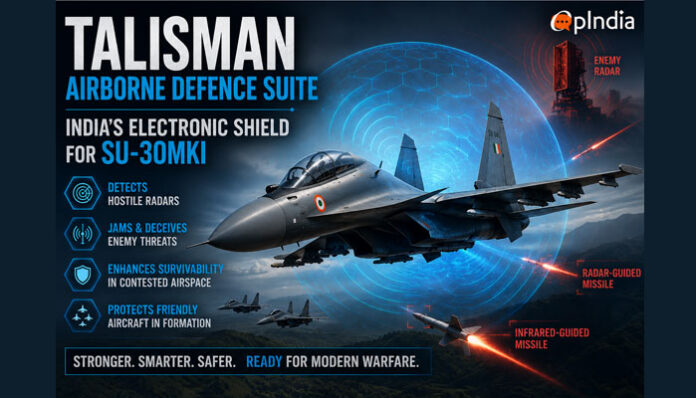
India is moving towards integrating the advanced Talisman Airborne Defence Suite (ADS) onto its Su-30 MKI fighter fleet, a development that could significantly enhance the survivability of the Indian Air Force’s frontline combat aircraft against modern missiles and threats.
The move comes amid the broader Super Sukhoi modernisation programme and follows the reported operational deployment of the system on the Indian Navy’s MiG-29K fleet. With over 260 Su-30MKIs in service, the integration could be one of the IAF’s largest electronic warfare upgrades. If it is successfully integrated, the Talisman Airborne system can provide an extra layer of protection for air defence networks and missile systems, underscoring the growing importance of electronic warfare in modern aerial combat. Let’s examine the Talisman Airborne system and how it will help India.
What is the Talisman Airborne Defence Suite?
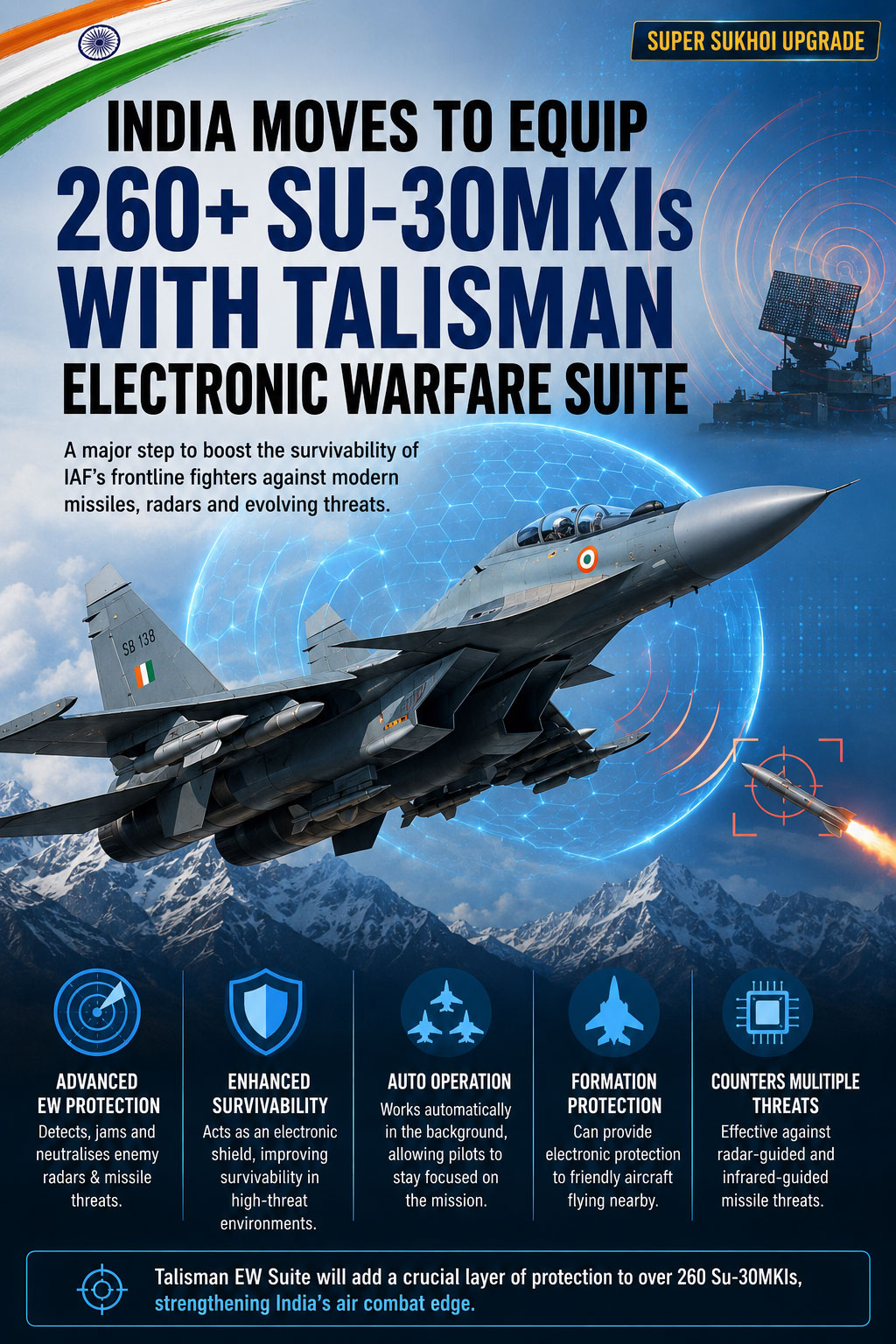
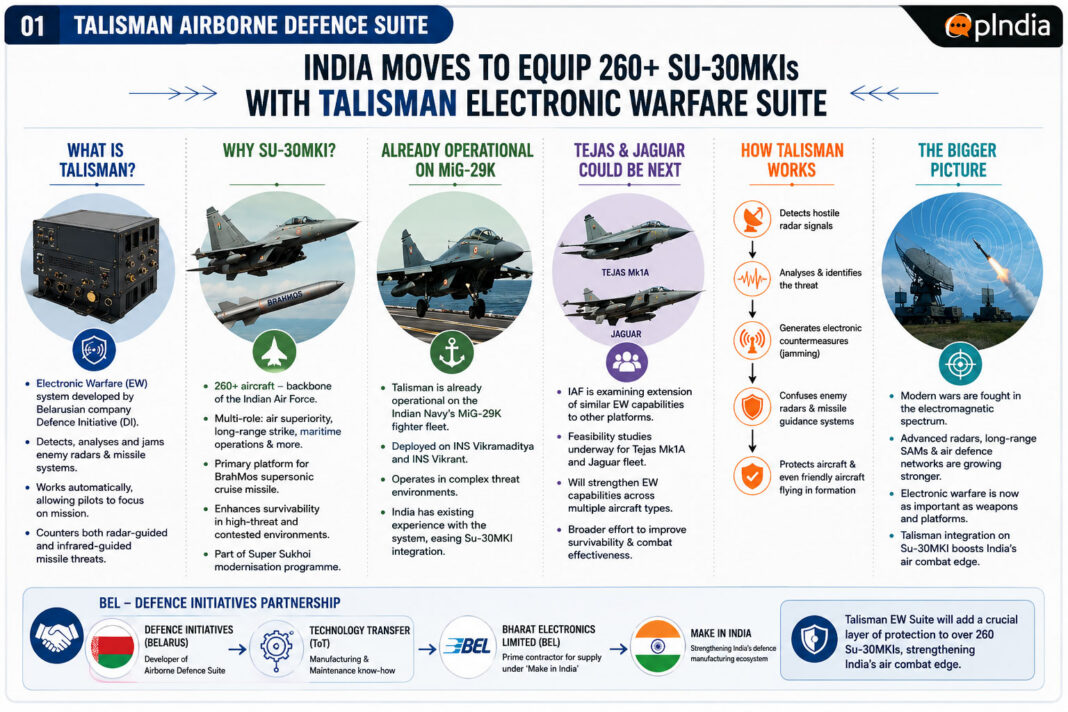
At its core, the Talisman Airborne Defence suite (ADS) is an electronic warfare (EW) system designed to protect fighter aircraft from enemy radars and threat missiles. It is developed by the Belarusian defence company Defence Initiative (DI). The system is intended to enhance aircraft survivability in contested airspace by detecting, analysing, and countering hostile electronic emissions before they can be used to track or engage the aircraft. In simple terms, Talisman acts like an electronic shield for a fighter jet. Instead of physically destroying an incoming threat, it uses electronic signals to confuse enemy radars and missile guidance systems, making it harder for them to track, detect or hit the aircraft. One key feature of the system is that it operates automatically. Unlike traditional defensive systems, which often require pilot intervention. Talisman is designed to function automatically; it allows the pilot to remain focused on flying and combat operations while the system manages electronic countermeasures in the background.
According to reports, Talisman can detect hostile radar signals, generate electronic countermeasures against multiple threats, and even help protect nearby friendly aircraft flying in formation. The system is designed to counter both radar-guided and infrared-guided missile threats.
The reported integration of Talisman onto the Indian Air Force’s Su-30MKI fleet highlights the growing importance of electronic warfare in modern combat, where defeating enemy sensors and missiles is as important as carrying advanced weapons.
Why is india integrating talisman on the Su-30MKI?
The importance of the reported Talisman integration lies in the aircraft chosen to receive it. The Su-30MKI is the backbone of the Indian Air Force, with more than 260 aircraft currently in service. It was developed jointly by Russia’s Sukhoi and India’s Hindustan Aeronautics Limited (HAL); the fighter performs a wide range of missions, including air superiority operations, long-range strike missions, and maritime roles.
It also serves as the primary platform for carrying the BrahMos supersonic cruise missile. It is one of the IAF’s most important combat assets. As a result, improving the survivability of the Su-30MKI has direct implications for India’s overall air combat capability. The integration of the Talisman Airborne Defence Suite could provide the aircraft with an additional layer of protection against increasingly sophisticated radar networks and missile systems. By helping pilots operate more effectively in contested environments, the system could improve the aircraft’s ability to survive and complete missions during high-intensity conflicts.
The move is also significant because it forms part of the Indian Air Force’s broader effort to modernise the Su-30MKI fleet under the Super Sukhoi programme. As modern warfare becomes increasingly dependent on electronic warfare capabilities, systems such as Talisman are expected to play a crucial role in enhancing the effectiveness and survivability of frontline combat aircraft.
Talisman is already operational on the Indian Navy’s MiG-29K fleet
The reported Su-30MKI integration is not the first time India has used the Talisman Airborne Defence Suite. According to defence reports, the system is already operational on the Indian Navy’s MiG-29K fighter fleet. The MiG-29K serves as the Navy’s carrier-based fighter aircraft and operates from INS Vikramaditya and INS Vikrant. These aircraft are expected to operate in complex threat environments where enemy radars and missile systems pose a significant challenge. The deployment of Talisman on the MiG-29K fleet suggests that Indian military planners already have some experience with the system. This could help ease the integration of the suite into the much larger Su-30MKI fleet.
Tejas and jaguar could be next
According to reports, the Indian Air Force is also examining the possibility of extending similar electronic warfare capabilities to other aircraft platforms. For that, the feasibility studies are reportedly underway for the Tejas Mk1A and the Jaguar fleet. While no formal decision has been announced, such a move would allow the IAF to strengthen electronic warfare capabilities across multiple aircraft types rather than limiting them to the Su-30MKI. If implemented, it would represent a broader effort to improve the survivability and combat effectiveness of India’s fighter fleet in increasingly contested airspaces.
The bigger picture
The integration of Talisman reflects a larger trend in modern warfare. Today’s fighter faces threats not only from enemy aircraft but also from advanced radar systems, long-range surface-to-air missiles and sophisticated air defence networks.
As countries continue to invest in more capable air defence systems, electronic warfare has become an increasingly important part of air combat. Modern militaries are focusing not only on acquiring better aircraft and weapons but also on improving their ability to evade detection and defeat enemy sensors. Against this backdrop, the reported induction of Talisman on the Su-30MKI fleet is another step in India’s efforts to increase the survivability of its frontline aircraft and prepare for future combat scenarios.
India looking to increase indigenous participation
While Talisman was originally developed by the Belarusian company Defence Initiative (DI), India has also been working to increase domestic participation in electronic warfare technologies. In 2022, Bharat Electronics Limited (BEL) signed an agreement with Defence Initiative to cooperate on the Airborne Defence Suite. According to reports, India is also developing indigenous airborne electronic warfare systems for future fighter aircraft. Such efforts aim to reduce dependence on imports while strengthening domestic defence manufacturing capabilities. BEL will be the prime contractor and will be supported by DI with ToT (Manufacturing and Maintenance) for the supply of an advanced EW suite for helicopters under the ‘Make in India’ category.
Conclusion
The reported integration of the Talisman Airborne Defence Suite on the Su-30MKI fleet marks another step in India’s efforts to strengthen the survivability of its frontline combat aircraft. With electronic warfare becoming increasingly important in modern conflicts, systems capable of disrupting enemy radars and missile guidance networks are emerging as critical force multipliers. While official details regarding the integration timeline remain limited, the move signals the Indian Air Force’s continued focus on enhancing the capabilities of its largest fighter fleet under the broader Super Sukhoi modernisation programme.


