

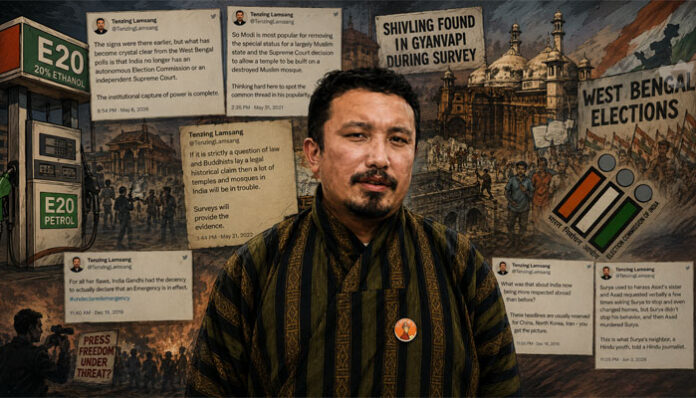
On 5th June, the Ministry of Petroleum and Natural Gas rejected reports claiming that Bhutan had turned down an offer of E20 petrol from India. In a post on X, the Ministry clarified that Indian Oil Marketing Companies had made no such offer and that there was no proposal to export E20 petrol to Bhutan.
Fact Check
— Ministry of Petroleum and Natural Gas #MoPNG (@PetroleumMin) July 5, 2026
❌ Claims that Bhutan declined an offer to import E20 petrol from India are incorrect.
No such offer has been made by the Oil Marketing Companies (OMCs), and there is no proposal for export of E20 petrol to Bhutan.
✅ Please rely only on official information from… pic.twitter.com/sqyAcEIvbw
The misleading claim originated in The Bhutanese, a newspaper founded and edited by Tenzing Lamsang. The report claimed that Indian OMCs, including IOCL, BPCL and HPCL, had offered E20 petrol to Bhutan, but the country had resisted the supply over infrastructure and fuel-quality concerns.
After Indian media outlets picked up the claim, the Petroleum Ministry issued its clarification and advised people to rely on official communications.
Lamsang’s own document did not prove his claim
Following the clarification, Lamsang defended his newspaper and shared a response received from Bhutan’s Department of Trade. He claimed that the document confirmed that Indian OMCs had offered E20 during technical meetings and that Bhutan had declined it.
1/2
— Tenzing Lamsang (@TenzingLamsang) July 5, 2026
Since people have tagged me to this tweet, please find the written response by the Department of Trade of the Bhutanese Govt confirming to me an offer was made by Indian OMCs & the Department requested the OMCs to supply normal petrol.
My verbal interviews confirmed it too. https://t.co/X2AMVOIieC pic.twitter.com/DVBy8WvPcm
However, the document said no such thing. It merely stated that Bhutan was not importing E20 and had requested Indian suppliers to continue providing conventional petrol for as long as it remained available. Bhutan also sought advance notice of any future transition so that dealers could upgrade old underground tanks and other infrastructure.
The response confirmed Bhutan’s concerns and preparations. It did not confirm that India had made an offer that Bhutan subsequently rejected. Lamsang therefore turned a precautionary request from Bhutan into a supposed diplomatic rejection of an Indian proposal.
His attempt to defend the report using a document that did not support its central claim raises questions about whether the story was designed to manufacture the appearance of friction between India and Bhutan.
"Bhutan Won't Buy Ethanol-Blended Petrol"
— OpIndia.com (@OpIndia_com) July 5, 2026
This half truth was spread by anti-Hindu, anti-India Tenzing Lamsang, who has repeatedly incited hatred against the Hindutva IT cell.
He has also been siding with Islamist and claimed that Buddhist monasteries lie buried beneath temples… pic.twitter.com/Sfv9qCFOeW
Who is Tenzing Lamsang
Tenzing Lamsang is the founder and editor of the Bhutanese newspaper The Bhutanese. His social media history shows that criticism of the Narendra Modi government, Indian institutions and India’s regional conduct is not new for him.
On 2nd May 2019, following the Lok Sabha elections, Lamsang wrote, “The biggest loser of India’s 2019 polls is the Election Commission of India’s credibility and its hard won regional and international reputation.” He added that the Election Commission had been reduced to the status of the CBI, which supposedly followed “the whims of the party in power”.
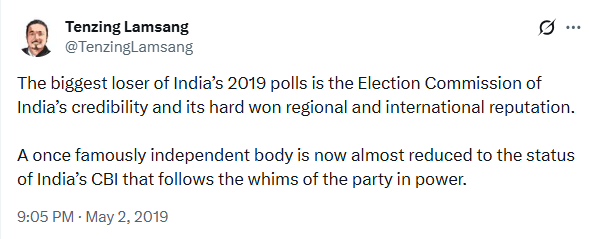
Lamsang wanted to portray India’s constitutional institutions as compromised merely because an election was not unfolding according to the expectations of Modi’s opponents. He repeated this line several years later without offering evidence of institutional capture.
On 6th May 2026, he claimed, “The signs were there earlier, but what has become crystal clear from the West Bengal polls is that India no longer has an autonomous Election Commission or an independent Supreme Court.” He declared that the “institutional capture of power is complete”.
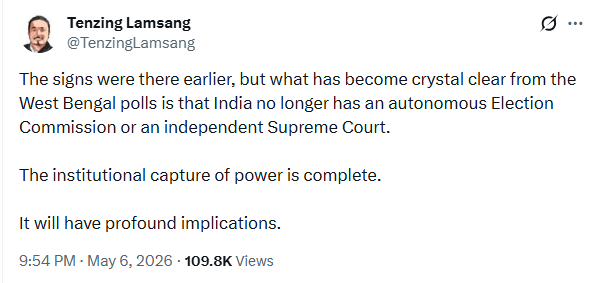
The sweeping accusation did not identify any judgment, order or legal provision establishing that either institution had surrendered its independence. Political disagreement with an election result or a court decision does not prove institutional capture.
Modi’s popularity reduced to an anti-Muslim conspiracy
On 31st May 2021, Lamsang reacted to a survey listing the abrogation of Article 370 and the Supreme Court verdict on the Ram Mandir among the Modi government’s major achievements.
He wrote, “So Modi is most popular for removing the special status for a largely Muslim state and the Supreme Court decision to allow a temple to be built on a destroyed Muslim mosque. Thinking hard here to spot the common thread in his popularity.”
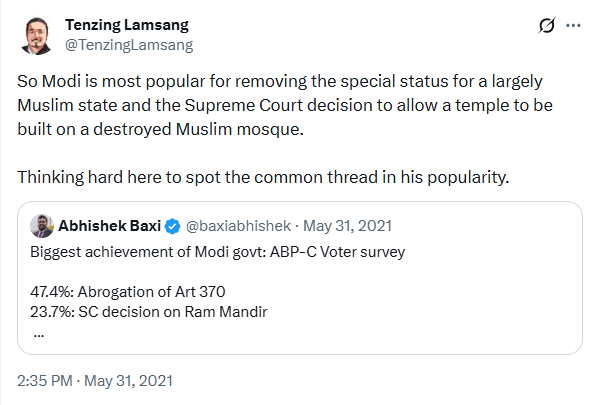
Through this framing, he attempted to reduce two complex constitutional and historical issues to supposed hostility towards Muslims. Article 370 concerned the constitutional status and complete integration of Jammu and Kashmir. The Ram Mandir was built after a Supreme Court judgment based on documentary, archaeological and legal evidence. Presenting both merely as attacks on Muslims erased their wider legal and historical context.
Comparing Modi-era India with the Emergency
On 19th December 2019, Lamsang wrote, “For all her flaws, Indira Gandhi had the decency to actually declare that an Emergency is in effect.”
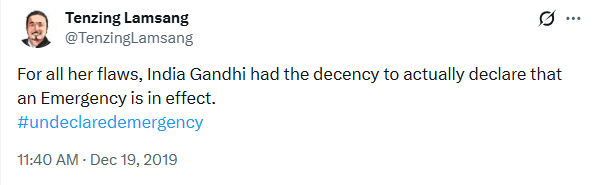
The post suggested that India under Modi was facing conditions comparable to the Emergency, when fundamental rights were suspended, opposition leaders were imprisoned and the press was censored. Criticism of the government, political protests and adverse media coverage were all continuing openly when Lamsang posted the remark, undermining his own attempt to suggest an undeclared Emergency.
A day earlier, on 18th December 2019, he had shared images of foreign newspapers covering protests in India and asked, “What was that about India now being more respected abroad than before?” He added that such headlines were usually reserved for “China, North Korea, Iran” and claimed that India’s “troll army” could only respond by abusing foreign journalists.
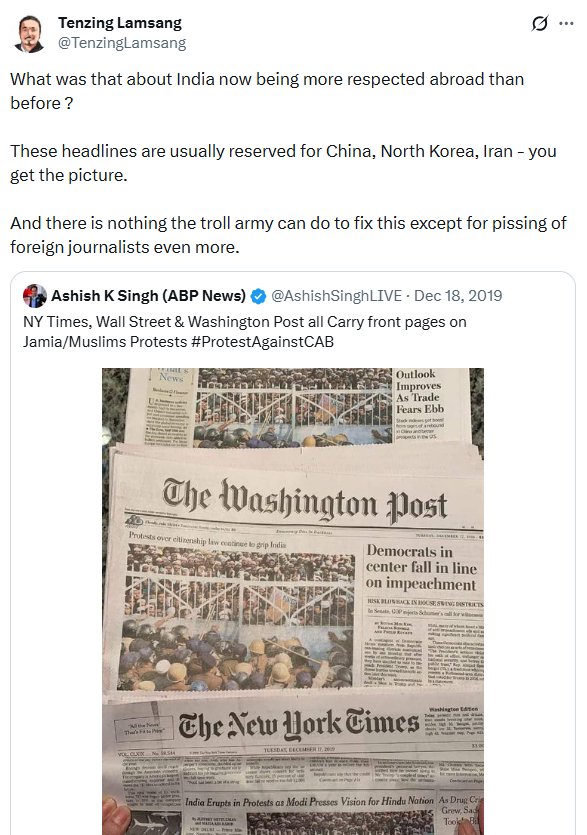
He wanted adverse Western coverage of protests to be treated as proof that India had become an international pariah. Foreign newspaper headlines, however, are neither impartial measures of diplomatic standing nor evidence that India resembles authoritarian regimes.
Targeting India over Ram Mandir and historical disputes
On 21st May 2022, just days after a Shivling was discovered during the court-mandated survey of the disputed Gyanvapi structure, Lamsang wrote that if Buddhists asserted legal and historical claims, “a lot of temples and mosques in India will be in trouble”. He referred to temples allegedly built over Buddhist monasteries and mosques later constructed over those temples, adding, “Surveys will provide the evidence.”
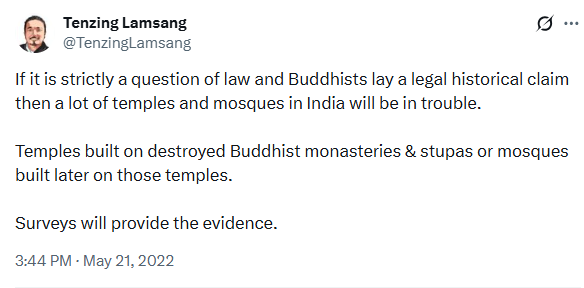
The timing and framing appeared aimed at diluting the Gyanvapi dispute and other cases involving temples destroyed or occupied during Islamic invasions by introducing broad, unverified counterclaims. Legal disputes over religious sites are determined through evidence concerning specific properties. They cannot be dismissed through sweeping equivalences.
Pushing an unverified motive in Surya Chauhan’s murder
On 3rd June 2026, Lamsang claimed that Surya Chauhan had harassed Asad’s sister and that Asad had repeatedly asked him to stop before murdering him. He attributed the claim to Surya’s neighbour, described as “a Hindu youth”, who had reportedly spoken to “a Hindu journalist”. He had quoted propagandist and anti-Hindu Karishma Aziz for this post.
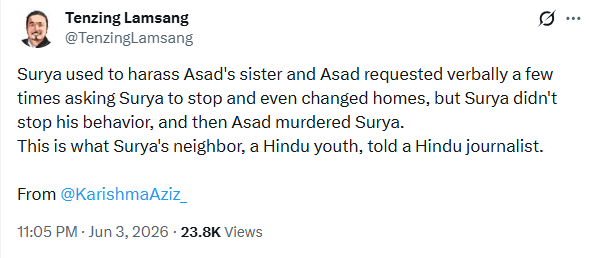
Surya Chauhan was a Class 11 student who was attacked in Khora on Bakrid. According to one of his friends, Asad had called Surya to the spot before surrounding him with his associates. Before the assault, Asad reportedly asked Surya whether he had ever seen a goat being slaughtered in the halal manner and said that he would show him. Surya was then allegedly stabbed multiple times. CCTV footage showing a group of youths attacking him also surfaced. He was taken to hospital but succumbed to his injuries on Friday afternoon.
Instead of restricting himself to the known circumstances of the attack, Lamsang circulated a motive that was not backed by any police finding cited in his post. He relied on a second-hand account while repeatedly highlighting the religious identities of the neighbour and the journalist, apparently to lend credibility to an otherwise unverified claim.
His old thread portrayed India as a regional bully
Lamsang’s hostility towards India’s regional position was particularly visible in a thread posted on 19th June 2019. He claimed that India’s idea of a friendly neighbourhood was “complete domination/monopoly” and said that South Asian countries had invited China to counterbalance India.
Thread
— Tenzing Lamsang (@TenzingLamsang) June 19, 2019
India’s idea of a ‘friendly neighborhood’ is to have complete domination/monopoly in the neighborhood with no foreign powers as it was used to for many decades.
Bhutan is a unique case but much of South Asia has unsurprisingly invited in China to counterbalance. https://t.co/WkGfbFvUzI
He described Indian concerns about neighbouring countries moving towards China as a reaction to Indian “loud mouths”. He compared Indian and Chinese economic and military capabilities, argued that India faced Pakistan and China on two fronts and claimed that even India’s partners did not support it during the Doklam confrontation.
Now knowing your arrogant demeanor you may say ‘Hey Doklam was about safeguarding Bhutan’s disputed border with China.’
— Tenzing Lamsang (@TenzingLamsang) June 19, 2019
Not really.
China has made past various incursions on Bhutanese side but not a peep from India.
This time it affected your chicken neck so all the noise.
He further claimed that India acted at Doklam not to defend Bhutan but because Chinese activity threatened India’s strategically important “chicken neck”. The thread repeatedly cast India as arrogant, weak and dependent on Bhutan while presenting Chinese expansion in South Asia as a defensive response to Indian conduct.
Seen alongside his latest E20 story, the pattern is difficult to miss. A routine Bhutanese request for continued conventional petrol supplies was converted into “Bhutan rejects India”. When the Indian government corrected the claim, Lamsang’s own evidence failed to substantiate it. His past posts show why such framing may have appealed to him, as it fits his longstanding attempt to depict the Modi government as authoritarian and India as an overbearing regional power.


