

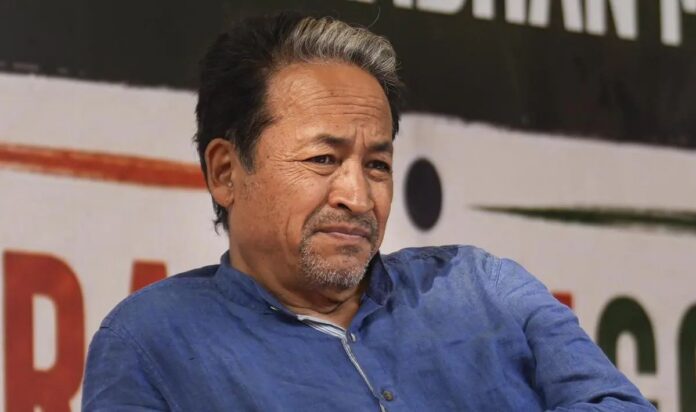
The Civil Society Forum of Ladakh has criticised the ongoing dialogue with the Centre over constitutional safeguards for the Union Territory, stating that the original agenda of protecting land, jobs, culture and the environment has been sidelined. At a meeting held in Leh on October 22, the Forum accused Sonam Wangchuk of dominating the discussions and expressed concern over what it described as delaying tactics and confrontational politics by certain members of the Leh Apex Body (LAB) and the Kargil Democratic Alliance (KDA).
The Forum has called for immediate Panchayat and Ladakh Autonomous Hill Development Council (LAHDC) elections across all eight districts, along with enhanced powers for elected councils. It has also demanded that the Leh Apex Body be reconstituted with democratically elected representatives from all districts, arguing that the existing leadership of the LAB and KDA no longer represents the inclusive voice of Ladakh.
The meeting was attended by former Ladakh MP Thupstan Chhewang, former Chief Executive Councillor (CEC) Rigzen Spalbar, former MLC Tsering Samphel, representatives of Thiksey and Thuksey Rinpoche, monks from various monasteries, members of the Ladakh Buddhist Association and GCM, Nambardars, retired officers and other civil society members.
Forum says original agenda of land, jobs and cultural safeguards has been hijacked
In its resolution, the Civil Society Forum expressed concern over the manner in which the dialogue process with the Government of India was being conducted. It said that despite several rounds of discussions and consensus reached between the Centre and representatives of the LAB and KDA, earlier agreements were being disregarded through shifting goalposts and delaying tactics.
The Forum claimed that the original agenda adopted by the Leh Apex Body, which focused on constitutional safeguards for land, jobs, culture and the environment, had been hijacked. According to the resolution, the dialogue has increasingly been dominated by Sonam Wangchuk and the KDA, compromising what it described as the interests of Leh’s Buddhist community and other districts.
The Forum argued that what should have been a dialogue to secure safeguards for Ladakh had instead turned into a confrontational process with the Centre. It maintained that such an approach was not in the larger interest of the Union Territory.
These are the Forum’s allegations as recorded in its resolution and reflect its position on the ongoing negotiations.
Thupstan Chhewang questions rejection of MHA draft proposal
Former MP Thupstan Chhewang raised concerns over the handling of the dialogue with the Ministry of Home Affairs (MHA). He said that leaders of the LAB and KDA had rejected the Centre’s draft proposal without adequately examining the available options and had misrepresented the outcomes of earlier meetings, creating confusion among the public.
Chhewang also attributed the non-holding of the scheduled meeting with the MHA in New Delhi on October 22 to repeated delays, misinformation and disregard for earlier consensus.
He expressed concern over the possible consequences of the continued deadlock, particularly for Leh and its Buddhist community.
The Forum’s resolution further observed that securing a Union Territory-level democratic political institution with comprehensive constitutional safeguards would require detailed drafting, constitutional consideration and parliamentary processes. It argued that such a settlement could take considerable time, especially amid continuing disagreements.
The Forum maintained that people in Ladakh should not be left in a democratic vacuum while negotiations continue without a clear resolution.
Civil society body says LAB and KDA no longer represent all districts
One of the central demands raised by the Forum was the need to broaden political representation in Ladakh.
The resolution stated that the existing LAB and KDA leadership no longer represented the inclusive voice of all districts. It called for the Leh Apex Body to be reconstituted with democratically elected representatives from every district under its jurisdiction, including representatives of monasteries, women, tribal communities, youth and border nomads.
The Forum argued that representatives chosen by the people, rather than nominated individuals, would have greater democratic legitimacy to negotiate with the Centre on behalf of Ladakh.
It also stressed that the region’s districts have distinct ethnic, cultural and economic identities. The resolution referred to the Brokpa community of Dha-Hanu, the Changpa of Changthang, the Buddhists of Zanskar and the Shina community of Drass, arguing that a centralised arrangement dominated by one district or a limited group of representatives could fail to adequately address these differences.
According to the Forum, elected institutions at the district level would provide a more direct means of protecting local interests.
Forum demands Panchayat and LAHDC elections across all eight districts
The Civil Society Forum has urged the Government of India and the Union Territory administration to prioritise Panchayat elections and LAHDC elections in all eight districts of Ladakh.
The resolution specifically named Leh, Kargil, Nubra, Sham, Changthang, Zanskar, Drass and Sankoo.
It argued that strengthening district-level democratic institutions would provide a practical and immediate route to safeguarding land, culture, natural resources, recruitment, tourism and mining-related decisions.
The Forum maintained that elected Hill Councils could be empowered to protect local interests, including through safeguards governing land and employment. It also argued that strengthening the existing LAHDC framework would require an amendment to the LAHDC Act rather than a full constitutional amendment, making it a more immediate option.
The resolution further pointed to the absence of Panchayats over the preceding six years, arguing that this had stalled village-level development, MGNREGA-related work and the flow of funds to local institutions.
The Forum said elections would restore public confidence in democratic representation and create legitimate interlocutors for future negotiations with the Centre.
Forum appeals to PM Modi and Amit Shah to intervene
In its appeal to the Government of India, the Civil Society Forum urged PM Modi and Union Home Minister Amit Shah to take note of what it described as the ground reality that the existing LAB and KDA leadership no longer represented all districts inclusively.
It called on the Centre not to allow the dialogue process to be held hostage to delaying tactics and confrontational politics. The Forum also demanded the immediate announcement of Panchayat and LAHDC elections, with enhanced powers for the councils to function as interim but effective safeguards until a broader constitutional settlement is reached.
The resolution also urged the Centre to honour the agreement that the Forum said had been reached by consensus on the Ladakh issue.
The latest intervention highlights differences within Ladakh’s civil society over the leadership, direction and pace of negotiations with the Centre. While the demand for constitutional safeguards over land, employment and culture remains central to the wider debate, the Forum’s resolution places additional emphasis on democratic decentralisation and representation across the region’s districts.
Whether the demands lead to a change in the composition of the negotiating bodies or accelerate the election process remains to be seen. The Forum has for now made its position clear: the pursuit of constitutional safeguards, it argues, should not come at the cost of democratic representation at the district and village levels.


