There is something profoundly ironic about invoking the legacy of ‘social reformers’ to deny citizens the very freedoms guaranteed by the Constitution of India.
The controversy surrounding BJP Rajya Sabha MP Medha Kulkarni’s participation in the traditional Vat Purnima rituals at Pune’s historic Mahatma Phule Wada has once again exposed an increasingly familiar tendency in sections of India’s self-proclaimed progressive establishment. Their commitment to liberty appears unwavering, until a Hindu seeks to exercise it.
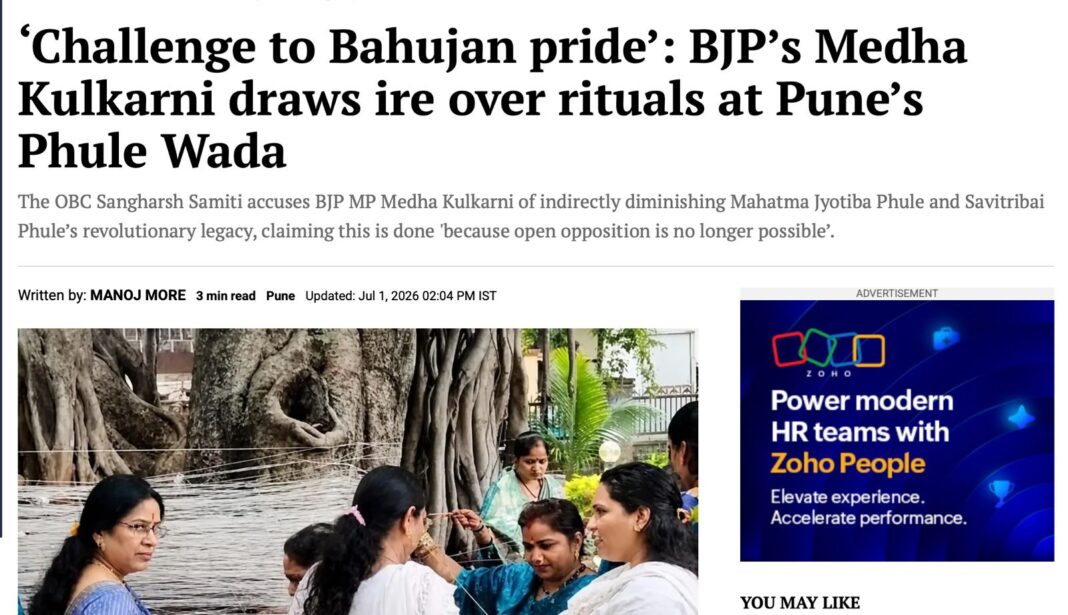
An article published in The Indian Express presents Kulkarni’s participation in the ritual not merely as an act of personal faith but as an ideological provocation against the legacy of Mahatma Jyotirao Phule and Savitribai Phule. The column amplifies allegations that performing Vat Purnima rituals at the site amounts to “Sanatanising” a space associated with social reform and even characterises it as an affront to “Bahujan pride.”
Such arguments may be rhetorically appealing to those eager to manufacture ideological binaries, but they collapse the moment one examines them through the lens of the Constitution rather than political activism.
The Indian Republic is not governed by the personal philosophical preferences of any historical figure, however revered. It is governed by a Constitution drafted under the chairmanship of Dr B. R. Ambedkar, himself one of the greatest champions of the rights and dignity of the Bahujan community.
That Constitution does not classify religious freedom according to whether an activist approves of a particular ritual. It does not empower governments or pressure groups to determine whether a citizen’s faith is sufficiently rational. It certainly does not permit constitutional rights to be suspended because a historical reformer may have disagreed with a particular religious custom.
Article 25 guarantees every individual the freedom of conscience and the right freely to profess, practise and propagate religion, subject only to public order, morality and health. The Constitution makes no distinction between an ordinary citizen and a Member of Parliament in this regard. Medha Kulkarni did not cease to be a Hindu the day she entered Parliament. She remains entitled to practise her faith just as a Muslim is entitled to offer namaz, a Christian to attend church, a Sikh to visit a gurdwara or a Buddhist to observe his religious traditions.
Those criticising Kulkarni appear to suggest that merely because she is an elected representative, she should abandon religious observances that some activists consider incompatible with their interpretation of Mahatma Phule’s legacy. That proposition finds no support either in constitutional jurisprudence or in common sense.
Indeed, if the same standard were applied consistently, public representatives from every religious community would constantly be required to justify their participation in religious ceremonies. Fortunately, India’s constitutional framework rejects such selective policing of personal faith.
Equally revealing is the convenient omission of an important fact from much of the outrage surrounding the episode.
The controversy itself arose after the Maharashtra Archaeology Department issued an order seeking to prevent the traditional Vat Purnima rituals at Mahatma Phule Wada, citing the ‘reformist legacy’ of Jyotirao and Savitribai Phule. The order was justified not based on structural damage to the protected monument, nor on concerns relating to public order, but on an ideological interpretation of history.
That decision did not survive scrutiny.
Following objections from Hindu organisations, local devotees and women who had observed the ritual at the site for decades, the department reversed course. Its subsequent communication explicitly directed that the traditions and customary practices that existed before the site became a protected monument should continue, while asking the police only to ensure maintenance of law and order.
This reversal was significant because it acknowledged what should have been obvious from the beginning: the question was never about archaeology. It was about whether the State could selectively extinguish a long-standing religious practice merely because some individuals believed it conflicted with their preferred ideological reading of a historical figure.
The answer, thankfully, was no.
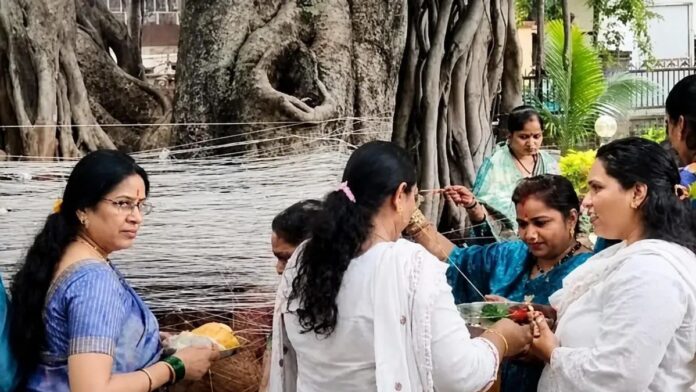
The ritual itself has reportedly been performed for decades near the banyan tree located outside the Wada building. The objectors themselves have not established that the practice damaged the monument or interfered with its preservation. Nor have they demonstrated that it violated any law.
Instead, their principal objection is philosophical. They argue that Mahatma Phule opposed ritualism.
That is undoubtedly part of his legacy. Jyotirao Phule criticised many practices that he thought were inconsistent with his beliefs. Savitribai Phule dedicated her life to women’s education and other issues.
But respecting a historical figure’s personal beliefs does not require converting every place associated with him into an ideological sanctuary where constitutional rights are suspended.
Historical figures are not constitutional authorities.
India does not function according to the personal convictions of MK Gandhi, Swami Vivekananda, Jyotirao Phule, B. R. Ambedkar or any other towering personality. Their ideas continue to influence public discourse, but none of them supersedes the Constitution.
The distinction is crucial.
If one accepts the proposition that religious practices can be prohibited wherever they appear inconsistent with the beliefs of a historical personality associated with a particular site, the implications become absurd. Public institutions across the country would become battlegrounds for competing ideological claims. Constitutional rights would become contingent upon historical interpretation rather than legal principle.
That is not how constitutional democracies function.
There is another contradiction embedded within the criticism directed at Medha Kulkarni.
The Phule couple, as per their followers, dedicated their lives to empowering women. They purportedly fought for women’s education at a time when society denied women even the most basic opportunities. They wanted women to think independently, make their own choices and exercise agency over their lives.
Medha Kulkarni is precisely the kind of woman that vision sought to make possible.
She is educated. She is politically active. She is an elected Member of Parliament. She exercises independent judgment. She participates in public life on equal footing with men.
When such a woman voluntarily chooses to observe Vat Purnima as an expression of personal faith, critics seek to portray her not as an empowered individual making an autonomous choice but as a symbol of ideological regression.
That approach is curiously paternalistic.
It effectively informs adult Hindu women that they are free to make choices, provided those choices conform to the ideological preferences of self-appointed progressive gatekeepers.
Women’s empowerment cannot become conditional upon abandoning traditions that others disapprove of. Agency means respecting a woman’s right to choose, even when that choice is religious.
One may personally disagree with Vat Purnima. One may not observe it. One may critique it academically or philosophically.
What one cannot do is argue that another woman should be prevented from participating in it merely because one’s own ideological worldview finds it objectionable.
That transforms disagreement into coercion.
The repeated invocation of “Bahujan pride” throughout the criticism deserves equal scrutiny. Dr Ambedkar’s constitutional vision did not create separate civil liberties for different caste groups. It created equal citizenship.
Reducing every disagreement involving Jyotirao Phule into a conflict between “Bahujan pride” and Hindu religious practices does little to honour either Ambedkar or Phule. Instead, it risks manufacturing caste antagonisms where none need exist. It is an attempt to sow faultlines within the Hindu society, pitting one community against the other.
Millions of Hindus from Scheduled Castes, Scheduled Tribes, OBC communities and other social groups continue to observe traditional festivals and rituals. To suggest that Hindu religious observance is inherently incompatible with Bahujan identity is simplistic, historically erroneous, and socially divisive.
The Constitution envisions citizens first, not permanently competing caste constituencies.
Perhaps the most troubling aspect of the controversy is the asymmetry with which religious freedom is increasingly discussed in India’s public discourse.
When members of minority communities seek accommodation for their religious practices, constitutional protections are rightly invoked. Religious freedom is celebrated as a cornerstone of liberal democracy. In fact, self-appointed gatekeepers of India’s secularism have repeatedly argued that public spaces should be opened for religious observations like offering namaz.
Yet when Hindu citizens seek to continue a decades-old tradition that neither harms public order nor damages a protected monument, the language abruptly changes. Suddenly, religious liberty becomes “superstition.” Constitutional rights become ideological provocations. Personal faith becomes a threat to social reform.
Rights cannot operate on such selective principles.
Either every citizen enjoys equal protection under Article 25, or constitutional guarantees become dependent upon the identity of the person exercising them.
The Constitution does not permit such discrimination.
One may admire Jyotirao Phule without agreeing with every philosophical position he held. One may celebrate Savitribai Phule for the work she did, but that doesn’t mean they should demonise those who observe their religious traditions without bothering anyone.
These are not mutually exclusive positions.
Indeed, India’s civilisational strength has long rested on its remarkable ability to accommodate diversity, not merely diversity between religions, but diversity within them.
The attempt to transform Mahatma Phule Wada into an exclusionary ideological space in which peaceful Hindu rituals are deemed unacceptable does not strengthen Phule’s legacy. It narrows it.
In fact, increasingly, a troubling pattern has emerged in India’s public discourse. Whenever there is an attempt to delegitimise a Hindu religious practice, it is seldom challenged on constitutional grounds. Instead, self-appointed custodians of social justice invoke the names of historical figures and selectively interpret their legacies to undermine contemporary Hindu traditions and beliefs.
The lives and works of historical personalities are reduced to ideological weapons, deployed not to inspire reform but to police the religious choices of ordinary Hindus. Curiously, this exercise is restricted only to Vedic faiths such as Hinduism, Jainism, and Buddhism. The Abrahamic faiths aren’t accounted for by these self-described ‘social reform merchants’ who routinely invoke past legacy to undermine religious traditions.
Even more troubling is the repeated attempt to frame such controversies through the prism of caste conflict. Expressions such as “Bahujan pride” are casually invoked to suggest that Hindu religious traditions are somehow incompatible with the aspirations of the Bahujan community. This is an artificial binary that finds little resonance in lived reality.
The true tribute to Phules lies not in weaponising their names against fellow citizens but in preserving the constitutional order that protects everyone’s liberty.
Medha Kulkarni’s participation in Vat Purnima did not diminish Mahatma Phule’s legacy.
If anything threatens that legacy, it is the growing tendency to invoke revered historical personalities as instruments to curtail freedoms that the Constitution explicitly guarantees.
India’s constitutional democracy is robust precisely because it protects the rights of those whose beliefs others may not share. That protection extends equally to Hindus, Muslims, Christians, Sikhs, Buddhists, Jains and every other citizen. It also extends to a Hindu woman who chooses to tie a sacred thread around a banyan tree outside Mahatma Phule Wada.
No newspaper article, no activist campaign and no ideological reinterpretation of history can legitimately take that right away.