

HomeOpinionsDrain of wealth from India: Dadabhai Naoroji and the question that sparked the freedom...

Drain of wealth from India: Dadabhai Naoroji and the question that sparked the freedom movement

The resulting subsistence income, somewhere between ₹16 and ₹35 a year, depending on the region and the decade he was looking at, became one of the first poverty lines ever built from real data anywhere in the world, seven decades before independent India would try anything similar.

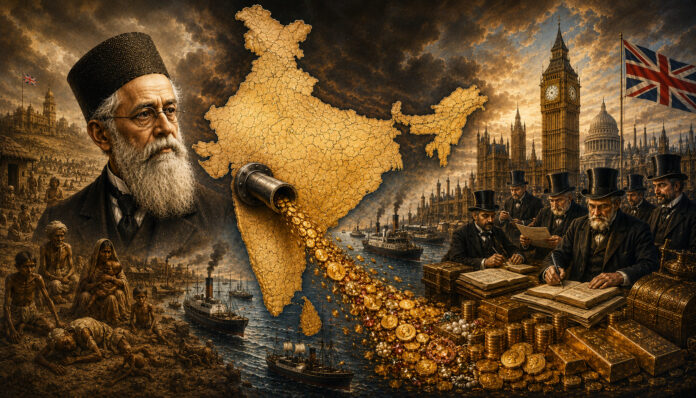
In 1901, Dadabhai Naoroji sat down to make what would become one of the most powerful economic arguments ever written from a colonised country. His case hinged on one uncomfortable number. India was consistently selling more to the world than it was buying from it. Year after year, the country ran an export surplus so steady you could almost set a clock by it.

By the economic logic taught in London’s own universities, that should have meant India was getting richer. But the reality on the ground told a different story. Naoroji spent six decades trying to explain the gap between what the ledgers said and what he saw in the famine camps of the Deccan. The answer he arrived at would eventually become the intellectual backbone of a freedom movement.

A hundred and twenty-five years later, India is once again putting out numbers that look like those of a rising nation. Indians now make more digital payments in a single month, 23.66 billion transactions in July 2026, worth about ₹29.88 lakh crore (roughly $315 billion), than the entire annual GDP of many countries. The digital sector is growing at nearly twice the pace of the rest of the economy.

Yet, alongside the celebration, a quieter, more uncomfortable question is starting to surface. Is India actually becoming as rich as these numbers suggest, or is it once again creating wealth that mostly ends up somewhere else? This is the first of two articles that try to answer that question honestly, without exaggeration, and without flinching. This one belongs to Naoroji. The next will belong to the present.

A mathematician’s doubt

Dadabhai Naoroji was born in Bombay in 1825, into a Parsi family that had more books than money. He went on to teach mathematics and natural philosophy at Elphinstone College, becoming the first Indian to hold a full professorship there. In 1855, he moved to London to set up a trading firm, driven by a simple but ambitious idea. To show that an Indian businessman could make it in Britain without compromising his principles. As a business, the venture was unremarkable. As a lesson in how the empire really worked, it was invaluable. Living in London and reading Parliamentary reports that most Indians never got to see, Naoroji started spotting a pattern that worried him far more than any profit and loss statement.

On 2 May 1867, he presented a paper titled ‘England’s Duties to India’ to the East India Association, an advocacy group he had founded that brought together both Britons and Indians. Using British Parliamentary Returns and customs data, not slogans or speculation, he made a pointed argument by conveying that large chunk of what India earned from trade was simply leaving the country, with nothing coming back in return.

Take the ‘Home Charges‘ alone, the catch-all label for expenses Britain incurred in England but charged to India. Between 1829 and the mid-1860s, nearly £100 million had moved from Indian pockets to English ones under this heading. And that figure didn’t even include interest on debt, which he counted separately.

The Home Charges covered five distinct items, and it’s worth naming all of them, because each has a modern equivalent:

  • The pensions and furlough pay of British officials
  • Interest on public debt that India had no say in taking on
  • Guaranteed annual returns paid to British shareholders in Indian railways, whether or not those railways made a profit
  • The cost of wars fought to expand or defend the empire, from Afghanistan to Burma
  • And, perhaps strangest to modern ears, a rule that required the Government of India to buy many of its ‘stores,’ railway equipment, weapons, even stationery, from British manufacturers, even if India could have produced them more cheaply itself.

How the trick worked

To understand why India’s export surplus didn’t translate into wealth at home, you need to look at a piece of financial machinery that most popular accounts skip, partly because it’s easy to get wrong, and partly because it only makes sense once you see how the pieces fit together, the Council Bill system.

Imagine a Manchester cotton merchant in the 1870s who wants to buy a shipment of raw cotton from Bombay. He doesn’t ship gold to India to pay for it. Instead, he walks into the office of the Secretary of State for India in London and buys a paper instrument called a Council Bill, paying in pounds sterling. That sterling never leaves London. It goes straight into the very account used to pay the Home Charges. The merchant then sends his Council Bill to India, where an exchange bank cashes it for him in rupees, rupees drawn from the Government of India’s own tax revenues. Only then is the Indian farmer who actually grew the cotton paid, and he is paid in rupees that ultimately came from Indian taxpayers.

Add it all up, and something odd starts to show. The cotton left India. The sterling it earned in Manchester never arrived. And the rupees used to pay the farmer had, in effect, been borrowed from India’s own treasury and handed back to him as if they were new money. On paper, India ran a healthy trade surplus almost every year under the Raj, exactly the kind of sign economists point to when they say a country is getting richer. In reality, this loop meant that the surplus brought India no gold, no capital, and no investment at all. The accounts balanced perfectly. The country did not.

This is what sets Naoroji’s argument apart from a simple complaint about greedy officials. He wasn’t just saying the British took India’s money. He was showing, with the actual records, how an entire monetary system could make a growing, trading economy poorer with every transaction, legally, quietly, and year after year.

The arithmetic of hunger

Naoroji didn’t just work from the top down, tracing pounds and rupees through government ledgers. He also worked from the bottom up, and this is the part of his research that’s hardest to sit with.

To show just how poor Indians really were, he needed a baseline for bare survival, and he found one in an unlikely place, colonial jails. Prisons kept meticulous, itemised records of what they fed inmates, down to the last anna spent on rice, dal, salt and ghee. Naoroji took that prison diet, priced it out, and then adjusted it for the fact that a real population includes children, who eat less than adult convicts. He assumed roughly a third of any population was made up of children, half of whom ate almost nothing extra and half who ate about half an adult’s ration, and worked out a weighted average. That gave him a poverty line set at three-quarters of the jail cost of living.

The resulting subsistence income, somewhere between ₹16 and ₹35 a year, depending on the region and the decade he was looking at, became one of the first poverty lines ever built from real data anywhere in the world, seven decades before independent India would try anything similar.

Then he compared that line to what ordinary Indians actually earned, and found that a large number of them fell below it. A colonial administration that took pride in feeding its convicts an adequate diet was, by its own published numbers, failing to feed a big share of its free population at all. Naoroji clearly intended that comparison to sting. It still does.

From lecture hall to movement

Naoroji kept refining this argument for the rest of his life, in speeches, in testimony before a Royal Commission on Indian expenditure, in a widely read 1876 lecture series later published as Poverty of India, and most fully in his 1901 book, Poverty and Un-British Rule in India. His numbers shifted as his methods improved; he was, after all, a mathematician by training who didn’t trust round figures, and later writers have sometimes quoted totals from different decades of his career as if they were one fixed number. They weren’t. What never changed was the core claim: year after year, India was paying for the privilege of being ruled by the British, and that payment left almost nothing productive behind.

He didn’t carry this argument alone for long. Mahadev Govind Ranade brought it into the emerging field of Indian political economy. Romesh Chunder Dutt, a retired civil servant, spent the turn of the century turning it into a two-volume Economic History of India. Gopal Krishna Gokhale took it onto the floor of the Imperial Legislative Council. By 1896, barely a decade after it was founded, the Indian National Congress had formally adopted the drain argument in its resolutions.

By the time Naoroji became, in 1892, the first Indian ever elected to the British House of Commons, representing Central Finsbury for the Liberal Party, and by the time he stood before the Indian National Congress in Calcutta in 1906 and spoke the word Swaraj, self-rule, from that platform for the first time, the drain theory was no longer just one man’s calculation. It had become the economic foundation of an entire political movement.

He died in Bombay in 1917, three decades before independence, having spent sixty years asking the same question in different rooms: why does a country that produces so much remain so poor?

A hundred years of argument

Here’s where honesty demands a pause, because Naoroji’s numbers have been argued over for more than a century, and the argument itself tells us something important.

In 1963, the American economic historian Morris D. Morris directly challenged the drain thesis in the Journal of Economic History. He argued that India’s stagnation had less to do with colonial extraction and more to do with the country’s own pre-industrial condition, in his view, it simply lacked the basic institutional and infrastructural foundations needed for an industrial revolution, even before the British tightened their grip. 

This became the founding text of what is now called the Cambridge School. Two decades later, historian Dharma Kumar carried a version of that scepticism into her edited Cambridge Economic History of India, which became the standard revisionist reference for a generation of scholars trained outside India.

The argument found a dramatic turn in 2017 and 2018, when economist Utsa Patnaik, working from two centuries of British tax and trade records, calculated that the drain totalled nearly $45 trillion between 1765 and 1938. She arrived at this by taking India’s annual export surplus across four historical periods and compounding it forward at roughly 5% interest to the present day. The figure travelled around the world, was cited by public intellectuals from Shashi Tharoor to reparations campaigners at the United Nations, and reignited a global conversation about the economics of empire that had gone quiet for decades.

It also drew serious criticism, not from defenders of colonial rule, but from economists and historians who pointed out that compounding almost any historical sum at interest over two centuries will, by design, produce a dramatically inflated figure. The method also assumes that India would certainly have invested every uncollected rupee productively, something that cannot be proved either way. 

One critic, applied the same compounding trick to a medieval royal debt and came up with an equally staggering modern figure, not to defend the Empire but to show that the arithmetic of compound interest can make almost any historical grievance look apocalyptic if you let it run for two hundred years.

As of this writing, the most recent word on the matter comes not from a polemicist on either side, but from a peer-reviewed 2020 paper by economic historian Pablo A. Nogues-Marco. He returned to the East India Company’s own budgets for the period 1757 to 1858 and concluded, cautiously, that the surviving figures do lend empirical support to the drain thesis for that earlier period specifically. At the same time, he noted that Morris’s institutional critique also has real force, and that the debate over the size, mechanism, and applicability of the drain to the later Raj period remains open. In other words, more than a hundred and fifty years after Naoroji first stood up in a London lecture hall, serious economic historians are still testing his arithmetic against fresh data, and still finding that some version of it holds.

The lesson here isn’t that the drain was imaginary, nor that it was exactly $45 trillion. The lesson is that grand, single totals are seductive but fragile, while itemised, carefully sourced numbers tend to last. Naoroji’s own figures, drawn from Parliamentary accounts rather than compounded interest, have proved far harder to shake than any one dramatic modern recalculation.

That is the discipline this series tries to borrow from him. Part Two of this article will not offer one sweeping figure for what India’s digital economy is loosing each year. It will do what Naoroji did. Follow the money through its actual mechanism, one item at a time, and let the reader add it up.

What Naoroji would ask today?

If you peel away the details- the cotton, the rupee, the Council Bill, the British official’s pension- what’s left of Naoroji’s method is one simple, transferable question. Who creates the value, who controls the system that moves it, and where does the extra wealth finally land? 

He asked this about land, revenue and trade, because those were the assets that mattered in 1867. A century and a half later, an Indian farmer’s cotton has a digital economy equivalent. An Indian citizen’s data, an Indian engineer’s code, an Indian founder’s intellectual property. And the Council Bill has a modern descendant too, a financial loop, entirely legal, in which value generated in India circles back through a foreign parent company before much of it ever becomes Indian capital. A hundred and fifty years ago, you could see the ship carrying away India’s cotton from the shore. Today, the cable carrying away its data cannot be seen at all. Part Two of the article goes looking for it anyway.

Join OpIndia's official WhatsApp channel

  Support Us  

For likes of 'The Wire' who consider 'nationalism' a bad word, there is never paucity of funds. They have a well-oiled international ecosystem that keeps their business running. We need your support to fight them. Please contribute whatever you can afford

Divyansh Tiwari
Divyansh Tiwari
Transforming legal conundrums and global affairs into riveting prose where scholarly research meets real world significance.

Related Articles

Trending now

Newslaundry’s ‘PM Modi sex symbol’ hitjob against journalist: Jyoti Yadav reveals how she was targeted for 2019 Modi story

Journalist Jyoti Yadav has accused Newslaundry of isolating and targeting her over a story on PM Modi that several other journalists had also pursued, once again highlighting the portal's appalling editorial policies and shameless double-standards.

Tarun Tejpal’s survivor breaks her silence: Thirteen years of being reduced to ‘victim’, ‘liar’ and ‘political plant’

Thirteen years after accusing Tarun Tejpal of rape, his former colleague has taken to Substack to recount her ordeal, the trauma of the trial, and how she was repeatedly reduced to labels like “victim”, “liar” and “political plant”.
- Advertisement -

