

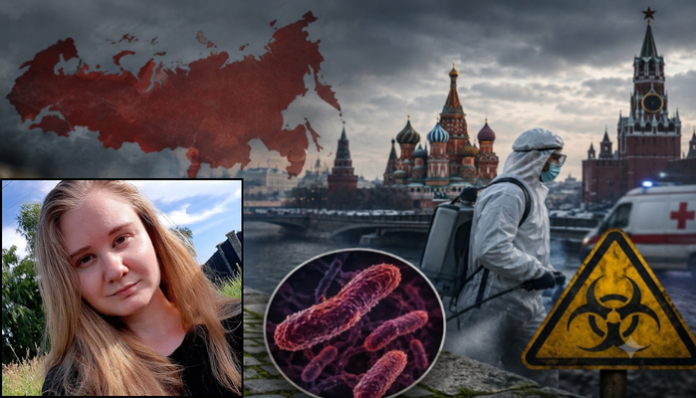
The sudden death of a 28-year-old laboratory worker in the Siberian region of Russia prompted the authorities to quarantine about 200 people as a precautionary measure. The laboratory worker, identified as Darya Shipilova, worked at the Irkutsk Anti-Plague Institute in Siberia’s Irkutsk region. Her death triggered suspicions of an outbreak of pneumonic plague, which led the authorities to place around 200 people who came into contact with her under observation.
As per reports, Rospotrebnadzor, Russia’s national public health and consumer protection agency, did not confirm the cause of her death but said that she died of “pneumonia of unknown aetiology”. The agency added that no microorganisms linked to her professional work were found on her body and added that “the sanitary and epidemiological situation in the Irkutsk region, the cities of Irkutsk and Shelekhov is stable”. Rospotrebnadzor has not yet confirmed a plague in the region.
Shipilova fell ill following a field expedition with colleagues in Buryatia, close to Russia’s eastern border with Mongolia. She was admitted to a hospital on September 29, 2026, and was diagnosed with severe pneumonia. She was subsequently placed on a ventilator as her condition deteriorated. However, she passed away two days later. Following her death, three hospitals in the region were placed under secure measures.
Mayor of Shelekhov municipal district bordering Mongolia, Maksim Modin, said that the inpatient facility where the researcher was treated has also been closed for quarantine. Some reports said that she caught the disease after she broke a test tube containing live bacteria at the laboratory. However, the claims were dismissed by Mikhail Favorov, a senior Russian epidemiologist, who said that people working at an anti-plague institute wear protective suits. Therefore, she could not have caught the infection even if the broken test tube reports are to be believed.
After the incident, authorities cancelled all scheduled public events in Irkutsk. Besides, a criminal investigation has been launched into any potential health and safety violations. Officials have said that no evidence of a wider outbreak has emerged so far; however, additional precautionary measures have been introduced around Shelekhov, near the research centre. Personnel working in an industrial aluminium facility in the area have been asked to wear masks.
The State Department issued a statement saying that it, along with theCentress for Disease Control and other agencies, was closely monitoring the situation. However, it did not issue any confirmation regarding the situation. “We encourage Russian authorities to share accurate information quickly and openly,” the department said in the statement.
Irkutsk region Governor Igor Kobzev appealed to people not to panic amid plague suspicions. Kobzev held an emergency meeting with regional authorities and Rospotrebnadzor chief Anna Popova to coordinate emergency containment measures.
“All identified contact persons have been placed under medical observation. As of today, the contacts show no signs of illness, and their laboratory test results are negative,” Kobzev reportedly said.
What is a pneumonic plague?
Pneumonic plague is one of three types of plague caused by the bacterium Yersinia pestis. It is the rarest, most severe, and most contagious form of plague caused by the bacterium. It spreads through breathing in airborne droplets from another person.
There are two types of the Pneumonic infection: Primary and Secondary. Primary Pneumonic Plague occurs when a person directly inhales infectious airborne droplets from an infected human or animal. Secondary Pneumonic Plague develops when an untreated case of bubonic or septicemic plague spreads through the bloodstream into the lungs.
According to the US Centres for Disease Control and Prevention, symptoms of Pneumonic plague can include fever, headache, weakness, shortness of breath, chest pain, and coughing. In severe cases, patients can cough up bloody or watery mucus. Its symptoms can take 1 to 3 days to appear. It can be cured with antibiotics if detected early.


