

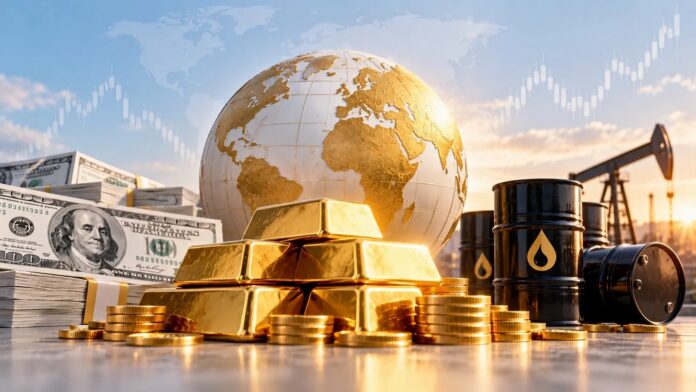
Gold has occupied a unique place in human history for thousands of years as a symbol of wealth, security and financial stability. In modern times, its price is determined by forces extending far beyond jewellery demand or mining production. The movements of the US dollar, crude oil prices, interest rates, wars and central-bank policies form an interconnected and dynamic financial system that influences the value of gold worldwide.
Interestingly, the price of gold depends very little on who is mining how much and in which country the mines are located. Instead, the price is dictated by macro liquidity, capital flows, and sovereign risk management at a global scale.
Understanding these relationships is particularly important for India, where gold is simultaneously a household asset, a major import, and an increasingly significant component of national foreign-exchange reserves.
The scale of gold’s appreciation over three decades is striking. In 1996, gold averaged approximately $388 per ounce, compared with around $4,150 in early October 2026, an increase of nearly eleven times. In Indian currency, prices rose from approximately ₹5,071 per 10 grams in 1996–97 to ₹1,49,570 in October 2026, nearly thirty times higher. The larger rupee-denominated increase reflects not only gold’s international appreciation but also the depreciation of the Indian currency against the dollar. These figures explain why gold has remained an important store of household wealth despite substantial short-term fluctuations.
However, gold’s long-term rise has never been uninterrupted. Prices declined during the technology boom of the late 1990s, surged after the 9/11 attacks and the Iraq War, and rose dramatically following the 2008 financial crisis. Gold crossed $2,000 during the Covid-19 pandemic and recorded a remarkable 64% increase in 2025. Each episode demonstrates how investors respond to changing global economic conditions, financial uncertainty and monetary policy.
The relationship between gold and the US dollar is crucial. Because international gold prices are quoted in dollars, a weaker dollar generally makes gold cheaper for buyers using other currencies, supporting demand. Conversely, a stronger dollar does the opposite. Interest rates add another dimension. Unlike government bonds, gold generates no interest or dividends. When interest rates rise, investors can earn higher returns from interest-bearing assets, making gold relatively less attractive.
But these relationships are not absolute. The events of 2026 provide a curious exception to usually observed patterns. Gold reached approximately $5,600 per ounce in January, driven by geopolitical uncertainty and expectations of monetary easing. When the United States and Israel launched military operations against Iran in February, conventional expectations suggested that gold would climb further. Instead, it declined sharply, losing approximately 27% from its peak by the subsequent correction.
The reason behind the fall was the third pillar of the dynamic trio: crude oil. The conflict disrupted supplies through the Strait of Hormuz, a maritime passage handling approximately one-fifth of global oil and liquefied natural gas flows. Brent crude surged from around $72 to $120 per barrel, raising fears of worldwide inflation. Higher oil prices increase transportation, fertiliser, manufacturing and electricity costs. Central banks respond to persistent inflation by maintaining or increasing interest rates, strengthening interest-bearing assets and potentially the dollar. Consequently, the same war that creates demand for gold as a safe haven can also generate economic conditions that push its price down.
The growing importance of gold also extends beyond just private investors. Following the freezing of approximately $300 billion in Russian foreign-exchange reserves in 2022, central banks accelerated efforts to diversify their holdings. They went on a gold-buying spree. Global central-bank purchases exceeded 1,000 tonnes annually between 2022 and 2024. By the end of 2025, gold represented approximately 27% of central-bank reserves, compared with 20% a year earlier. India’s Reserve Bank increased its holdings from about 795 tonnes in September 2025 to 881 tonnes by March 2026. These figures reflect a growing preference for assets that are not dependent on another government’s financial system.
Holding the world’s largest private stock of above-ground gold, Indian households treat the metal as core multi-generational wealth rather than mere jewellery. When escalating import bills and depreciating exchange rates compel governments to raise tariffs to curb outward trade deficits, domestic consumer behaviour adapts. Instead of liquidating family holdings, Indian households transition toward lighter ornaments, exchange old metal, or utilise formal gold-backed loans to access liquidity while keeping the physical asset intact.
India’s gold imports reached approximately $71.98 billion in FY2025–26, adding pressure to the trade balance alongside expensive crude oil. Higher import duties and a weakening rupee further complicate domestic pricing. Meanwhile, gold exchange-traded funds are attracting growing investment, although physical gold remains dominant.
The larger lesson is that gold is neither a guaranteed protection against every crisis nor an asset that rises continuously. Its price reflects competing forces: geopolitical fear, oil-driven inflation, interest rates, currency movements and central-bank diversification. Gold’s enduring importance lies less in predictable returns than in its ability to preserve wealth and diversify financial risk over long periods. Understanding gold investment requires following not just bullion markets, but the wider global economy.
Read the complete article here in Chapter One Magazine.


