

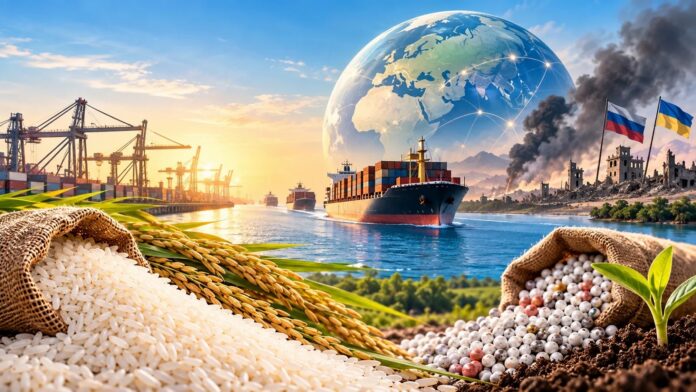
The world may be approaching another food supply crisis, but this time the threat is not simply a shortage of grain. It is the convergence of several disruptions: the Russia–Ukraine war affecting Black Sea grain shipments, conflict around the Strait of Hormuz threatening crucial fertiliser supplies, rising international food prices, and an intensifying El Niño threatening agricultural production across the world.
External Affairs Minister S. Jaishankar’s September 2026 warning of a possible food crisis has emphasised the same issues. International data reveal mounting pressure, although not an immediate global shortage. The FAO Food Price Index reached 133.3 points in August 2026, approximately 7.6% above January’s level. Meanwhile, global cereal production is projected to decline from a record 3,043 million tonnes in 2025 to approximately 2,980 million tonnes in 2026. The inventories remain substantial. The danger, therefore, lies increasingly in the ability to transport and distribute food rather than its absolute availability. The disruption of global shipping routes is the major cause behind this.
The Black Sea illustrates this distinction. Both Russia and Ukraine are major wheat exporters, but renewed attacks on ports and shipping infrastructure have disrupted exports. Grain may remain available in warehouses while import-dependent countries, particularly in Africa and West Asia, struggle to obtain it affordably.
The Strait of Hormuz presents another vulnerability. Disruptions to Gulf fertiliser exports have increased costs, threatening future harvests in countries where farmers cannot afford adequate fertiliser. Today’s fertiliser shortage could consequently become tomorrow’s food shortage.
India faces an additional challenge from the monsoon. Deficient and uneven rainfall has damaged paddy prospects, while the strengthening El Niño raises concerns about agricultural conditions extending into 2027. An industry estimate suggests that India’s rice production could decline by around 10 million tonnes, from the previous record of 154 million tonnes to approximately 144 million tonnes. This is not yet an official government forecast, but it highlights the potential severity of the situation.
Yet India possesses an important safeguard: substantial government grain stocks. As of September, rice inventories, including unmilled paddy, stood at 59.6 million tonnes, compared with a buffer benchmark of 10.3 million tonnes. Wheat stocks were approximately 48 million tonnes, comfortably above the required buffer. These reserves, together with free foodgrain distribution covering more than 81 crore beneficiaries, provide considerable protection against an immediate food-security emergency.
However, grain reserves cannot fully protect consumers from rising prices. India imports roughly two-thirds of its edible oil requirements, making households vulnerable to global price increases. Pulses are another pressure point, with imports meeting approximately 18–20% of consumption. The government has accumulated pulse reserves and reduced certain edible-oil import duties, but international prices, shipping costs and currency movements remain important risks.
The approaching Rabi season will test India’s preparedness further. Wheat production is projected to reach a record 121 million tonnes, but below-average reservoir levels, uncertain irrigation supplies and the timely availability of DAP fertiliser could affect sowing. Government assurances of adequate fertiliser stocks must ultimately translate into supplies reaching farmers when required.
The article also highlights a difficult policy balance. India accounts for more than 40% of global rice exports, meaning restrictions imposed to protect domestic consumers can create shortages elsewhere. Conversely, maintaining exports during a poor harvest could intensify domestic price pressures. Decisions concerning grain exports, procurement, subsidies and even surplus rice supplied to ethanol producers therefore carry consequences beyond India’s borders.
All things considered, India is comparatively secure in rice and wheat, but vulnerable in fertiliser, edible oils, pulses and water availability. A single disappointing harvest is unlikely to create an immediate national shortage. The greater danger would arise if weak harvests continued into 2027, fertiliser disruptions reduced future yields, and inflation eroded household purchasing power. India’s challenge is therefore not merely to preserve sufficient grain in warehouses, but to ensure that agricultural inputs remain available, farmers can sustain production, and food stays affordable through a prolonged period of geopolitical and climatic uncertainty.
Read the full article here on Chapter One Magazine.


