

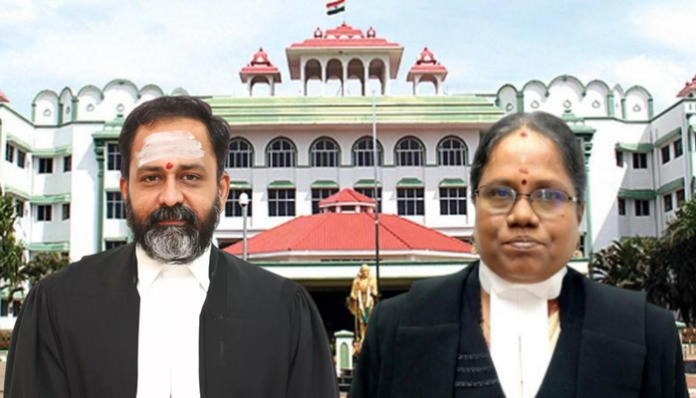
The Madurai Bench of the Madras High Court on Tuesday (October 6, 2026) distinguished Hinduism from Abrahamic religions, saying that the former is inclusive while the latter are inherently exclusive. A Division Bench of Justice G. R. Swaminathan and M.D. Sumathi observed in the verdict upholding the central government’s decision to deny the FCRA registration to Kanzeon Public Charitable Trust, which runs a Zen meditation centre in Kodaikanal, Tamil Nadu.
“Unlike Hinduism, which is inclusive, the Abrahamic religions are inherently exclusive. The devout Jews, Christians and Muslims believe that theirs is the one true and complete revelation because that is what their Holy books say of themselves,” the High Court said.
Respondent wrongly projected itself as non-religious: HC
The High Court dismissed the Trust’s appeal against challenging the government’s decision, stating that the Trust did not correctly identify itself as a religious organisation despite being one. The court said that organisations engaged in religious conversion cannot be granted registration under the Foreign Contribution (Regulation) Act (FCRA). “Though the applicant is engaged in religious programs, they wrongly projected themselves as non-religious. That is why the respondent authority had to say “Illa Samy” (No Sir) to Rev.Fr.Ama Samy (which name literally translates as “Yes”),” the court said.
The Trust had argued that it was not a religious organisation and that the Zen meditation centre run by it belonged to “India’s Dhyana tradition” and its activities cannot be described as having a religious nature. The government, however, maintained that the trust was engaged in religious programmes.
The Bench held that Zen Buddhism is a variant of the Mahayana Buddhist school and that the trust should have disclosed itself as a religious organisation while seeking FCRA registration. It added that the FCRA only bars an unregistered religious organisation from receiving foreign aid. A religious organisation can seek registration under Sections 11 and 12 of the FCRA, but it has to declare itself as one. “The appellant need not have been so coy…one has to make a clean breast of everything. One cannot keep any card up one’s sleeve. This is no game of hide and seek,” the Bench said.
A leopard will not change its spots: HC.
The High Court noted that the author of the trust is an ordained priest called Rev.Fr.Ama Samy SJ. The Court highlighted that Christianity is an evangelical religion, which aims to convert people. “At this stage, the learned standing counsel pointed out that the author of the trust and the moving spirit behind the appellant organisation is an ordained Christian priest. He is addressed as “Rev.Fr.Ama Samy SJ”. One cannot forget the fact that Christianity is a messianic religion. Their theological and religious mission is to bring everyone within the fold of Jesus Christ. There is a saying: a leopard will not change its spots,” the court observed.
Examining the material placed before it, the High Court noticed motifs installed at the meditation centre and referred to the argument that appropriation of local motifs marks the initial step of the ultimate takeover. “It is not for us to doubt if the said claim is genuine or spurious. A strong argument is being made that the native and local motifs are appropriated by the messianic religions so that the ground is prepared for eventual takeover. It is not within our province to engage in such debates. They have to be waged elsewhere,” the court said.
Radical Christian groups notorious for conversion activities: HC
The High Court, however, cautioned against the adverse effects of one religion trying to gain prominence over others. “We are a pluralist nation. Unlike the USA, we are not a melting pot but a salad bowl, a beautiful metaphor credited to Justice Ruma Pal. This status quo would be upset if one religious group gains ascendancy,” the court warned.
Citing precedents, the High Court pointed out that foreign funds can be used to influence national polity. The court referred to the recent instances of friction between Christian and Muslims groups in Kerala and added that if “foreign funds are freely allowed inside to facilitate conversion activities, the sovereignty of the nation would be imperilled”.
The court also highlighted that radical Christian organisations are notorious for engaging in conversion activities. “We specifically highlight the issue of conversion because radical Christian Institutions are notorious for indulging in such activities,” the court said. It stated that there is no vested or absolute right to receive foreign funds.


