

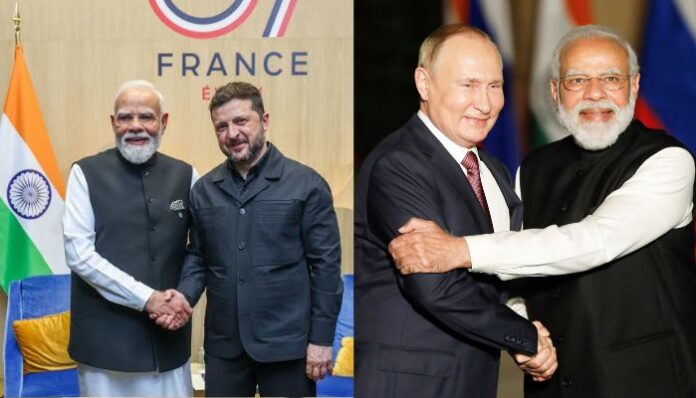
India has proposed a three-part truce between Russia and Ukraine that seeks to stop attacks on energy facilities and other critical infrastructure, keep grain and energy flowing through Black Sea ports and end strikes on commercial shipping in the strategic waterway. The proposal was conveyed to the Ukrainian leadership during External Affairs Minister S Jaishankar’s visit to Kyiv on 3rd September, in what marked another major step in New Delhi’s efforts to help bring an end to the Russia-Ukraine war.
The Indian proposal goes beyond separate ceasefire initiatives put forward by Egypt, Türkiye and the United States. While Egypt and Türkiye have focused mainly on keeping grain shipments moving through the Black Sea, and the US has proposed an “energy ceasefire”, India’s plan seeks to cover both infrastructure and commercial shipping while keeping vital commodity supplies flowing. The proposal has also gained attention because recent attacks on commercial vessels have affected Indian seafarers and disrupted important energy supplies. India’s three-part truce proposal seeks to:
- Stop attacks on energy facilities and critical infrastructure
- Keep grain and energy flowing through the Black Sea
- End attacks on commercial shipping in the Black Sea
The response from Moscow and Kyiv to the proposal was initially unclear, although follow-up discussions have taken place. However, Ukraine has now indicated that it is willing to consider the Indian initiative. Ukrainian Foreign Minister Andrii Sybiha has described India’s proposal as the “most comprehensive” among the peace initiatives currently being considered.
Ukraine calls India’s proposal ‘most comprehensive’
Ukraine is currently evaluating four international proposals aimed at ending or reducing the conflict, from India, Türkiye, Egypt and the United States. According to Sybiha, India’s proposal stands out from the others because of its wider scope.
“We have four proposals. The most comprehensive is India’s proposal. For the first time, India has signalled its willingness to play a role,” Sybiha said.
Ukraine says India’s ceasefire plan is the broadest of four proposals it has got- India, the US, Turkey and Egypt; Kyiv will only accept an energy truce if it is tied to a Black Sea halt on strikes, Foreign Minister Andrii Sybiha remarked. From European Pravda: https://t.co/LdiCKRIYVc
— Sidhant Sibal (@sidhant) October 3, 2026
His comments are significant because they show that New Delhi’s diplomatic engagement is no longer limited to repeatedly calling for dialogue. India is now putting forward a concrete framework covering some of the most sensitive aspects of the conflict, including attacks on energy and port infrastructure and commercial shipping in the Black Sea. Sybiha also said Ukraine was ready to consider different ceasefire formats, including arrangements along the front lines, provided that any truce also addressed attacks on energy and port infrastructure and the situation in the Black Sea.
India has strong reasons for taking such an active role. The Black Sea conflict has disrupted grain supplies and, more importantly for New Delhi, energy shipments from Russia. According to the report, Black Sea ports account for almost 30% of Russian energy flows to India. Five Indian seafarers have also been killed in attacks involving Russian and Ukrainian forces on merchant vessels in recent weeks.
Putin praises Modi’s ideas for ending the war
Russian President Vladimir Putin also responded warmly to these diplomatic efforts, praising Prime Minister Narendra Modi and noting that he has very good ideas for finding a peaceful resolution.
Addressing an audience, Putin said, “Prime Minister Narendra Modi is one of those world leaders who, despite our very good and even friendly relations, constantly raises the question and asks about putting an end to the conflict in Ukraine”.
“PM Modi is one of those world leaders who, despite our very good and even friendly relations, constantly raises the question and asks the question about putting an end to the conflict in Ukraine..And we are thankful to the PM for his ideas,” says Russia’s President Putin https://t.co/bIcfbg3Agd
— Shashank Mattoo (@MattooShashank) October 1, 2026
Putin added that Modi has a genuine interest in ending the conflict and has been pushing for solutions acceptable to both sides. “He has an avid interest and very good ideas aimed at finding mutually acceptable solutions,” Putin said. “In that sense, naturally, the Prime Minister takes a neutral position but with an interest in the end of the conflict.”
The Russian President also thanked Modi for his efforts. “We are thankful for his desire to put an end to this conflict through peaceful means and as soon as possible,” Putin added.
Modi has similarly maintained that India is ready to support meaningful peace efforts because of its good relations with both Russia and Ukraine. “I believe, by virtue of our good relations with both sides, including key stakeholders, we can strengthen efforts dedicated to the restoration of an early and lasting peace in Ukraine,” Modi said.
PM Modi tells Putin: ‘Endless war’ must become ‘end of war’
This active mediation builds upon consistent messaging from Prime Minister Narendra Modi, who once again called for an end to the Russia-Ukraine conflict during his meeting with Russian President Vladimir Putin on the sidelines of the Shanghai Cooperation Organisation summit in Bishkek, Kyrgyzstan.
Modi made it clear that India does not support an indefinite continuation of the conflict and wants the international community to work towards a peaceful resolution. “We have to move from a situation of ‘endless war’ to ‘end of war’,” Modi said, stressing that it was the desire of humanity that the conflict should end at the earliest.
He also reiterated India’s longstanding position that disputes should be resolved through dialogue and diplomacy. “As you know, India supports all peaceful methods to resolve the impasse,” Modi said. “India advocates for resolving all problems peacefully, which is necessary for all of humanity.”
This is not the first time Modi has used such a direct message while speaking to Putin. During his earlier meeting with the Russian President at the SCO summit in Uzbekistan in 2022, Modi had famously said, “This is not the era of war.”
India has continued to maintain the same position throughout the conflict. New Delhi has kept communication channels open with both Moscow and Kyiv instead of completely aligning itself with either side. Modi has also spoken separately with Putin and Ukrainian President Volodymyr Zelensky, urging dialogue and diplomacy.
Trump repeatedly threatened India over Russian oil
India’s growing role in the peace process comes at a time when the country has faced repeated threats from the administration of US President Donald Trump over accusations that it is fuelling Russia’s war through its continued purchase of Russian oil.
Recently, a new US sanctions law has given the President powers to impose tariffs of up to 100% on goods from countries that are among the biggest importers of Russian crude or natural gas, putting countries such as India and China under potential pressure.
The Trump administration imposed a 50% tariff on Indian goods and threatened to increase it up to 100% last year, with the additional levy directly linked to India’s purchase of Russian crude. Trump administration has repeatedly argued that India’s energy purchases indirectly support Russia’s war effort.
Trump’s trade adviser Peter Navarro went as far as calling the Ukraine conflict “Modi’s war”. In an interview with Bloomberg Television, Navarro argued that India’s purchases of Russian oil were contributing to the continuation of the war. When reminded that Russia had started the war, Navarro doubled down, saying, “No, I mean Modi’s war!”
White House trade adviser Peter Navarro sought to raise pressure on India to halt purchases of Russian energy after the US imposed crippling new tariffs on New Delhi, casting the conflict in Ukraine as “Modi’s war" https://t.co/5Oec0y2Arb
— Bloomberg (@business) August 27, 2025
He also criticised India for prioritising its energy needs and said, “The road to peace runs at least partly through New Delhi.” Navarro accused India of being “arrogant” for arguing that it had the sovereign right to purchase oil from whichever country it wanted. “India, you’re the biggest democracy in the world. Okay? Act like one. Side with the democracies,” he said.
It’s clear that the US has absolutely no interest in ending the Ukraine war. Their take on India is getting more ludicrous every day … https://t.co/Usd1TKu8kl
— Prof. Shamika Ravi (@ShamikaRavi) August 28, 2025
New Delhi, however, has maintained that its energy purchases are driven by national interest and the need to secure affordable energy for its population. India has also consistently argued that the conflict must ultimately be resolved through dialogue and diplomacy.
Now India is proposing peace while America has emerged as the biggest profiteer
The contrast is striking. While Washington repeatedly accused India of helping finance Russia’s war because of its Russian oil purchases, it is now India that has put forward a three-part proposal aimed at reducing hostilities and keeping vital trade routes open.
Navarro had argued that India was indirectly responsible for the continuation of the war and even said that American taxpayers were funding “Modi’s war”. Yet India’s latest diplomatic initiative is directly aimed at stopping attacks, protecting commercial shipping and maintaining the flow of energy and food.
While Trump’s administration sermonises India and slaps punitive tariffs, the United States has emerged as the biggest profiteer of the Russia-Ukraine war. American oil and gas companies registered record profits, including a massive 125% jump in 2022, by selling liquefied natural gas (LNG) to Europe at prices up to four times domestic rates.
US energy companies such as ExxonMobil and Chevron recorded record profits in the aftermath of the war, while American defence companies also benefited from the massive military assistance provided to Ukraine.
Furthermore, the US defence industry has raked in billions through massive arms sales and military supply packages to Ukraine, with Washington openly boasting that the funding rejuvenates domestic manufacturing. Even as the West demands strict adherence to sanctions, US-Russia bilateral trade has expanded in certain sectors, and American companies have explored returning to Russian energy projects.
The contrast has therefore become increasingly difficult to ignore in Washington’s hypocrisy.
When Europe and America buy petroleum products refined from Russian crude or continue importing Russian non-ferrous metals and fertilisers, it is business as usual, but when India secures its own energy needs, it is suddenly blamed for the conflict. Moreover, while Washington criticises India’s cautious diplomatic balances, including its ties with China, it conveniently overlooks its own complex geopolitical alignments, such as providing financial and military accommodations to Pakistan despite Islamabad’s historical role in harbouring terrorism.
The situation has now taken an ironic turn. The country that was repeatedly accused of “funding” Russia’s war through energy purchases is putting forward a concrete plan to reduce the fighting, while the country that imposed tariffs and threatened further economic pressure on India has yet to secure even a lasting ceasefire.
Trump failed to secure lasting peace; India now steps up
Donald Trump had repeatedly presented himself as someone capable of ending the Russia-Ukraine war and used negotiations, threats and economic pressure to push both sides towards a settlement. Yet despite multiple rounds of diplomatic efforts and pressure tactics, a lasting peace agreement has remained out of reach.
This is where India’s position could become important.
New Delhi has something Washington does not have in the same measure: strong communication with both sides. India has maintained close ties with Russia while also building a relationship with Ukraine. Modi has spoken with Putin, met Zelensky and sent senior officials to engage with both governments.
India has also avoided reducing the conflict to a simple confrontation between two camps. Instead, it has repeatedly argued that dialogue is the only realistic path towards peace.
The latest three-part proposal reflects that approach. It does not seek to solve every territorial or political dispute overnight. Instead, it focuses on practical steps that can immediately reduce the impact of the conflict, stopping attacks on infrastructure, protecting commercial shipping and keeping food and energy supplies moving.
The fact that Ukraine has described the Indian proposal as the “most comprehensive” is particularly important. It suggests that Kyiv is willing to seriously consider New Delhi’s initiative. At the same time, Putin’s praise for Modi’s “very good ideas” indicates that Moscow also recognises India’s efforts.
This puts India in a potentially unique position. New Delhi is not trying to replace Russia or Ukraine in the negotiations. Rather, it is using its relationship with both sides to push them towards a framework that can reduce hostilities.
India’s mediation could raise its global stature
If India succeeds in helping Russia and Ukraine move even towards a meaningful ceasefire, it would be a major diplomatic achievement for New Delhi and potentially for the wider world.
The Russia-Ukraine war has already lasted for more than four years and has caused enormous human, economic and geopolitical damage. Its consequences have spread far beyond Europe, affecting food supplies, energy markets, shipping, inflation and global diplomatic relations.
India has repeatedly said that the conflict cannot be solved on the battlefield alone. Now, instead of merely making that argument, New Delhi has placed a concrete proposal on the table. The response from Ukraine and the appreciation from Russia show that India’s approach is receiving attention from both sides. If this eventually develops into a meaningful ceasefire or contributes to a lasting peace agreement, it would further establish India as a credible global voice capable of engaging with opposing sides during major international crises.
For a country that was repeatedly accused by the West of indirectly prolonging the war because of its Russian oil purchases, there is a clear irony in the present situation. India is now actively proposing ways to stop attacks and restore the flow of energy and food, while maintaining dialogue with both Moscow and Kyiv.


