

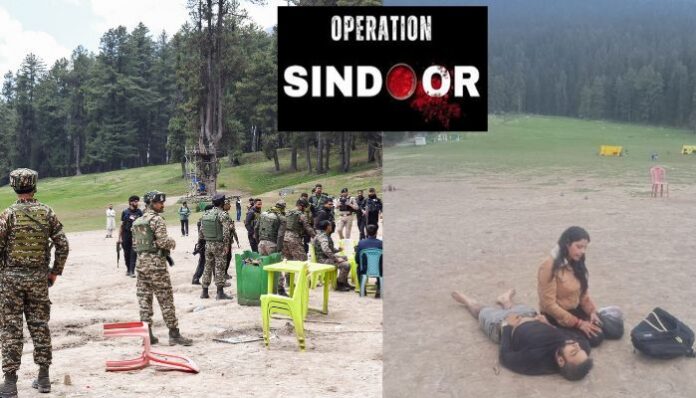
On this day last year, 22nd April, 2025, the nation was shaken by one of the most brutal terror attacks in the Anantnag district of Jammu and Kashmir. Pakistani terrorists, in a calculated and cold-blooded operation, gunned down 26 civilians after specifically identifying them as Hindus. Today, as India remembers the victims, the latest updates confirm that the wounds of that afternoon remain deep, but the country’s resolve to dismantle the infrastructure of hate has only grown stronger.
The attack unfolded at the popular Baisaran Valley. It was a typical afternoon filled with tourists enjoying the scenery until a group of Pakistani terrorists, belonging to the TRF (The Resistance Front), ambushed a group of unarmed visitors. According to survivors and eyewitnesses, the assailants didn’t just open fire randomly; they conducted a “religious screening.”
The terrorists forced them to prove their faith. They were asked to recite the Islamic Kalma, and also the terrorists pulled their pants to confirm their religious identity through circumcision markers. Those identified as Hindus were executed at point-blank range while their wives and children were forced to watch.
PM Modi’s tribute: “India will never bow to any form of terror”
Marking the first anniversary, Prime Minister Narendra Modi led a unified India in honouring the 26 lives lost, stating that the country’s resolve against terrorism remains “unshakeable.”
In a poignant post on X, the Prime Minister wrote: “Remembering the innocent lives lost in the gruesome Pahalgam terror attack on this day last year. They will never be forgotten. My thoughts are also with the bereaved families as they cope with this loss. As a nation, we stand united in grief and resolve. India will never bow to any form of terror. The heinous designs of terrorists will never succeed.”
Remembering the innocent lives lost in the gruesome Pahalgam terror attack on this day last year. They will never be forgotten. My thoughts are also with the bereaved families as they cope with this loss.
— Narendra Modi (@narendramodi) April 22, 2026
As a nation, we stand united in grief and resolve. India will never bow to…
PM Modi further emphasised that India has moved beyond mere condemnation to a doctrine of “decisive and proactive justice,” assuring the families of the victims that they are not alone in their grief.
The haunting proof of hate against Hindus
In the days following the attack, a heart-wrenching video surfaced online that captured the sheer scale of the horror. The footage showed tourists frantically calling out for help as dead bodies lay scattered across the green meadows.
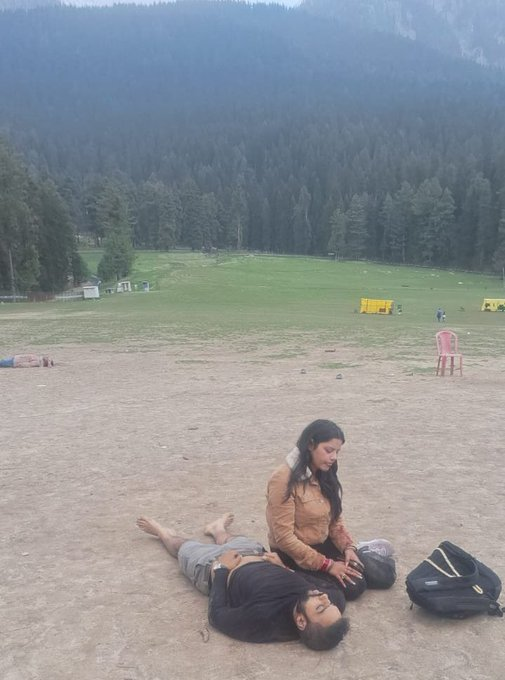
Eyewitnesses heard in the video confirmed that the attack was entirely religiously motivated. One of the haunting pictures of the attack that has gone viral on social media is of a grief-stricken woman helplessly sitting beside his dead husband. According to reports, the woman was recently married and was on her honeymoon in Kashmir when the terrorists attacked and killed her husband.
The myth of ‘Terror has no religion’
The Pahalgam massacre reignited a fierce debate over the phrase “terrorism has no religion.” Critics and survivors point out that the terrorists themselves explicitly use religion as their primary weapon and motivation. By meticulously checking IDs, demanding the recitation of the Kalma, and even using circumcision markers to separate Hindus from others, the attackers made their intent clear.
Asavari Jagdale, who survived the ordeal, recounted the trauma of watching her father and uncle being killed simply because they failed to recite the Kalma.
April 22, 2025 Pahalgam terror attack anniversary | Pune, Maharashtra: Daughter of deceased Pahalgam terror attack victim Santosh Jagdale, Asavari Jagdale says, “A year has passed since the Pahalgam Terror attack… It’s a black day for us because we were very happy when we… pic.twitter.com/RiQQVVuMGo
— ANI (@ANI) April 22, 2026
While some “secular liberals” continue to claim that terror lacks a religious identity, such denials only facilitate more violence. The Islamic terrorists involved in this attack openly boasted of their Jihadi beliefs, yet many cheerleaders of secularism seem to ignore the terrorists’ own justifications for slaughtering “Kafirs.” This denial of the ideological fuel behind such attacks is seen by many as an insult to those who perished specifically because of their faith.
India’s decisive response: Diplomatic and strategic
Following the attack, the Modi Government did not settle for diplomatic protests. The Cabinet Committee on Security (CCS) met and took several historic decisions to squeeze Pakistan. India took the unprecedented step of suspending the Indus Waters Treaty, a decades-old agreement, stating that “blood and water cannot flow together.” This suspension remains in place until Pakistan ends its support for cross-border terrorism.
India also shut down the Attari border checkpost, a key route for trade and travel between the two countries. In addition, Pakistani military advisors in New Delhi were expelled, and visa exemptions under SAARC for Pakistani nationals were revoked, giving them 48 hours to leave. These steps marked a clear shift from earlier diplomatic approaches to a more assertive stance.
Operation Sindoor
Within two weeks of the massacre, on 7th May, 2025, the Indian Armed Forces launched Operation Sindoor. Named as a tribute to the “Sindoor” (vermillion) wiped off the foreheads of the newly widowed women in Pahalgam, the operation involved precision missiles and air strikes.
Over 100 aircraft were involved in targeting nine major terror launchpads and infrastructure facilities deep within Pakistan-administered territory. The operation successfully neutralised facilities used by Lashkar-e-Taiba (LeT) and Jaish-e-Mohammad (JeM).
These terrorist groups have been provided with infrastructure concealed in government facilities to carry out their operations in Pakistan and Pakistan-occupied Jammu & Kashmir (PoJK). Several training camps (Markaz), and Launch Pads of these terror outfits are currently being run near army facilities.
While Launch pads are extensively used for staging/arms training activities, religious indoctrination and other support activities such as funding, propaganda, expansion, etc., are being carried out with the backing of the Pak Establishment in larger facilities that are located well inside Pakistan.
By hitting these targets, India sent a clear message: every act of cowardice will be met with a response that hits the enemy where it hurts the most.
Operation Mahadev: The final reckoning
While Operation Sindoor targeted the infrastructure, Operation Mahadev was launched to hunt down the terrorists responsible. On 28th July 2025, Union Home Minister Amit Shah announced the success of the operation in the Parliament. He confirmed that the joint operation of the Indian Army, CRPF and Jammu and Kashmir Police successfully eliminated India’s enemies before they could escape to Pakistan.
The three terrorists killed in the encounter were identified as Hashim Musa (alias Abu Suleman), Hamza Afghani, and Zibran. They were high-category LeT operatives. Suleman, a former Pakistani commando, was identified as the mastermind behind the Pahalgam massacre. The security forces used advanced sensors to track their signals in the Lidwas forest area near Srinagar. Their elimination brought a sense of closure to the families, as forensic reports confirmed that the rifles seized from them were the same ones used to gun down the tourists in Baisaran Valley.


