

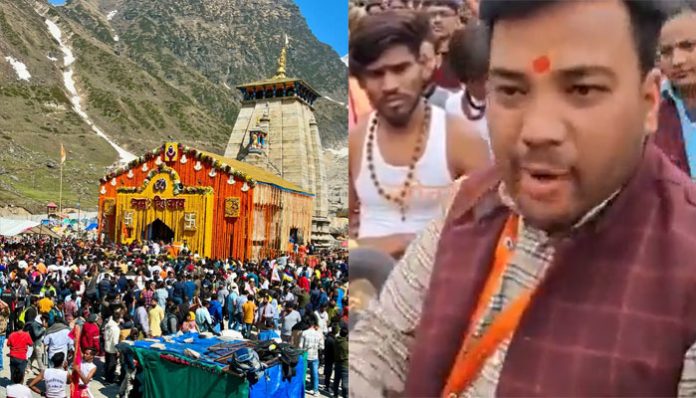
Hindu sacred places like Kedarnath are known for their desolate location and divine silence. These places are meant for devotees to visit and meditate to connect to God and their spiritual selves. However, in recent times, a trend has come to the fore where influencers and reel addicts have started visiting these places as if they are tourist spots just for the sake of making reels to gain traction on social media. One such incident has come to light where a group from Indore attempted to set a record for playing “Dhol Tasha” at the highest altitude.
केदारनाथ धाम में REEL के लिए चल रही 'नौटंकी' पर आज वहां के कुछ जागरुक लोगों ने रोक लगाने का काम किया। pic.twitter.com/dYhAxekmQH
— Sachin Gupta (@SachinGuptaUP) May 14, 2024
The group comprising 44 boys and 18 girls were playing Dhol Tasha outside Kedarnath temple when one of the priests objected and warned them against it, saying that he is ready to face the government officials if one of them have given permission for the event at the holy shrine. The video of the incident has gone viral on social media.
केदारनाथ धाम में REEL के लिए चल रही 'नौटंकी' पर आज वहां के कुछ जागरुक लोगों ने रोक लगाने का काम किया। pic.twitter.com/dYhAxekmQH
— Sachin Gupta (@SachinGuptaUP) May 14, 2024
The act of the group was aimed at garnering social media attention and they were not the only ones visiting sacred places for the same. Such individuals and groups often face significant backlash from devotees and locals who see it as a disturbance to the sanctity and peace of the sacred sites. Such incidents have highlighted a troubling trend brewing across the country where the reverence owed to spiritual sites is overshadowed by the clamour of viral fame. Even in the official videos by Shri Kedarnath Dham, one can see hundreds of mobile phones making videos of the Aarti.
आज की संध्या आरती दर्शन।
— श्री केदारनाथ (@ShriKedarnath) May 14, 2024
श्री केदारनाथ धाम।?
हर हर महादेव?#ShriKedarnath ?️?? pic.twitter.com/nQttnYmVL6
Another video shows how bad the situation is because of reel-addicts.
बात कड़वी और दुखी करने वाली है पर सच है pic.twitter.com/rmRG4Tk92E
— R S ???? (@rs_rajender) May 15, 2024
Following the incident, several social media users thanked the priest for speaking up. X user Abhishek said, “Finally, responsible local citizens came forward and stopped this drama in Kedarnath which had become a centre of various kinds of so-called cultural activities.”
आखिरकार जिम्मेदार स्थानीय नागरिक सामने आये और ना-ना प्रकार की कथित सांस्कृतिक गतिविधियों के केन्द्र बन चुके केदारनाथ में इस नौटंकी पर रोक लगाई ? pic.twitter.com/3h1Mxvn0ZF
— ABHISHEK SEMWAL (@Abhiisshhek) May 14, 2024
X user Ramukaka said, “People have ruined every temple by making it a video reel spot. Dancing, singing, hooliganism is what is happening in every temple. Instead of worship, recitation and bhajans, only drama is happening.”
बहुत सही किया हर मंदिर को वीडियो रील स्पॉट बना कर बरबाद कर दिया है लोगो ने । नाच गाना हुल्लड़पन बस यही हो रहा हर मंदिर में । पूजा पाठक भजन छोड़ कर नौटंकी हो रही बस । https://t.co/5ZQf9wRzHv
— रामूकाका (@Ramukakasayss) May 15, 2024
Ecological and cultural impacts – Beyond the noise
Notably, places like Kedarnath have fragile ecosystems. It is susceptible to various threats from increased human activity. The noise not only disturbs the spiritual ambiance but also affects the local wildlife that is not habitual to so much noise putting them in a distressed situation.
In many cases, it has been seen that birds and animals slowly migrate from such areas where noise pollution increases substantially over time. Take the example of metro cities. You will hardly find any birds other than pigeons in cities as most of them are left because of light, air and noise pollution. These activities contribute to broader environmental degradation, including littering and pollution, which compound the threat to these vulnerable areas.
Strict government and administrative action is need of the hour
Responding to hooliganism and irresponsible behaviour of the tourists, several local governments and administrations have acted in the past. In regions like Ladakh, strict regulations were implemented to curb such activities. For example, several videos surfaced over time where influencers raced SUVs on the fragile terrains of Pangong Tso. Following the viral videos, the administration not only imposed heavy fines but also imposed rules against it.
Recently, a group of youth were caught taking drugs and making reels at Kedarnath. They were seen apologising to police after getting caught.
#BigBreaking उत्तराखंड : #केदारनाथ_धाम में नशा करने वाले 4 भक्तों को पुलिस ने पकड़ा। चारों ने ऑन कैमरा पुलिस से माफी मांगी। पुलिस ने इस बार नशा करने वालों और अमर्यादित REEL बनाने वालों पर कड़ा एक्शन लेने की बात कही है।#Kedarnath #BadrinathDham pic.twitter.com/nH8CsSHWkH
— Arjun Chaudharyy (@Arjunpchaudhary) May 12, 2024
Last year, the Kedarnath temple administration put a ban on making reels around the temple after a video of a couple went viral where the woman was seen proposing to her boyfriend in front of the temple. Kedarnath Badrinath temple committee had taken a strong objection on the viral reel.
Kedarnath Badrinath temple committee takes a strong objection on the viral reel of the couple where a women proposes a men in front of the kedarnath temple. Committee decided to complete ban on smartphone, camera and recording reels near the temple area.#Kedarnath pic.twitter.com/1eeDoQ4ntn
— Aditya Vijayvargiya (@aditya_vijay_7) July 7, 2023
In September 2021, influencer Aarti Sahu was made to apologise after she made a dance reel in front of a temple that went viral and faced backlash. In October 2023, an influencer was booked for making a reel in Ram Ki Paidi Ghat in Ayodhya.
Last year, a helicopter pilot had to abort takeoff because of a reel-addict.
Reel guy in Kedarnath. pic.twitter.com/dmcXo3bqaO
— Nomadic-Explorer (@shekharrath) July 16, 2023
It is the responsibility of the state government and local administration to enforce stricter regulations to ensure that the sanctity and environmental integrity of these locations are preserved. In the recent case revolving around Kedarnath Temple, it is essential to note that sacred places are not tourist spots and regulations should be in place to avoid such incidents. Moreover, those officials who permitted “setting a record of Dhol Tasha” should be held accountable for their failure to apply their minds beforehand.
Restoring sanctity and sustainability: ecologically sensitive regions need a check on footfalls too
The recurring incidents at Kedarnath Dham and other religious sites call for a renewed view to respecting and protecting these sacred spaces. Recently, a large influx of devotees was seen at Uttarakhand’s Yamunotri. In another viral video, hundreds of pilgrims, carriers and horses were seen precariously packed in a narrow, dangerous path, reportedly near Yamunotri. It was a traffic jam that could have easily ended in a great disaster.
? Massive rush in Uttarakhand's Yamunotri as devotees wait for hours on hillside path. (?-NDTV) pic.twitter.com/That6v6ItA
— Indian Tech & Infra (@IndianTechGuide) May 13, 2024
The crushing crowd could have resulted in a major incident. It is essential to have a pass system for the devotees who can visit such sensitive places so that overcrowding can be avoided. Clear, and strict implementation of sanitation rules, littering rules, mobile phone usage and pilgrim movement have to be laid out, keeping safety and the region’s sustainability as priority.
Promoting awareness about the cultural and ecological importance of such locations, alongside implementing and enforcing appropriate regulations, can help mitigate the impact of such disruptions.
There should be a balance between welcoming devotees and preserving the tranquillity and sanctity of Kedarnath Dham and other sacred sites. Incidents like Kedarnath and Yamunotri should be seen as stark reminders of the need for a collective effort to maintain the spiritual, cultural, and natural integrity of sacred sites and it cannot be done by the administration alone. People visiting such sites should act responsibly and think beyond reposts and shares.


