

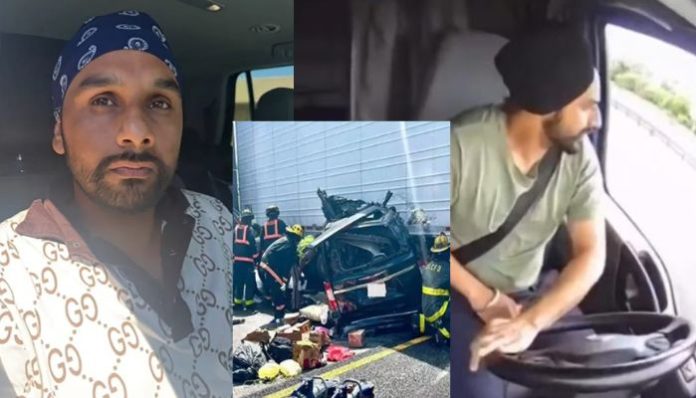
On 12th August, three people lost their lives in Florida, when an 18-wheeler trailer truck driven by Harjinder Singh, an ‘asylum’ seeker in the US, made an illegal U-turn on the Florida Turnpike. The people in the minivan that slammed into the truck had no chance of survival. The video of the crash went viral across social media, not only because of the horrific impact but also because Singh appeared almost unfazed as he calmly switched off the engine after blocking the entire highway.
(1) UPDATE: These are the alleged semi-truck drivers who k*lled three people while making a U-turn at an “Official Use Only” turn on the Florida Turnpike
— Unlimited L's (@unlimited_ls) August 15, 2025
The Florida Highway Patrol is describing the wreck as a homicide investigation pic.twitter.com/QqYhuidXoD
28-year-old trucker Harjinder Singh hails from Tarn Taran, Punjab in India. He was denied bail following the incident. Singh has been labelled an “unauthorised alien” and a “substantial flight risk”. He now faces three counts of vehicular homicide which will put him in prison for decades and eventual deportation. However, Singh’s story is not merely about the reckless road accident. It also throws light on how the immigration loopholes in America, particularly during the Biden administration, allowed an illegal entrant to work for years despite his asylum being earlier rejected during Trump administration 1.0.
Furthermore, there is another uncomfortable lurking question beneath this case which, if exposed during the investigation, will throw light on the use of the ‘Khalistan card’ by Punjabi youth to secure asylum abroad. By using the ‘Khalistan card’, Punjabi youth often exploit Western concerns about religious persecution in India. Notably, there are videos on his TikTok account that directly links his ideological leaning towards
The use of ‘Khalistan card’
There is a strong possibility that in his asylum application, Harjinder used the ‘Khalistan card’. Though there are no asylum documents available publicly, when he claimed he might face persecution, it leads to the belief that he might have claimed he was a ‘pro-Khalistani’ and that going back to India would lead to his persecution by the Indian government. The belief gets stronger by going through his TikTok account which connects him directly to Sikhs for Justice (SFJ). The connection was first discovered by Independent journalist who goes by “OnTheNewsBeat” on social media platform X.
Videos posted to his social media show the Florida truck driver, Harjinder Singh, taking part in events belonging to the group Sikhs for Justice (SFJ)
— Journalist V (@OnTheNewsBeat) August 24, 2025
SFJ is an outlawed group in India and given sanctuary in USA and Canada. Now it's members are murdering Americans. pic.twitter.com/bEShBppfMX
For those who are unaware, SFJ, a Khalistani terrorist outfit, is banned by the Government of India. Its founder Gurpatwant Singh Pannun is a designated terrorist in India and wanted for several crimes.
On 29th January 2024, Harjinder posted a video which was shot at SFJ’s so-called ‘Khalistan referendum’ held at Civic Center Plaza in San Francisco.

In another post, he shared a video about Khalistani terrorist Gurbachan Singh Manochahal, who was Jathedar of Akal Takhat Sahib and founder of the Bhindranwale Tiger Force of Khalistan in 1984. He was responsible for over 1,000 murders and was killed in a police encounter by Punjab Police in March 1993.
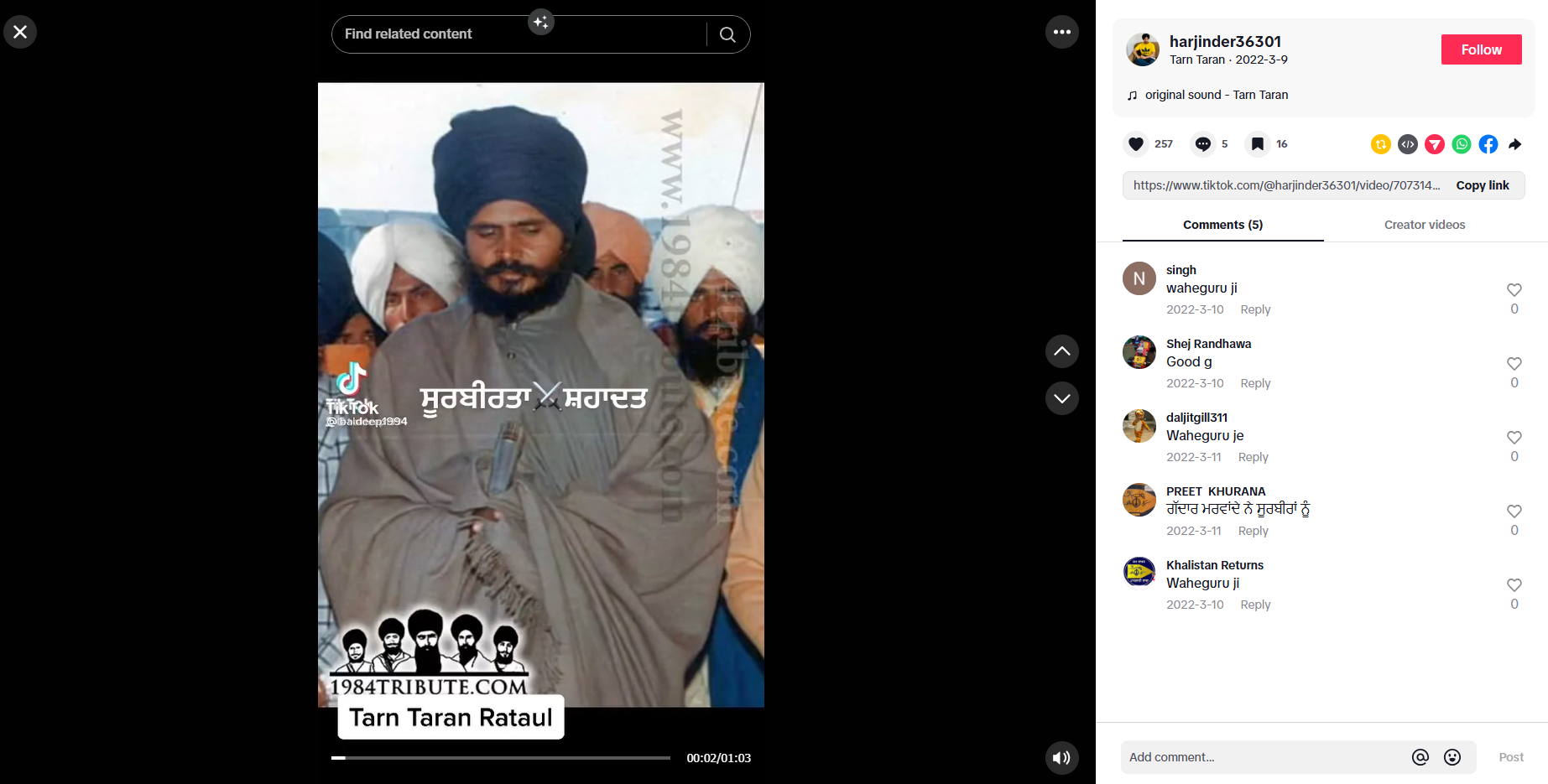
Notably, tens of thousands of Punjabi youth have played the same trick. They apply for asylum by citing fear of persecution in India on religious or political grounds, even if they have no connection with separatist movements.
Former Sangrur MP Simranjit Singh Mann himself once boasted of issuing nearly 50,000 letters supporting such asylum pleas in exchange for money. These letters claimed that the applicants faced possible persecution in India as sympathisers of the Khalistan movement. For many, it was nothing more than a ticket to bypass the legal immigration process.
Singh’s asylum case fits this pattern. Though we could not confirm it and no court filings spell it out in black and white, it is not unreasonable to assert that he might have invoked the same Khalistan-linked persecution narrative that thousands of others have used successfully. Such claims often gain sympathetic ears, especially in countries where governments are keen to present themselves as protectors of minorities.
This abuse of asylum, cosplaying as human rights protection, has now become full-fledged in several countries including the US, Canada, Australia and many others. Agents in Punjab guide youths on which story to tell, which vocabulary to use, and which community organisations abroad will back their claims. There are many attorneys in those countries who help such “asylum seekers” to file their applications, of course in exchange for hefty fees.
The tragedy is that, while genuine asylum seekers do exist, the sheer volume of fraudulent cases undermines them and sometimes leads to disastrous outcomes for host countries, just as the case of Harjinder Singh has turned out to be.
Illegal entry through the dunki route
Notably, Harjinder Singh did not enter the United States via the legal channel of a visa. He chose the ‘dunki route’ and spent one and a half months to reach the US via Mexico. The dunki route is basically a human smuggling network that ferries desperate migrants through countries like Dubai, Nicaragua, and Mexico before slipping them across the porous southern border into the US.
According to family and friends, Singh paid around Rs 22 lakh to an agent. His journey reportedly took a month and a half. He first reached Dubai, then Nicaragua, and finally Mexico, from where he crossed into California on foot. Like thousands of young men from Punjab who dream of an American life, Singh did not flee poverty or persecution. His family owns between 12 and 13 acres of farmland which is enough to have a healthy and luxurious lifestyle in India. His friends admit he went abroad simply to “build a better life”.
His family has urged not to subject him to harsh punishment. His relative, Dilbagh Singh, said, “His age is 28 years, and if he gets 45 years of jail, then you can imagine what will be the condition of his family. We are also saddened over the death of three persons in the accident. Similar incidents have taken place earlier as well.”
This is the story of countless Punjabi families. Their sons are sent overseas by any means possible, debts pile up, and there is an unspoken hope that remittances will justify the risks.
Trump administration denial of asylum and work papers
When Singh reached the US, he applied for asylum, as it is a standard practice for illegal entrants hoping to avoid deportation. Under the Trump 1.0 administration, he did not succeed.
By 2019, Singh had already been processed for fast-track deportation. He was detained and later released on a $5,000 immigration bond. In September 2020, his request for work authorisation was flatly rejected by the then Trump administration.
It is not a surprise that his application was rejected as, according to media reports, he could barely respond to basic English questions. He managed to identify only 2 answers correctly out of 12 in a language proficiency test. Furthermore, on a driving test, he recognised only 1 out of 4 traffic signs. Yet, somehow, while his asylum application lingered, he managed to slip through cracks at the state level and secure commercial driving licences in Washington and later California.
Biden administration reversal and approval
What changed was the arrival of Joe Biden in the White House. On 9th June 2021, the very same asylum application that had been effectively frozen under Trump was suddenly given a new life. Singh’s work permit was approved, which gave him access to lawful employment. That authorisation opened the door for him to apply for state-level commercial driver’s licences or CDLs.
Another post on his TikTok account shows him holding s certificate with a person. In the background, it says, “PNW CDL Training”. The post is from 18th July 2023.
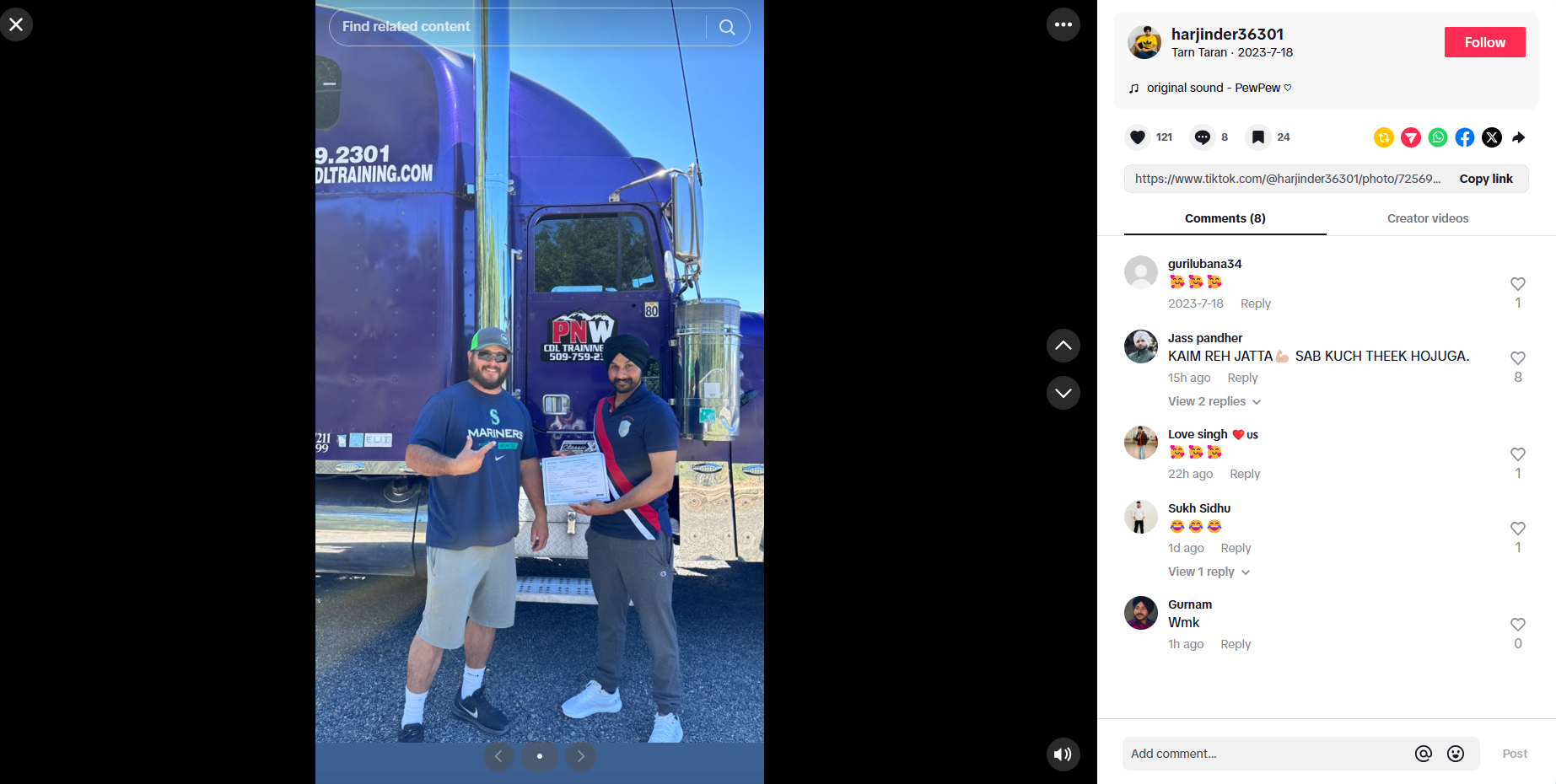
PNW CDL Training LLC is a Washington-based training institute owned by Brandon and Crystal Tatro. The person Harjinder is standing with looks strikingly similar to Brandon, whose photograph is available on the website.

This is where policy laxity led to dangerous, life-ending consequences. While it is the duty of the federal government to withhold work permits until asylum claims are granted, the Biden-era Department of Homeland Security extended such permissions anyway. This effectively armed an illegal immigrant with the right to operate a 40-ton truck across American highways.
UPDATE: Harjinder Singh, an illegal alien from India who killed three innocent people, FAILED an English Language Proficiency assessment. Singh provided correct responses to just 2 of 12 verbal questions and only accurately identifying 1 of 4 highway traffic signs.
— Homeland Security (@DHSgov) August 20, 2025
And yet,… pic.twitter.com/AwndMrW9Vm
In this reversal lies the real controversy. Singh was on the path of deportation. However, it was stalled not because he proved genuine grounds of persecution but because he claimed that returning to India would endanger his life.
Life in the US and work as trucker
Once Harjinder’s work permit was cleared in June 2021, Singh slipped further into the American system. California issued him a commercial driver’s licence. Later, even Washington gave him one, despite his questionable immigration status.
According to federal law, only US citizens or lawful permanent residents are supposed to obtain such licences. But in practice, several states have allowed anyone with work authorisation to apply. Since Singh had Biden-era work papers, states like California had no barrier in issuing him a licence. The result… an illegal entrant from Tarn Taran was suddenly driving a 40-ton truck across American highways.
Ironically, despite his newfound “legal” work life in America, Singh remained an outsider in both worlds. He never returned to India, not even for his father’s funeral in 2020. That tells its own story, that the fear of losing his asylum status outweighed the pull of family duty. According to family members, he was planning to come back to India to visit after another two years, which means he had hopes his asylum status would have been cleared by then.
Florida crash and aftermath
Following the 12th August accident, Singh and his brother, who was travelling with him, initially fled Florida for California. They were later arrested in Stockton and extradited back. Judge Lauren Sweet denied him bail and called him an “unauthorised alien” and “flight risk”. He now faces up to 50 years in prison before deportation proceedings begin.
The fallout has been swift. The US suspended visas for foreign truck drivers, with Secretary of State Marco Rubio warning that “foreign workers on American roads” were endangering lives and undercutting local livelihoods. There are around 1.5 lakh Punjabi truckers in the US. The crackdown could be devastating.
Meanwhile, petitions in favour of Harjinder have surfaced. One of them has over two million signatures seeking “fair sentencing” for him. Counter-petitions demand deportation not just for him but for those defending him.
Interestingly, Punjab MP from Shiromani Akali Dal (SAD), Harsimrat Kaur Badal, came in support of the Punjabi drivers in the US and urged Minister of External Affairs (MEA), Dr S Jaishankar, to intervene. In a post on X, she claimed that “Any mass level action against them would be discriminatory in nature considering the fact that Punjabis have built and sustained trucking logistics and trucking networks over decades” and added, “Also stressed that a grave mistake by one driver which had resulted in a fatal accident should not be used to punish the entire community”.
Today I appealed to @DrSJaishankar to take up the issue of freezing the work visas of all foreign truck drivers following a fatal crash involving a Punjabi trucker with the US govt. Also urged the external affairs minister to take steps to allay the fears of Punjabis that those… pic.twitter.com/9SzRw61a31
— Harsimrat Kaur Badal (@HarsimratBadal_) August 23, 2025
Asylum abuse and its dangers
Harjinder’s case is no longer just about the tragic crash. It is about the immigration system that let asylum seekers slip in without following the lawful process, based on convenient stories of persecution.
Singh entered illegally, failed in tests, was denied by one administration, but managed to survive in the US by playing the persecution card, quite possibly the ‘Khalistan persecution’ narrative. Under Biden, he was granted a work permit. That single act opened the door for him to obtain state licences, take up a high-risk job, and ultimately cause a tragedy that claimed three innocent lives.
The cost of such loopholes is borne by host societies. Three Americans died. Thousands of Punjabi truckers now face an uncertain future. US-India diplomatic channels are being dragged into the mess. And Harjinder Singh himself, once a farmer’s son from Tarn Taran, is staring at decades behind bars before an inevitable deportation.
However, the larger question remains. How many more such “asylum success stories” are out there, built not on genuine persecution but on exploitation of Western guilt narratives?


