

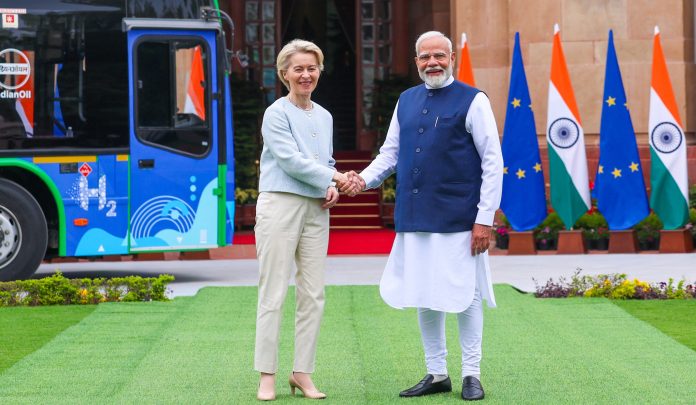
In a move underscoring Europe’s independent trade strategy, the European Union is accelerating negotiations for a Free Trade Agreement (FTA) with India, even as U.S. President Donald Trump urges the bloc to impose up to 100% tariffs on Indian for continued purchase of Russian oil. Commerce Minister Piyush Goyal said that 60%-65% of the chapters have already been finalised, and the agreement will be concluded substantially soon.
The 13th round of EU-India FTA talks kicked off in New Delhi on Monday, with EU Trade and Food Commissioner Maroš Šefčovič and Agriculture Commissioner Christophe Hansen scheduled to arrive in India on 12 September. Minister Piyush Goyal said, “By the time my counterpart Mr Maros Sefcovic, the EU trade commissioner, and Mr Christophe Hansen, the EU agriculture commissioner, come to India, I think we will be quite set to try and conclude the agreement substantially.”
Goyal stated that the agreement could be substantially concluded by the end of 2025, paving the way for a joint strategic agenda at the next EU-India summit in early 2026.
Like the trade deal discussions with the US, agriculture remains the most complex subject, with India unwilling to open up the sector to protect the domestic farmers. In that context, participation of the Agriculture Commissioner of the EU is significant. Wine and spirits, processed agricultural products, dairy, sustainability commitments, and business visas are some of the thorniest issues.
An EU official told media that the broad agri-food market access offer involved in any agreement would be discussed along with negotiations on the EU-India Geographical Indications (GIs) agreement, and general cooperation with India on agricultural matters.
The FTA, relaunched in 2022 after a seven-year hiatus, aims to boost bilateral trade, currently valued at around €120 billion annually, by addressing market access for goods, services, investment, and contentious issues like agriculture and non-tariff barriers.
Sources indicate that chapters on digital trade and anti-fraud measures have been closed, with agriculture now formally on the table, a sign talks are nearing completion. The deal could enhance India’s exports in sectors like pharmaceuticals, garments, and steel, while providing the EU access to India’s burgeoning consumer market.
This progress comes against the backdrop of Trump’s recent actions against India. According to multiple reports, the U.S. president has pressed EU leaders to slap tariffs of up to 100% on imports from India and China, citing their purchases of Russian oil as fuelling Moscow’s war in Ukraine. Trump, who earlier this year raised U.S. tariffs on Indian imports to 50%, argued the measures would isolate Russian President Vladimir Putin economically. However, EU officials have dismissed the idea as unlikely, pointing to legal hurdles, ongoing FTA negotiations, and the bloc’s own trade priorities.
EU Commission President Ursula von der Leyen, in a recent call with Prime Minister Narendra Modi, reaffirmed the bloc’s commitment to wrapping up the FTA by year-end, while welcoming India’s role in Ukraine peace efforts. Danish Ambassador to India Rasmus Nørgaard, in an interview, countered Trump’s characterization of India’s economy as “dead,” calling it “the world’s fastest growing economy” and praised the EU’s investment push.
The EU-India FTA, if signed, could add billions to both economies and reinforce multipolar trade dynamics, potentially mitigating the impact of U.S. tariffs estimated at 0.3-0.4% of India’s GDP in the short term. As negotiations intensify, all eyes are on whether Brussels will yield to Washington’s demands or chart its own course with New Delhi.


