

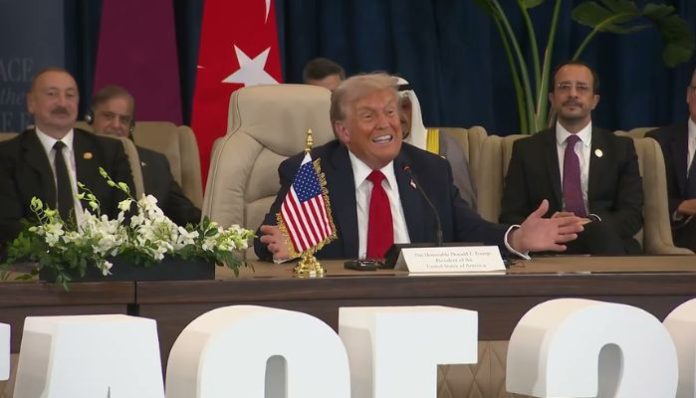
On 13th October, a historic moment for Middle East peace came at the “Shamashir Peace Summit” in Sharm el-Sheikh as the world leaders signed a peace pact. However, peace was not the centre of the summit in reality, as it quickly turned into a spectacle of self-congratulation led by the President of the United States, Donald Trump. The President, who stood at the centre of the event like a director on his own movie set, appeared less interested in diplomacy and more in stagecraft.
Before the signing of the Gaza peace accord, Trump took to the stage with his trademark flourish. He declared the accord “a tremendous day for the world, and a tremendous day for the Middle East”. Trump described the gathering as “the greatest assemblage of countries in terms of wealth and power ever gathered”. He set the tone for the show, which later became more about his triumphalism than diplomacy.
In his initial address, Trump spoke of the “granddaddy of all deals” and praised his team and the nations involved. He noted that the hostages had been released “on schedule” and that “things were working out incredibly well”. Trump credited countries like Qatar and Turkey for their cooperation, personally thanking their leaders with familiar informality, before acknowledging Egypt’s role as host. With cameras clicking and delegates watching, he called for the documents to be brought in, ready to sign what he proclaimed was a peace deal “3,000 years in the making.”
While the show began as an international gathering to celebrate the so-called Gaza peace accord, what came after was, well, kind of expected. Trump’s oratory took on the tone of a curtain call. He praised himself for ending the war, credited his “talent-packed” team, and accepted Egypt’s highest civilian honour, the Order of the Nile, with the solemnity of a coronation.
Around him, leaders from every major power bloc stood as he praised himself as the centrepiece of the peace accord, including Egypt, Italy, Turkey, Qatar, Pakistan, the United Kingdom, and the EU. Each one of the leaders was reduced to background cast in a performance only one man seemed to be headlining.
Pakistan’s Prime Minister sings praises
Pakistan’s Prime Minister Shehbaz Sharif’s speech at the summit sounded less like a leader’s address and more like a public show of praise for Donald Trump. He called Trump “the man the world needed most” and even nominated him again for the Nobel Peace Prize, saying, “Pakistan had nominated President Donald Trump for his extraordinary efforts to stop war between India and Pakistan and achieve a ceasefire.” His tone was almost worshipful as he spoke about Trump’s “untiring efforts” and “relentless work to make the world a place of peace and prosperity.”
In what felt more like flattery than diplomacy, Sharif went on to say, “Mr President, I salute your exemplary and visionary leadership. History will remember you as the man who stopped seven and today eight wars.” By the time he ended with, “God bless you and give you long life to serve humanity,” it seemed less like a formal statement and more like a man rolling in gratitude at Trump’s feet.
The world’s leaders as supporting actors
Even as Pakistan’s Prime Minister Shehbaz Sharif took the microphone to nominate Trump again for the Nobel Peace Prize, the President looked pleased but unsurprised. His smile stretched wider as he listened to a near-eulogy describing him as “the man the world needed the most”.
Across the stage, leaders stood lined up behind him, silent, still, and awkward. General Asim Munir of Pakistan, positioned right behind Trump, wore an expression that needed no words. His fixed stare and rigid posture said enough, somewhere between protocol and compulsion. It was the kind of image that conveyed authority enforced by circumstance, not shared by consent.
Later, when Trump looked for Britain’s Prime Minister Keir Starmer, who was standing just next to Sharif behind him, Trump theatrically looked for him, virtually forcing him to raise his hand like a schoolboy before calling him to the dais and promptly sending him back. The moment, half comical and half telling, summed up the dynamic of the evening, that world leaders assembled not as peers but as props in Trump’s grand tableau.
WATCH: Trump asked, “Where is the UK?”
— Clash Report (@clashreport) October 13, 2025
Starmer raised his hand. Trump called him to the stage, making him think he was going to speak.
Starmer approached the podium. “It’s nice that you’re here,” Trump said, then sent him back, offending Starmer. pic.twitter.com/Y67s4JGmEM
In between, he turned to the Prime Minister of Italy, Giorgia Meloni, and bluntly asked her, during the speech at a peace accord, if he could call her “beautiful”. While Meloni could only smile, diplomacy, decorum, and dignity quietly left the room.
‘I did what no one could’
The speech Trump delivered was long and looping. It felt more of a campaign rally than a summit address. “At long last, we have peace in the Middle East,” he declared, as if resolving millennia of history in one afternoon. He reminded the audience of his achievements, from the Abraham Accords to hostages’ release, and thanked nations for “truckloads of aid” before swiftly pivoting to the US’s “strongest military in the world.”
The tone of his speech circled between self-admiration and unsaid parody. “We know how to rebuild, and we do it better than anyone,” he said, turning a post-war humanitarian task into a business pitch. Even his thanks to Egypt came wrapped in transaction-speak, “You paid a lot for those planes, but you got a good deal.”
The tone oscillated between self-admiration and inadvertent parody. “We know how to rebuild, and we do it better than anyone,” he said, turning a post-war humanitarian task into a business pitch. Even his thanks to Egypt came wrapped in transaction-speak, “You paid a lot for those planes, but you got a good deal.”
The peace deal that became a monologue
Every few minutes, Trump shifted the spotlight to himself rather than Gaza. When he wasn’t recounting global investment numbers, he was listing every leader present, adding unscripted commentary like “beautiful,” “fantastic,” or “great guy” as if auditioning them for his approval.
In short, the world leaders were there to celebrate a fragile truce, with Trump coming to celebrate himself. The message was unmistakeable. Peace in Gaza came with an agenda, the agenda to propagate Trump as the only hope for world peace.


