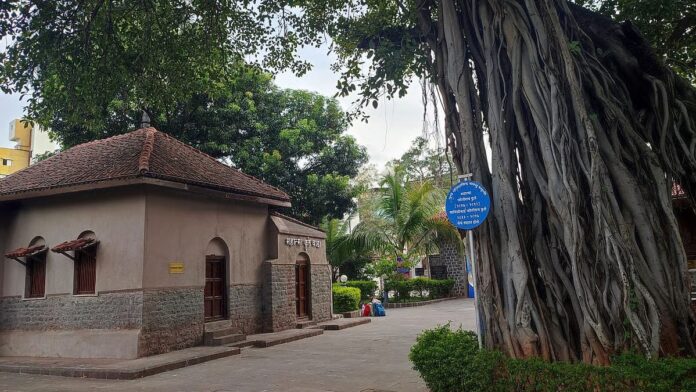
UPDATE: In a fresh letter dated 23 June 2026, the Assistant Director (Archaeology), Pune Division, asked the police to maintain law and order while ensuring that the pre-existing tradition and customary practice associated with Vat Purnima at Mahatma Phule Wada continue.
A fresh controversy has erupted in Pune after the Maharashtra Archaeology Department issued an order effectively barring women from performing Vat Purnima rituals at the historic Mahatma Phule Wada in Ganj Peth on 29 June 2026. The order, which asks the Pune Police to ensure that no religious programme is held at the site, has now been challenged through a detailed legal objection petition that accuses the authorities of acting arbitrarily, violating constitutional rights, and misusing heritage protection law to stop a long-standing religious practice.
At the heart of the row is a banyan tree located inside the protected premises of Mahatma Phule Wada, where local married women have for years observed Vat Purnima by tying sacred threads around the tree and offering prayers. However, in a communication dated 2 June 2026, the office of the Assistant Director (Archaeology), Pune Division, wrote to the Pune Police Commissioner asking for police deployment from morning till evening on 29 June to ensure that no such religious activity takes place inside the protected monument premises. The order was issued after a representation by Prashant Yatish Phule and invoked Rule 8(f) of the Maharashtra Ancient Monuments and Archaeological Sites and Remains Rules, 1962.
Archaeology Department cites Phule legacy, seeks police action to stop ritual
In its letter to the police, the Archaeology Department stated that Jyotirao Phule and Savitribai Phule had dedicated their lives to “social reform” and were opposed to what it described as ritualism and religious orthodoxy. It also referred to an incident from last year, when ‘activists’ associated with Mahatma Phule Samata Pratishthan objected to women performing Vat Purnima rituals at the banyan tree, allegedly creating a law-and-order issue that had to be handled by the police. Citing this background and the representation received, the department asked the police to ensure that women do not perform the ritual at the tree on Vat Purnima this year.
The department’s reasoning, as reflected in the order, is that Mahatma Phule Wada is not merely a protected monument but also a site associated with Phule’s “anti-ritual social reform legacy”, and therefore such rituals ought not to be allowed there. It further cited Rule 8(f), which bars violation of any custom, usage or practice applicable to or observed in a monument, and used it to justify preventing the observance of Vat Purnima within the protected premises.
12-page legal objection says order based on ideology, not law
The order has now been met with a 12-page legal objection and representation dated 19 June 2026, addressed to the Director of Archaeology and Museums, the Assistant Director of Archaeology, the Pune Police Commissioner and the Pune District Collector. Filed on behalf of women who traditionally observe Vat Purnima at the site and citizens described as admirers of Mahatma Phule, the petition seeks immediate withdrawal of the 2 June order and permission for the ritual to be performed peacefully on 29 June.
The petition argues that the Archaeology Department acted solely on the basis of a private representation submitted by one individual and issued a blanket prohibition without hearing the women affected by the decision, without giving them prior notice, and without relying on any archaeological or structural assessment showing that the ritual damages the monument. It contends that the order is not based on conservation concerns but on an ideological reading of Jyotirao Phule’s views, which, the petition says, cannot be used by the state as a legal basis to prohibit a peaceful religious observance.
Petition says Vat Purnima ritual is longstanding, peaceful and causes no damage
According to the objection, the banyan tree inside the Phule Wada premises has been worshipped on Vat Purnima for several years and the practice has never caused any harm to the monument. In fact, the petition points out that the Archaeology Department’s own order acknowledges that the ritual had taken place in previous years and that the police had only been deployed to maintain law and order when objections were raised by activists. The petition underlines that the order does not cite any expert report, structural assessment, archaeological finding or scientific study to show that tying threads around the tree or performing prayers at the spot causes any actual damage to the protected structure.
Rule 8(f) has been twisted to ban, rather than protect, existing practice: Petition
One of the central legal arguments in the objection is that the Archaeology Department has wrongly interpreted Rule 8(f) of the 1962 Rules. The petition says the rule merely prohibits violation of customs, usages or practices applicable to a monument; it does not empower the state to abolish a practice that is already being observed there. In other words, if women have been performing Vat Purnima prayers at the banyan tree inside Mahatma Phule Wada for years, then the continuation of that practice would be in line with the rule, whereas banning it would amount to disrupting an existing custom.
The petition further argues that neither the Maharashtra Ancient Monuments and Archaeological Sites and Remains Act, 1960 nor the Rules framed under it grant the Archaeology Department any explicit power to completely prohibit a peaceful religious observance of this nature. It cites provisions of the 1960 Act to claim that protected status does not automatically extinguish traditional religious usage, especially where no damage to the monument is shown.
Petition invokes Articles 14, 19, 21, 25 and 26, says state cannot ban rituals based on ideological preference
The legal objection invokes multiple constitutional guarantees, including Article 14 (equality before law), Article 19 (freedom of expression and assembly), Article 21 (right to life and dignity), and Articles 25 and 26 (freedom of religion and management of religious affairs). It argues that the state cannot stop women from observing a religious practice simply because an official or complainant believes that Mahatma Phule opposed ritualism.
The petition also accuses the administration of selectively targeting one religious practice at one monument while similar observances at other protected sites are not interfered with. On that basis, it alleges discrimination and arbitrariness. It further says that if the state’s real concern was crowd management, preservation or public order, it could have imposed narrowly tailored restrictions such as regulating the number of participants, fixing a time window, preventing any act that might physically damage the tree or monument, and maintaining adequate police deployment. Imposing a complete ban, the petition argues, fails the test of proportionality and is legally indefensible.
‘Natural justice violated’: Petition says women were not heard before order was passed
The objection also attacks the process followed by the Archaeology Department, saying the order was passed after considering only the complaint made by Prashant Yatish Phule while completely ignoring the women and devotees who would be directly affected by the prohibition. No notice was issued to them, no hearing was granted, and no opportunity was given to present their side before the administration acted. The petition therefore alleges violation of the principles of natural justice and says the order is liable to be set aside on that ground alone.
Petition seeks withdrawal of order, warns of High Court move
In its final prayers, the objection petition demands that the 2 June 2026 order be immediately withdrawn and that women be explicitly allowed to perform Vat Purnima rituals peacefully at Mahatma Phule Wada on 29 June. It also asks that the police be directed not to stop the ritual but to maintain law and order during the observance and prevent any disruption. The petition further demands that in future, no such order be passed without first issuing notice to the affected women and hearing their side.
Significantly, the petition warns that if the administration does not revoke the order within time, the petitioners would be free to move the High Court under Article 226 of the Constitution. With Vat Purnima only days away, the matter has now escalated from a local dispute into a larger battle over religious freedom, administrative overreach, and the use of Mahatma Phule’s legacy to justify state intervention in a traditional Hindu observance.