

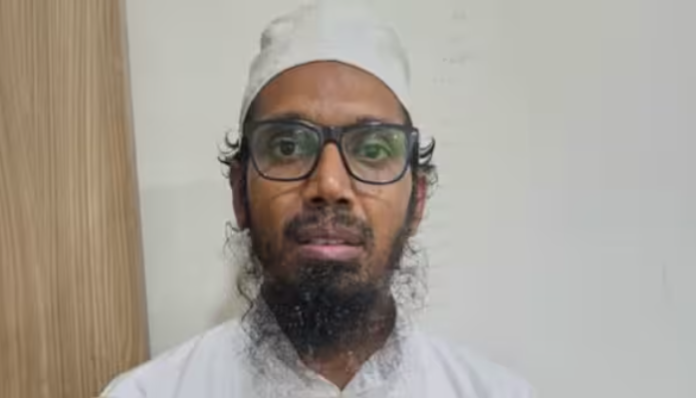
On 10th August, a Special NIA Court in Gujarat’s Ahmedabad rejected the regular bail plea of Dr Syed Ahmed Mohiuddin, the main accused Jihadi in the 2025 ISIS ricin terror plot case.
Appearing for Syed Ahmed Mohiuddin, advocate K.M. Dastoor argued that his client was innocent and had been falsely implicated. The defence said the material on record did not establish his links with any terrorist organisation or show that he intended to harm people. It also argued that Mohiuddin did not know what was inside the bags in which weapons were found and had no knowledge of the process of preparing ricin.
Court finds prima facie material against accused
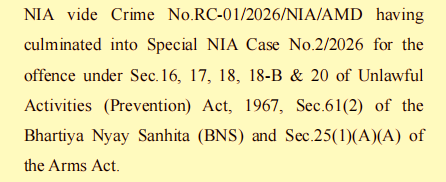
Special Judge (NIA) Hemang R. Rawal said the case involved serious charges under Sections 16, 17, 18, 18-B and 20 of the Unlawful Activities (Prevention) Act (UAPA), Section 61(2) of the Bharatiya Nyaya Sanhita (BNS) and the Arms Act.
The court said the investigation had produced prima facie material against the 2025 ISIS ricin terror plot accused Jihadi Mohiuddin and a chargesheet had been filed in the case.
The court noted that Mohiuddin, who is a doctor, was accused of setting up a laboratory at his Hyderabad home without the required permission. Investigators said ricin was prepared there using castor seeds and chemicals. The court observed that, given his medical background, it could not be said that he was completely unaware of the nature of ricin, a highly toxic biological toxin with the potential to cause mass deaths.
Prosecution says doctor worked with handler
Opposing the bail plea, Special Public Prosecutor M.G. Kapadiya told the court that Mohiuddin was facing a serious prosecution and had travelled towards Mehsana carrying three pistols and 30 live cartridges without a licence. The prosecution said this, along with other evidence, showed his involvement in the wider conspiracy.
The prosecution claimed that Mohiuddin had converted his Hyderabad residence into a clandestine laboratory for extracting ricin from castor beans. His mobile phone, according to the prosecution, contained conversations with a Telegram user identified as Abu Khadija, described as a wanted accused. These conversations included discussions about obtaining acetone, castor seeds and weapons for preparing ricin.
Notably, Ricin is a highly toxic protein which is derived from the castor bean plant, Ricinus communis. Ricin is not a virus or bacterium; rather, it is a lectin toxic to inhibits protein synthesis in cells. Its consumption can lead to organ failure and quick death. Extraction of ricin involves mashing castor beans, removing the oil, and then chemically processing the remaining mash to isolate the Ricin-rich pulp. Although a sophisticated work, this process requires only basic lab equipment, gloves and acetone.
“Per contra, learned Spl. P.P. has submitted that the applicant-accused is facing serious prosecution. The
learned Spl. P.P. has further submitted that the applicant-accused was travelling to Mehsana carrying three pistols and 30 live cartridges without any license and the said act of the applicant-accused itself speaks about his ill intention. The learned Spl. P.P. has further submitted that the applicant-accused converted his residence into a clandestine laboratory to extract Ricin from castor beans using chemicals, intending to carry out mass casualty attacks in Indian cities,” the court order reads.
The prosecution further told the court that Mohiuddin had agreed to assist Abu Khadija in activities being carried out in the name of a religious cause. He had also sought around US$4 lakh to establish business operations. As part of the wider plan, he travelled to Delhi, where he discussed plans, funding and future operational activities.
The prosecution also said Mohiuddin took an oath on Abu Khadija’s instructions, recorded it and sent the video to the handler. He then tried to expand the network by administering similar oaths to Abdul Vajid and Naved Pamidi. According to the prosecution, he also sent photographs and videos showing the preparation of toxic material to Abu Khadija.
Court lists allegations against Mohiuddin
According to the court’s summary of the chargesheet, Mohiuddin came in contact with Abu Khatija through Telegram in 2025 and agreed to assist him. He allegedly sought about US$4 lakh for business operations and travelled to Delhi in August 2025 to meet an associate and discuss plans and funding.
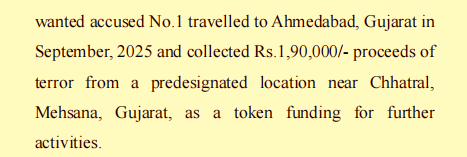
The court also recorded that Mohiuddin travelled to Ahmedabad in September 2025 and collected Rs 1.90 lakh, described as terror proceeds, from a pre-designated location near Chhatral in Mehsana. He later recorded an oath and shared it with his handler, while similar oaths were administered to other individuals as part of efforts to expand the network.
The chargesheet further states that Mohiuddin procured castor seeds, oil-extraction equipment and chemicals such as acetone. The court noted the prosecution’s case that these materials were used to prepare ricin at a laboratory at his Hyderabad residence. The chargesheet describes ricin as a highly toxic biological toxin listed in Schedule-I of the Chemical Weapons Convention.
The court also recorded that Mohiuddin had arranged to receive additional funds and materials and planned to visit Ahmedabad in November 2025, where he received advanced weapons for a terrorist act. Based on these allegations, the court said the accusations were serious and prima facie showed his involvement in the case.
Mohiuddin was aware of the ricin terror plot; he knew that the bags contained weapons
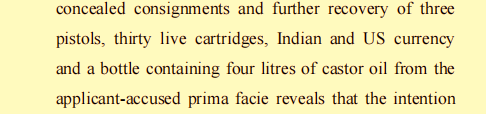
The court rejected the defence argument that the ISIS ricin terror plot accused Syed Ahmed Mohiuddin did not know about the weapons. It pointed to the recovery of three pistols, 30 live cartridges, Indian and US currency and a bottle containing four litres of castor oil. The judge said the material in the chargesheet indicated that Mohiuddin was acting on the instructions of Abu Khadija and that the weapons were obtained for an improper purpose.
The court also said the records indicated a conspiracy involving Mohiuddin, Abu Khadija and other accused persons.
“Thus, the allegations levelled against the applicant-accused seem to be serious in nature, and prima facie reveal the involvement of applicant-accused with the offence in question,” the court stated.
The Special NIA Court further highlighted that since the accused Syed Ahmed Mohiuddin is a doctor, “it cannot be said that he was absolutely unknown to the material prepared by him in the nature of Ricin, a toxic biological toxin, which is having potential of mass killing. Further, the existence of a lab at the residence of the applicant-accused without there being any license/permission from a competent authority, prima facie speaks about the ill intention of the applicant-accused.”
The court also noted that accused ISIS ricin terror plot accused jihadi Mohiuddin had allegedly travelled to different locations including Delhi and Ahmedabad, to meet operatives and collect concealed consignments, and further recovery of three pistols, thirty live cartridges, Indian and US currency and a bottle containing four litres of castor oil from the applicant-accused prima facie “reveals that the intention on the part of the applicant-accused was not holy or for any human cause,” the court noted.
Citing the chargesheet, the Special NIA Court noted that accused Dr Syed Ahmed Mohiuddin was in contact with the wanted main accused and was acting as per his instructions, leading to the preparation of Ricin and further the procurement and holding of weapon pistols. The court, thus, rejected Defence’s claim that Mohiuddin was unaware of the bags and their contents (weapons).
“The recovery of weapon from applicant-accused prima facie 10 reveals that the said weapon was obtained for oblique purpose and therefore, the contention raised by the learned Advocate for the applicant-accused that applicant-accused had no knowledge about the bags and contents thereof, deserves no acceptance at the hands of this Court,” the court said.
“Further, the video recovered from mobile phone of accused No.1 also speaks about the ill intention on the part of applicant-accused and does not reveal that the applicant-accused was moving towards the holy path and doing good to humanity,” the court added.
Considering the seriousness of the accusations and the restrictions imposed by Section 43D(5) of the UAPA, Special Judge Hemang R. Rawal refused to grant bail. The court rejected the application without any order as to costs.
“Considering the aforesaid and rigors of section 43D(5) of the Unlawful Activities ( Prevention) Act, this Court deems it fit not to exercise the discretionary jurisdiction vested with this Court in favour of the applicant-accused, and hence, the present application is hereby rejected with no order as to costs,” the court ordered.
Case background
The case emerged after the Gujarat ATS arrested three men in connection with an Islamic State-Khorasan Province (ISKP)-linked network. Investigators said members of the group had conducted reconnaissance of crowded markets and religious or organisational sites in Ahmedabad, Delhi and Lucknow while gathering information that could be used for a possible terror attack.
Mohiuddin, a doctor from Telangana who studied medicine in China, was arrested with firearms, ammunition and castor oil. Investigators said he was trying to prepare ricin from castor seeds at his Hyderabad residence. The ATS also traced his communication with an Afghan handler linked to ISKP, while the investigation continued into funding, other members and possible links to a wider network.


