

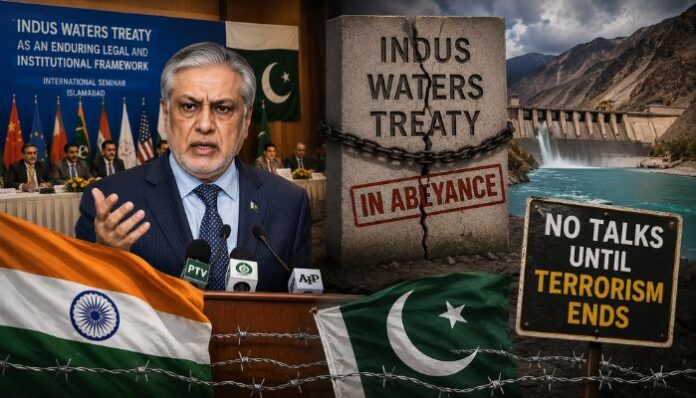
On Tuesday, 30th June, desperate Pakistan organised a unilateral international conference on the Indus Waters Treaty (IWT) in Islamabad, where its leaders issued a series of warnings and empty threats against India over New Delhi’s decision to keep the landmark water-sharing agreement in abeyance.
The conference came as Pakistan continues to struggle with the consequences of India’s decision following the Pakistan-sponsored Pahalgam terror attack in April 2025. While Islamabad tried to project the event as an international effort to defend the treaty, India has made it clear that there will be no discussions on the IWT until Pakistan takes credible action against cross-border terrorism.
Pakistan organises Conference to raise pressure on India
The conference, titled “Indus Waters Treaty as an Enduring Legal and Institutional Framework”, brought together Pakistani officials, local experts and a few international specialists on water and international law. Pakistan’s Information Minister Attaullah Tarar described it as a “first-of-its-kind international seminar” aimed at reinforcing Islamabad’s case against India’s suspension of the decades-old agreement.
The Indus River Basin sustains one of the world’s largest contiguous irrigation systems, provides over 80 percent of Pakistan’s agricultural water needs, and supports the lives and livelihoods of over 240 million people.
— Asim Iftikhar Ahmad, PR of Pakistan to the UN (@PakistanPR_UN) June 30, 2026
For more than six decades, the Indus Waters Treaty (IWT)… https://t.co/4ZrKYkTMND
Pakistan’s leaders repeatedly argued that the treaty was much more than a water-sharing arrangement and warned that its suspension could have wider consequences for international agreements. Pakistan’s economy is heavily dependent on the Indus River system, with agriculture and hydropower relying on its waters. India’s decision to suspend the treaty has also deprived Pakistan of hydrological data that helped it plan water management.
Addressing the conference, Pakistan’s Deputy Prime Minister and Foreign Minister Ishaq Dar said the treaty was “not merely a water-sharing arrangement but a vital instrument of regional peace, stability, and cooperation.” Pakistan Peoples Party chairman Bilawal Bhutto Zardari also claimed that the treaty was “never a favour to Pakistan.”
Pakistan has increasingly tried to internationalise the issue after India put the treaty in abeyance. Interestingly, a country founded on the Two-Nation Theory has also started highlighting its pre-Islamic Indus Valley Civilisation heritage while making its case over the Indus River waters.
Ishaq Dar says water should not be “Weaponised”
After the conference, Ishaq Dar shared his message on X, repeating Pakistan’s position on the treaty.
“Shared waters must never be weaponised. They must remain a bridge between nations, guided by cooperation, dialogue, and respect for international law,” Dar wrote.
It was a privilege to address the seminar, “Indus Waters Treaty: An Instrument of Regional Peace and Stability,” where leading experts from Pakistan and abroad discussed one of the defining challenges of our time in South Asia.
— Ishaq Dar (@MIshaqDar50) June 30, 2026
I underscored that the Indus Waters Treaty is not…
He further warned that any attempt to deprive Pakistan of its rights under the treaty would have “profound consequences” for regional peace and security and would affect the interests of nearly two billion people in South Asia.
Social media calls it a “Begging Seminar”
While Pakistan projected the conference as a major diplomatic initiative, many social media users mocked the event by calling it the “Begging Seminar.” Several users said the conference reflected Pakistan’s growing desperation after India suspended the treaty and refused to resume engagement despite repeated appeals from Islamabad.
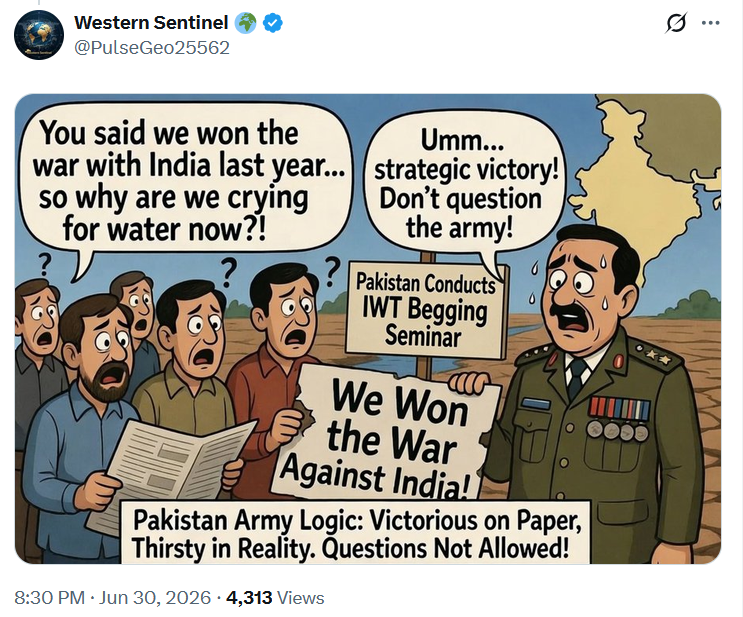
Many posts argued that instead of addressing India’s concerns over terrorism, Pakistan was trying to seek international sympathy through seminars and public statements.
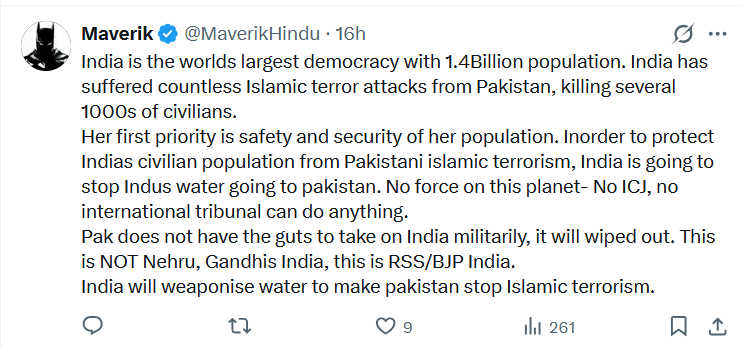
Pakistani ministers continue warning India
Several other Pakistani leaders also used the conference to criticise India’s decision.
Pakistani Senator Musadik Malik claimed that the Indus Waters Treaty had survived three wars between two nuclear powers and warned, “If this treaty doesn’t hold, no world order that is on paper post World War II will remain secure.”
Addressing a press conference, Pakistan’s climate change minister, Malik, warned that Islamabad would “cut off those hands” that he claimed sought to control the Indus water.
Calling the IWT one of the strongest international agreements ever negotiated, Malik argued that international law should be tested by how it protects weaker countries rather than stronger ones. Without naming India, he questioned the value of international treaties if “one powerful country wakes up one day and says the treaty doesn’t apply to me and I unilaterally suspend or put it in abeyance.”
Former Pakistani Foreign Minister and Chairperson of the National Assembly Standing Committee on Foreign Affairs, Hina Rabbani Khar, also urged Islamabad to aggressively pursue legal and diplomatic options. She argued that the treaty “cannot be held in abeyance through political statements or unilateral decisions” and insisted that any modification or termination would require the consent of both governments through a formally ratified agreement.
At the IWT Intl Conference in Islamabad ‘The descent of India into a rogue state is multi dimensional. Claiming to hold in abeyance the robust, enduring, survivor of two wars- Indus Water Treaty- shows that it no more deserves to be sitting in UN General assembly. pic.twitter.com/tGswyB8nb8
— Hina Rabbani Khar (@HinaRKhar) June 30, 2026
Khar further questioned why India believed it could suspend what she described as one of the world’s most successful transboundary water agreements. She expressed concern that the treaty had survived three full-scale wars but was now being challenged through what she called unilateral political decisions.
Information Minister Attaullah Tarar also attempted to portray the conference as a major international event, saying it was the first seminar of its kind as Pakistan sought to strengthen its case against India’s decision.
India makes it clear: No talks until Terrorism ends
Despite Pakistan’s repeated appeals and public statements, India has made it clear that the conference and the statements made there will not change its position.
According to multiple media reports, India will not engage with Pakistan on the Indus Waters Treaty in any form until New Delhi’s concerns regarding cross-border terrorism are addressed and the treaty is comprehensively revamped.
Pakistan’s Water Resources Secretary Syed Ali Murtaza has written several letters to his Indian counterpart, Debashree Mukherjee, requesting India to reconsider its decision and expressing Islamabad‘s willingness to discuss New Delhi’s concerns.
However, India has not responded to any of those letters. New Delhi will not hold any dialogue on the treaty unless Pakistan first takes credible action against terrorism and agrees to a complete overhaul of the agreement.
Responding to remarks by Pakistan’s Defence Minister, Ministry of External Affairs spokesperson Randhir Jaiswal said Pakistan was making “desperate attempts to cover up its own failings.”
#WATCH | "We have placed the Indus Waters Treaty in abeyance and it will remain suspended until Pakistan completely stops cross-border terrorism."
— DD News (@DDNewslive) June 5, 2026
Ministry of External Affairs spokesperson Randhir Jaiswal outlined India's clear position in response to comments made by Pakistan's… pic.twitter.com/mUaXYoaK8Y
“Such remarks are desperate attempts by Pakistan to cover up its own failings and divert attention away from its human rights abuses. We categorically reject these fabricated claims with the contempt they deserve,” Jaiswal said.
India has repeatedly emphasised that its decision to suspend the treaty remains unchanged.
Why India suspended the Indus Waters Treaty?
The Indus Waters Treaty was signed on September 19, 1960, in Karachi by India’s first Prime Minister Jawaharlal Nehru and Pakistan’s President Ayub Khan. Brokered by the World Bank, the agreement governs the sharing of the waters of the Indus River system and its six rivers between the two countries.
For more than six decades, the treaty continued despite several wars and periods of military tension.
However, the situation changed after the Pakistan-sponsored terrorist attack in Pahalgam, Jammu and Kashmir, on 22nd April, 2025, in which 26 civilians were killed. Following the attack, India announced that it was placing the treaty in abeyance, arguing that cross-border terrorism and continued cooperation under the agreement could not coexist.
Prime Minister Narendra Modi declared that “Blood and water cannot flow together,” making it clear that India would no longer separate water cooperation from Pakistan’s support for terrorism.
Since then, India has accelerated hydropower and water infrastructure projects on the western rivers and has indicated that it will maximise the utilisation of water available under its control wherever legally and technically possible. New Delhi has maintained that the Indus Waters Treaty will remain in abeyance until Pakistan takes credible, concrete and irreversible action to dismantle the terror infrastructure operating from its territory.


