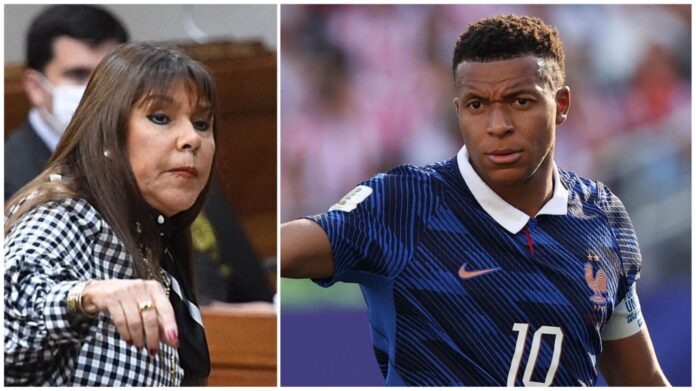
The 2026 FIFA World Cup has produced its fair share of dramatic footballing moments, but one of the tournament’s biggest controversies has unfolded far away from the pitch. What began as anger over a post-match handshake has spiralled into a diplomatic row involving accusations of racism, sexism, legal threats, government interventions, and international condemnation.
At the centre of the storm are Paraguayan Senator Celeste Amarilla and France captain Kylian Mbappé. The feud reached a fresh low when Amarilla called the French footballer a “son of a b**” during a speech on the Senate floor, days after Mbappé allegedly described her as a “despicable woman and unworthy of her office.”
What exactly triggered the unprecedented exchange? Why has the controversy attracted the attention of FIFA, the United Nations, the French government, and Paraguay’s own administration? Here’s everything that has happened so far.
The match that sparked the controversy
The dispute traces its origins to France’s tense 1-0 victory over Paraguay in the FIFA World Cup Round of 16.
The encounter was fiercely contested, with Mbappé eventually scoring the decisive goal from the penalty spot to send France into the quarter-finals. However, instead of discussions centring on the football, attention soon shifted to an alleged incident after the final whistle.
According to Amarilla, Mbappé refused to shake hands with Paraguay goalkeeper Orlando Gill, who had reportedly approached him after the match. The senator claimed the French forward shouted at the goalkeeper and dismissed his gesture.
Whether the interaction unfolded exactly as Amarilla described remains disputed, but she has repeatedly cited the alleged snub as the principal reason behind her criticism of the French striker.
Speaking in Paraguay’s Senate, Amarilla said:
“When Orlando Gill, a boy who was surely setting foot in a World Cup for the first time, in Europe for the first time, was playing before the world and extends his hand with all the humility of a Paraguayan, and this son of a b**** refuses to shake his hand and yells in his face, that is not French. A Frenchman would never have done that.”
The remarks represented yet another escalation in an already bitter public feud.
The controversy began with racial remarks
The senator’s latest insult came only after she had already attracted global condemnation for making racial comments against Mbappé.
In a series of social media posts following Paraguay’s defeat, Amarilla described the French captain as a “colonised Cameroonian” who had merely “pretended to be French.”
She further labelled him arrogant, embittered, ugly, nouveau riche, and cowardly.
She also mocked his education and repeatedly questioned his French identity despite Mbappé being born and raised in France.
The remarks immediately drew outrage across Europe and Latin America.
Critics pointed out that questioning a French citizen’s nationality because of his African heritage echoed a form of racial discrimination that many European footballers have faced throughout their careers.
Mbappé hits back
Unlike many footballers who choose to ignore political criticism, Mbappé publicly responded.
The France captain accused Amarilla of racism and said she had brought embarrassment to Paraguay rather than honour.
He reportedly wrote that the senator was “unworthy” of the office she occupies and stressed that she did not represent Paraguay or its people.
Mbappé also argued that Amarilla’s comments had overshadowed Paraguay’s impressive World Cup campaign.
He added that he would never allow racism and hatred to spread unchecked, regardless of who expressed it.
His response only intensified the confrontation.
Amarilla demands an apology, and threatens legal action
Instead of withdrawing from the dispute, Amarilla published an extraordinary open letter addressed directly to Mbappé.
While she admitted that some of her earlier comments had been made “in the heat of the moment” and acknowledged deleting several offensive posts, she demanded that Mbappé apologise to her.
She argued that calling her “despicable” and “unworthy” amounted to gender-based political violence.
The senator claimed she could initiate legal proceedings against the footballer under laws dealing with violence against women in politics.
She wrote:
“This is gender-based violence, plain and simple.”
She insisted that Mbappé retract his remarks or face possible legal consequences.
In another dramatic warning, Amarilla invoked the case of Brazilian football legend Ronaldinho, who was detained in Paraguay in 2020 over passport-related offences.
“Don’t mess with Paraguayans,” she warned.
The “son of a b****” remark
Far from calming the situation, Amarilla reignited the controversy this week by using even stronger language inside the Paraguayan Senate.
Referring once again to the alleged handshake incident involving Orlando Gill, she called Mbappé a “son of a b**.”
She also sought to distinguish the French footballer from France itself.
According to Amarilla, France represents the intellectual traditions of philosophers such as Jean-Jacques Rousseau, René Descartes and Montesquieu, writers like Victor Hugo, and thinkers including Simone de Beauvoir.
“I refuse to reduce all of that great France and that enormous cultural, artistic and democratic legacy to Mbappé,” she declared.
United Nations condemns Amarilla’s remarks
The controversy soon moved beyond football.
The United Nations Human Rights Office condemned Amarilla’s comments, describing them as racist and dehumanising.
UN human rights spokesperson Thameen Al-Kheetan stated that the senator’s remarks were “despicable” and highlighted the persistence of racism directed at footballers around the world.
The intervention by the UN significantly elevated what had initially appeared to be a sporting controversy.
Paraguay distances itself from its own senator
The Paraguayan government also moved quickly to clarify that Amarilla’s views did not represent the country’s official position.
The country’s Foreign Ministry issued a statement condemning her comments and reaffirming Paraguay’s commitment to human dignity, equality, human rights, opposition to racism, and opposition to xenophobia.
The ministry further expressed solidarity with those offended by Amarilla’s statements and reiterated Paraguay’s respect for France.
Such public distancing from a sitting senator is relatively rare and underscored the seriousness with which the government viewed the diplomatic fallout.
FIFA and France respond
The controversy also prompted reactions from football authorities.
Gianni Infantino said FIFA unequivocally condemned the racist abuse directed at Mbappé.
Meanwhile, the French Football Federation announced plans to pursue criminal legal action over Amarilla’s comments.
The federation described the senator’s remarks as unacceptable and contrary to football’s commitment against discrimination.
France’s public prosecutor also reportedly opened an investigation after receiving complaints relating to aggravated public insult and incitement to hatred.
President Macron backs Mbappé
French President Emmanuel Macron also entered the debate.
Posting on social media, Macron wrote:
“Another goal for Kylian Mbappé. Against racism this time.”
He added that France’s response would always be rooted in dignity, fraternity and respect.
The presidential intervention reflected how the controversy had evolved from a football dispute into an issue touching national identity and racial discrimination.
France coach says Mbappé remains focused
Despite the growing off-field drama, France manager Didier Deschamps insisted the controversy had not affected his captain.
Ahead of France’s World Cup quarter-final against Morocco, Deschamps told reporters:
“Kylian is in a good place mentally. He’s ready for tomorrow.”
France have attempted to keep the matter from becoming a distraction during their World Cup campaign.
Another controversy involving Paraguay
Interestingly, Amarilla was not the only Paraguayan public figure to attract criticism during the World Cup.
Former Paraguay goalkeeper José Luis Chilavert also sparked outrage before the France match by suggesting Paraguay would face “a squad from Africa” rather than France.
His comments were widely criticised as racially insensitive and further intensified scrutiny of anti-Black rhetoric surrounding the tournament.
Beyond football: Where criticism crosses the line
Sport naturally evokes passion. Players can be criticised for poor performances, controversial conduct or perceived arrogance. If Mbappé indeed refused a post-match handshake, fans and commentators are entitled to debate whether that reflected poor sportsmanship.
However, there is a fundamental distinction between criticising behaviour and attacking someone’s race, ancestry or identity.
Amarilla’s initial comments did not merely question Mbappé’s conduct. By referring to him as a “colonised Cameroonian” who was only “pretending to be French”, she challenged his legitimacy as a French citizen because of his ethnic background. That is precisely why her remarks drew condemnation from the United Nations, FIFA, the French government and even Paraguay’s own administration.
Her subsequent attempt to partially retract the racial insults while simultaneously escalating the personal feud, culminating in calling Mbappé a “son of a b****” in Parliament, has done little to repair the damage.
Likewise, if Mbappé indeed described the senator as “despicable” and “unworthy of office”, those remarks reflect the heated nature of the exchange. But equating criticism from a footballer with gender-based political violence while continuing to use abusive language herself has struck many observers as contradictory.
A controversy that overshadows football
Paraguay’s remarkable World Cup campaign should have been remembered for exceeding expectations and reaching the knockout stages. France’s victory should have been discussed in terms of Mbappé’s match-winning performance and Les Bleus’ march towards another World Cup title.
Instead, the tournament has become engulfed in a row that has drawn in politicians, football administrators, international organisations and heads of state.
With criminal complaints reportedly under consideration, diplomatic statements issued by governments, and global condemnation of racist rhetoric, what began as a dispute over a handshake has transformed into one of the most extraordinary off-field controversies of the 2026 FIFA World Cup.
Whether the exchange ends with apologies, legal proceedings or continued public confrontation, it has already demonstrated how quickly sporting rivalries can spill into politics, and how remarks made in the heat of the moment can overshadow achievements on the football pitch.