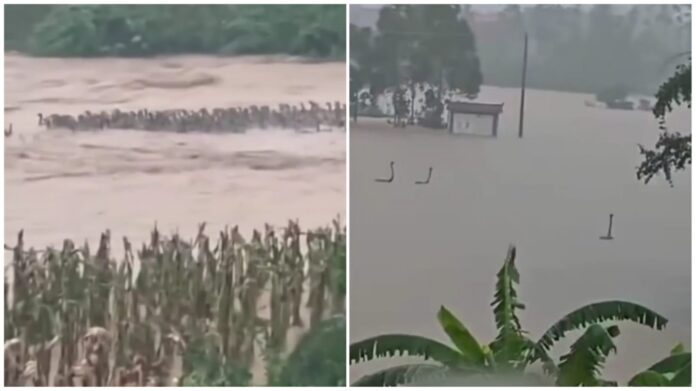
Social media has been awash with chilling videos showing hundreds of snakes slithering through murky floodwaters in China’s Guangxi Zhuang Autonomous Region after devastating floods triggered by Typhoon Maysak destroyed a snake breeding farm. One widely shared clip shows hundreds of snakes, many with their hoods raised above the muddy water, being swept through submerged streets as floodwaters surged through the area.
Çin'de etkili olan sel bir barajı çökertti, su altında kalan çiftlikten yaklaşık 900 yılan kaçtı.
— TRT HABER (@trthaber) July 10, 2026
Aralarında ölümcül kobraların da bulunduğu yılanların sardığı Dengwei köyünde 'acil durum' ilan edildi.https://t.co/OfduOGXqWp pic.twitter.com/uAAXSUf35u
The dramatic visuals quickly went viral, sparking alarm across social media as reports emerged that nearly 900 snakes, including several venomous cobras, had escaped into nearby villages after the floodwaters breached a commercial snake farm.
Nearly 900 snakes escape after flood destroys breeding farm
The incident unfolded in Dengwei village near Hengzhou city in southern China’s Guangxi region, where days of torrential rainfall caused rivers and reservoirs to overflow, inundating large parts of the countryside.
According to local authorities, floodwaters destroyed a snake breeding facility, allowing approximately 800 to 900 snakes to escape into surrounding farmland, residential areas and flooded roads.
Officials confirmed the incident earlier this week and immediately issued public safety warnings, urging residents to remain indoors, avoid entering floodwaters and report any snake sightings instead of attempting to capture the reptiles themselves.
Emergency response teams comprising local officials and villagers were deployed with fishing nets and specialised capture equipment to recover the escaped snakes.
Videos released by Chinese state media showed rescue personnel searching through debris while snakes floated on stagnant floodwater or clung to piles of garbage carried by the floods.
Venomous cobras among the escaped reptiles
Authorities said the majority of the escaped reptiles were non-venomous species such as water snakes and king ratsnakes, which are commonly bred on commercial snake farms.
However, several venomous cobras also escaped, prompting authorities to issue emergency advisories on preventing snake bites and avoiding unnecessary movement through flooded areas.
Local reports said at least one resident was bitten by a snake and taken to hospital for treatment.
Officials later said many of the escaped snakes had either been swept away by strong flood currents, drowned or dispersed as water levels gradually receded, reducing the long-term threat to nearby communities.
Typhoon Maysak leaves trail of destruction.
The snake escape occurred amid one of Guangxi’s worst flood emergencies in recent years.
Typhoon Maysak brought relentless rainfall to southern China, triggering flash floods, overflowing reservoirs, landslides and extensive infrastructure damage across the region.
The flooding forced hundreds of residents to evacuate as embankments failed and villages were submerged. Although water levels have begun receding in some areas, weather authorities have warned that additional rainfall could hamper recovery operations and trigger fresh flooding.
Why does China have snake farms?
While the viral videos shocked viewers worldwide, commercial snake farming is a well-established industry in China.
The Dengwei facility reportedly bred three primary species, cobras, king ratsnakes and water snakes, for multiple commercial purposes.
Traditional Chinese medicine
Snake parts, particularly venom, gall bladders, skin and meat, have long been used in traditional Chinese medicine. Snake venom is processed into medicines believed to help treat neurological disorders, arthritis and certain inflammatory conditions, although the effectiveness of many traditional remedies remains scientifically debated.
One of the most famous and profitable products is snake wine. Whole snakes, often venomous, are steeped in high-proof rice wine for months or even years. Consumed in small daily doses, it is traditionally used as a tonic to relieve arthritis and boost overall vitality.
Antivenom production
One of the most important uses of snake farming is the extraction of venom for producing life-saving antivenom. Pharmaceutical laboratories use carefully collected venom to manufacture treatments for victims of venomous snake bites, making regulated snake farms an important part of China’s medical supply chain.
Meat and leather industry
Snake meat is considered a delicacy in parts of southern China and is served in soups, stir-fries and traditional dishes. Snake skins are also used in the leather industry to manufacture handbags, belts, wallets and other luxury products.
Scientific research
Some breeding facilities also supply snakes for biological and pharmaceutical research, particularly studies involving venom proteins that could lead to new medicines.
Culinary Demand
Snake meat is a deeply rooted culinary tradition, particularly in southern provinces like Guangdong. China processes tens of millions of pounds of snake meat annually. Dishes like snake soup are revered not just for their flavour, but for their perceived health benefits, such as warding off colds and increasing longevity.
A terrifying reminder of nature’s unpredictability
Floods frequently force wild animals out of their habitats, but the Guangxi incident was particularly alarming because it involved hundreds of captive snakes escaping simultaneously from a commercial breeding facility.
Although officials believe the immediate danger has diminished as floodwaters continue to recede, the viral footage of cobras gliding through muddy streets has left many online users stunned.
For residents of Dengwei village, however, the terrifying images were not merely social media content, they were an unsettling reality, as floodwaters transformed their neighbourhood into an unexpected habitat for hundreds of slithering reptiles.