

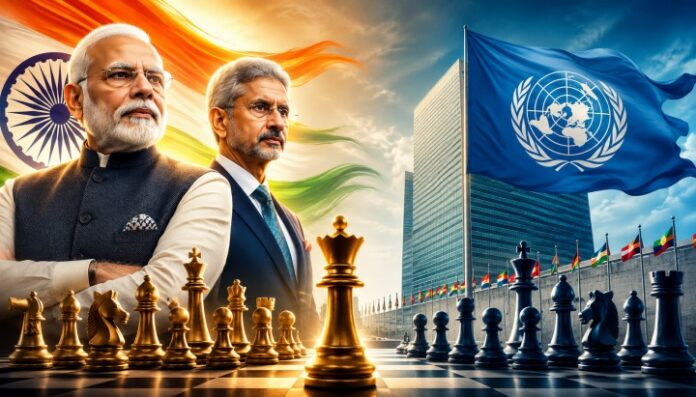
At the United Nations this summer, two clocks are running at once, and India has a hand in both. On Monday, External Affairs Minister S. Jaishankar stood in a hall at UN Headquarters with the East River just outside and launched India’s campaign for a non-permanent Security Council seat for 2028-29.
If it succeeds, it will be the country’s ninth time on the Council. A few floors away, in quieter rooms where decisions are usually kept close, the Security Council has already begun the discreet process of finding someone to replace António Guterres when his term ends in December. The two exercises rarely share the same news cycle, yet together they show how influence actually moves inside the UN system these days.
India formally launches its campaign for United Nations Security Council 2028-2029. pic.twitter.com/RUnu1akAYe
— Dr. S. Jaishankar (@DrSJaishankar) July 13, 2026
1). India’s campaign for the UN Security Council 2028-29
How a non permanent seat is won?
Ten of the fifteen seats on the Security Council rotate. They’re filled by the General Assembly’s 193 members through a secret ballot that requires a two-thirds majority. By long-standing regional understanding, the seats are divided roughly this way: three for Africa, two for Asia-Pacific, one for Eastern Europe, two for Latin America and the Caribbean, and two for the Western Europe and Others group. The winners serve two-year terms alongside the five permanent members, China, France, Russia, Britain and the United States, who hold the veto.
Regional groups usually try to line up behind a single candidate well before the vote reaches the Assembly floor. That’s why many of these elections look cleaner on paper than they actually are. Even so, consensus doesn’t always mean everyone is on board. When India ran for the 2021-22 term, the one it remembers most clearly, it had the full endorsement of the 53 member Asia-Pacific group and no rival in sight, yet still collected eight anonymous ‘no’ votes among the 184 cast in its favour. Secret ballots have a way of keeping their own counsel. Some countries think even further ahead. Malaysia has already started lobbying for a seat in 2035, with the Organisation of Islamic Cooperation’s backing since 2023.
SHANTI: The vision behind the vote
Minister of External Affairs S. Jaishankar built his pitch around one word, SHANTI. He explained it as ‘Securing Holistic Advancement through Norms, Trust and Integrity.’ The choice was deliberate. Shanti means peace in Sanskrit and Hindi, and he used it as the thread running through six priorities India wants the Security Council to focus on, giving the Global South a stronger voice on peace and security, making the multilateral system more democratic and effective, bringing modern technology into peacekeeping, taking a human centred approach to artificial intelligence, protecting a free and rules based maritime order, and stepping up cooperation against terrorism and its financing while keeping the Women, Peace and Security agenda alive.
It’s a wide-ranging agenda, but it holds together. India has sent close to 300,000 peacekeepers to roughly fifty UN missions since the Organisation was founded, a record Jaishankar returned to several times during his remarks. The focus on counter-terrorism also carried a clear echo from India’s last term on the Council. During its October 2021 presidency, India arranged for the Council to meet in Mumbai so members could hear directly from survivors of the 2008 attacks before discussing how extremists are now exploiting new technology. Jaishankar closed by saying that a Council serious about delivering results needs a voice from the Global South at its table.
One continuous minister at the helm
India has already sat on the Council as an elected member eight times, 1950-51, 1967-68, 1972-73, 1977-78, 1984-85, 1991-92, 2011-12, and most recently 2021-22, and is now reaching for a ninth. What stands out isn’t the total so much as the gaps between some of those terms. Nineteen years passed between the 1991-92 and 2011-12 stints, and this campaign has been deliberately launched early to avoid another long drought.
There’s also a quieter thread of continuity. Jaishankar has been External Affairs Minister since May 2019, longer than anyone else has held the post on its own in recent decades. That means the same person who oversaw India’s successful, unopposed campaign for the 2021-22 seat six years ago is the one who, this week, personally opened the bid for 2028-29. It’s hard to say whether any other foreign minister across the globe has quite so directly bookended two Council campaigns. What’s clear is that India’s institutional memory of how to win these arguments hasn’t had to change hands.
The Tajikistan contest
India isn’t running unopposed this time. Tajikistan has already declared its candidacy for the same Asia-Pacific seat that Bahrain will vacate at the end of 2027, with the Organisation of Islamic Cooperation’s support since 2023 on the principle of Islamic solidarity. The OIC is no small player; it has 56 members in the General Assembly, and India will still need two-thirds of all 193 votes when the Assembly votes in June 2027, not just a simple majority.
Even so, India enters the race with some real structural advantages. Its diplomatic and economic footprint is far larger than Tajikistan’s, it has eight previous terms on the Council while Dushanbe has none, and it already has early declared support from countries as different as Fiji, the United States, Austria and Sri Lanka. None of that makes the two-thirds threshold automatic, and New Delhi isn’t treating the contest as a formality. Jaishankar’s recent swing through Qatar, Bahrain, Kuwait and Oman just before arriving in New York was, in part, an early investment in the kind of vote-gathering such margins require. But the underlying arithmetic still leans comfortably in India’s favour.
The Modi-Jaishankar doctrine behind the diplomacy
None of this sits apart from the larger shift in Indian foreign policy since 2019, what analysts have come to call the Modi-Jaishankar doctrine, or simply multi-alignment. It means dealing with Washington, Moscow, Beijing, Brussels and the Gulf at the same time, and on India’s own terms, instead of anchoring itself to any one bloc. You could see the approach in the very fortnight around the SHANTI launch.
S. Jaishankar arrived in New York from the Gulf and left for Brussels and the EU-India Trade and Technology Council. The UNSC bid itself carries the same signature: India positions itself both as a power the West actively courts and as the self-described voice of the Global South.
The strategy carries real costs, which is part of what makes it a doctrine rather than simple convenience. Washington has slapped tariffs over India’s continued purchase of discounted Russian oil, and India has stayed outside arrangements like AUKUS. Western commentators sometimes frame these choices as evasive rather than principled. New Delhi’s quiet counter, visible in a campaign like this one, is that the results themselves make the case. A country willing to talk to everyone turns out to be a country most of the General Assembly is prepared to vote for.
2). The election of the next United Nations Secretary General
The UN Charter is deliberately brief on this. Article 97 simply says the Secretary-General shall be appointed by the General Assembly upon the recommendation of the Security Council. Almost everything else- the length of the term, how the selection actually happens, and the political choreography around it- has been worked out through custom and precedent rather than formal rules. The Assembly fixed the term at five years, renewable once, way back in 1946. António Guterres is now finishing his second term and will leave office on 31 December 2026. His successor will take over on 1 January 2027 as the UN’s tenth Secretary-General.
How the world chooses its top diplomat
Since a 2015 reform, the process has become far more open than the old closed door bargaining of the Cold War era, when the Council would simply meet in private until a name eventually surfaced. The old way could produce strange results. In 1981, a deadlock between China and the United States over a third term for Kurt Waldheim dragged on through sixteen inconclusive rounds before the Council finally settled on Javier Pérez de Cuéllar, a relatively unknown candidate who had barely campaigned at all.
These days, countries put forward nominees who must submit a vision statement, a CV and campaign financing disclosures. The candidates then appear in public ‘interactive dialogues’ with the General Assembly, this year’s were held in April in the Trusteeship Council chamber, the same room once used for decolonisation debates. The real decision, though, still happens behind closed doors. The Security Council runs a series of private straw polls in which members rate each candidate as ‘encourage,’ ‘discourage’ or ‘no opinion.’ In the later rounds the five permanent members vote on red paper, so a ‘discourage’ from Beijing, Moscow, Paris, London or Washington, an early hint of a veto, shows up clearly without anyone having to call a formal vote. A candidate needs nine encouraging votes and no red “discourage” marks to be recommended. The Assembly then makes the appointment, traditionally by acclamation.
Why this choice matters now?
Little of this makes headlines outside UN circles, but the office still carries real weight. The Secretary-General sets budget priorities, appoints senior officials in peacekeeping and humanitarian affairs, and increasingly helps shape rules on issues the Charter’s drafters never imagined, from climate finance to the governance of autonomous weapons.
The selection is unfolding at a particularly awkward moment. The Security Council has been gridlocked over Gaza, Ukraine and Iran, UN finances are stretched, and confidence in multilateral institutions has eroded. There is also a sharper debate this time around about representation. In eighty years and nine Secretaries-General, the post has never gone to a woman. General Assembly President Annalena Baerbock has noted that the outcome will show whether the United Nations actually reflects the diversity of the people it claims to serve.
For India the stakes are practical. The next Secretary General will have a say on peacekeeping reform, development financing and technology governance, areas where New Delhi has been quietly urging stronger and more consistent engagement with the Global South, something the outgoing Secretariat has struggled to maintain amid the crises in Kyiv, Gaza and Tehran.
The contenders
Six candidates were formally nominated this cycle, though the field has already narrowed by one. Virginia Gamba, put forward by the Maldives as the Asia-Pacific group’s candidate, withdrew before the interactive dialogues began, leaving that region without a nominee even as India campaigns for its own non-permanent Council seat. Of the five who remain, four come from Latin America and the Caribbean, which has fed an informal sense that the job is ‘due’ to the region after decades without one, alongside a stronger argument that it is long overdue for a woman.
Rafael Grossi of Argentina, who has led the International Atomic Energy Agency since 2019, was the first to enter, in November 2025, with backing from Argentina, Italy and Paraguay. His record is the most contentious in the field. As the IAEA’s chief inspector during the Iran nuclear crisis, including the June 2025 flare up between Israel, the United States and Iran, he has been accused by Tehran of political bias, cooperation with his agency was suspended, even as France, Germany and Britain defended his independence. His handling of Ukraine’s occupied Zaporizhzhia nuclear plant has drawn quieter versions of the same criticism.
Michelle Bachelet of Chile, who served twice as her country’s president and as UN High Commissioner for Human Rights from 2018 to 2022, entered in February with the unusual support of three governments, Brazil, Mexico and Chile, though Chile later withdrew its sponsorship under a new administration, leaving Brazil and Mexico to carry her bid. Her record carries a specific complication for India. During three successive Human Rights Council sessions as Commissioner, she pressed New Delhi on Kashmir, from the 2019 communications lockdown to preventive detention laws, and each time Indian diplomats formally objected, once describing her remarks as simply ‘unwarranted.’ Whether this reflects a rights mandate applied evenly to a large democracy or a blind spot on Indian sovereignty remains genuinely disputed, but the friction, unlike almost anywhere else in this field, is real and repeated.
Rebeca Grynspan of Costa Rica, the first woman and first Central American to head the UN Conference on Trade and Development, has campaigned on developing world debt relief and helped broker the Black Sea Grain Initiative. Of the five, her priorities sit closest to India’s own Global South advocacy, and no comparable controversy attaches to her name.
María Fernanda Espinosa of Ecuador, nominated not by her own country but by Antigua and Barbuda, already made history in 2018 as only the fourth woman, after India’s own Vijaya Lakshmi Pandit in 1953, to preside over the General Assembly; nothing serious in her record touches India either.
Macky Sall of Senegal, nominated by Burundi rather than his own country, is the field’s most politically damaged figure. As president, he postponed Senegal’s February 2024 election weeks before voting, triggering accusations of a ‘constitutional coup’ and the forcible removal of opposition lawmakers from parliament, before courts forced him to relent. Senegal eventually held a competitive election, and Sall left office on schedule, but the episode remains the defining fact of his candidacy.
Conclusion
New Delhi has not declared any preference among the five candidates and has said little in public beyond general support for a transparent, merit based process. The studied neutrality is useful for a country that is simultaneously trying to gather votes from all of them for its own Council bid. India’s deeper interest lies less in personalities than in how the system itself is structured. It has long argued that expanding only the non-permanent category would achieve very little if the real centres of decision-making power remain exactly where they have sat since 1945.
Whoever becomes the tenth Secretary General this autumn will inherit that argument still unresolved, and will have to decide fairly early how seriously to engage the countries, India foremost among them, that regard it as the United Nations’ oldest unfinished business.


