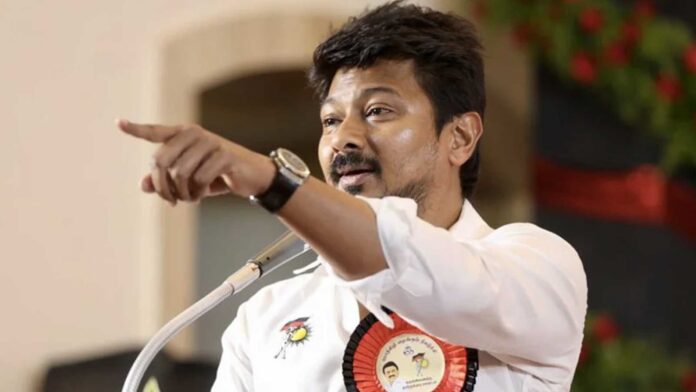
The arrest of DMK leader Udhayanidhi Stalin over his alleged vulgar remarks targeting actor Trisha Krishnan has once again put the Tamil Nadu minister’s political style under the spotlight. While the DMK has predictably dismissed the action as “political vendetta,” the controversy is part of a much longer pattern.
For years, Udhayanidhi Stalin has built a reputation for making inflammatory remarks, seemingly secure in the belief that outrage would only strengthen his political brand.
His latest controversy stems from a public rally in Thanjavur, where he responded to chants of actor Trisha’s name with an offensive double entendre. The remarks prompted complaints from the Tamilaga Vettri Kazhagam (TVK), BJP leaders, and appeals to the National Commission for Women, who argued that such comments normalise the objectification of women in public life.
Yet, if there is one episode that best encapsulates Udhayanidhi Stalin’s penchant for reckless rhetoric, it is his infamous September 2023 speech calling for the “eradication” of Sanatana Dharma.
Comparing Hinduism to diseases
On 2 September 2023, Udhayanidhi Stalin attended the so-called “Eradicate Sanatan Conference” organised by the Tamil Nadu Progressive Writers and Artists Association in Chennai. Rather than distancing himself from the event’s provocative title, he openly endorsed it.
“The title of this conference has been excellently coined. You’ve named it ‘Eradicate Sanatan Conference’ and not ‘Oppose Sanatan Conference’,” he declared, congratulating the organisers.
He then proceeded to compare Sanatana Dharma to diseases and pests.
“Mosquitoes, dengue, flu, malaria, corona, we should not oppose these things. They have to be eradicated. The same is the case with Sanatanam.”
The analogy sparked nationwide outrage because it went far beyond criticism of religious practices or social customs. By equating Sanatana Dharma, a faith followed by hundreds of millions of Hindus, with diseases that must be eliminated, Stalin crossed into rhetoric that many viewed as openly hateful towards an entire religious tradition.
He did not stop there.
Attempting to justify his position, Udhayanidhi claimed that Sanatana Dharma represented inequality, caste discrimination, and opposition to social justice. He asserted that it was something “eternal” that could not be questioned and therefore deserved abolition rather than debate.
Following the event, he reiterated his position on social media, stating that they would continue their efforts to eliminate Sanatan.
A government minister at an anti-Hindu platform
The controversy was amplified because Udhayanidhi was not merely a party functionary but a serving minister in the Tamil Nadu government. The conference was also attended by HR&CE Minister P.K. Sekarbabu and several prominent leaders from the DMK and its ideological allies, including Dravidar Kazhagam chief K. Veeramani, VCK leader Thol. Thirumavalavan, Congress leader Peter Alphonse, CPI(M) representatives, and others.
The participation of ministers at an event explicitly advocating the “eradication” of Sanatana Dharma strengthened criticism that the DMK government was lending legitimacy to rhetoric directed against Hindu beliefs while simultaneously controlling thousands of Hindu temples through the state’s HR&CE Department.
A pattern of provocation
The Trisha controversy therefore appears less like an isolated lapse and more like another chapter in a recurring pattern.
Whether it was comparing Hinduism to dengue and malaria, celebrating an event dedicated to the “eradication” of Sanatana Dharma, or now allegedly making vulgar insinuations about a woman actor during a political rally, Udhayanidhi Stalin has repeatedly chosen provocation over restraint.
Political disagreement is a legitimate feature of democracy. Criticising religious practices, governments, or opponents is protected political speech. However, rhetoric that likens an entire faith to infectious diseases or uses objectionable remarks against women inevitably attracts scrutiny and backlash.
Speech has consequences
Udhayanidhi Stalin reportedly described his arrest as a “joke” and said he would challenge it legally. Whether the case ultimately results in conviction or dismissal will be decided by the courts.
What is beyond dispute, however, is that public figures occupy positions of influence. Their words shape political discourse, social attitudes, and public behaviour. The repeated use of inflammatory language may generate headlines and energise partisan supporters, but it also deepens divisions and lowers the standards of democratic debate.
The latest controversy is therefore not simply about one allegedly vulgar remark aimed at an actor. It is a reminder of a political career that has repeatedly courted outrage, from calling for the “eradication” of Sanatana Dharma to making comments that opponents now say demean women in public life. Regardless of where one stands politically, it illustrates a broader truth: leaders who repeatedly push the limits of acceptable public discourse should not be surprised when their words eventually invite legal and political consequences.