

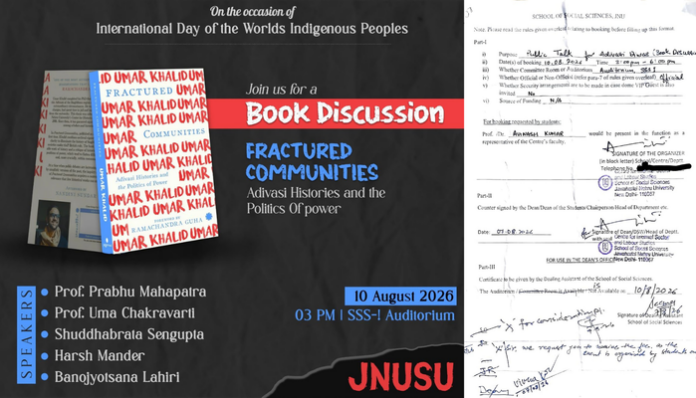
Jawaharlal Nehru University (JNU) on Sunday (9th August) cancelled the booking of its SSS-1 auditorium by the JNU’s Students Union (JNUSU) for a “book discussion” event, organised to discuss a book by Umar Khalid, that was slated to take place on 10th August. According to the notice issued by JNU Joint Registrar MK Pachauri, the booking was cancelled because of non-disclosure of full details of the proposed event in the request form submitted to the university.
“The booking of the auditorium SSS-1 stands cancelled because of non-disclosure of the full facts about the program which is going to take place on 10th August 2026 from 3 pm to 6 pm,” the university administration stated.
JNU is a democratic and decentralised institution. The permission was given by Dean, SSS who has taken action as well in cancelling the event.
— Jawaharlal Nehru University (JNU) (@JNU_official_50) August 9, 2026
The booking of the auditorium SSS-1 stands cancelled because of non-disclosure of the full facts about the program which is going to… pic.twitter.com/SsEsMO3muT
The request form shared by the university in a post on X cited “Public Talk for Adivasi Diwas (Book Discussion)” to mark Adivasi Diwas (Tribal Day) as the purpose of the booking. The auditorium was booked by Dr Avinash Kumar of the Centre for International Legal Studies (CISLS).
The proposed discussion was scheduled to take place on August 10 from 3 pm to 6 pm and was to be attended by the likes of Prof. Prabhu Mohapatra, Prof. Uma Chakravarti, Shuddhabrata Sengupta, and Harsh Mander. The permission for the stated event was granted by the Dean, SSS, who later cancelled it a day before the scheduled discussion.
The JNU notice of cancellation of the event did not cite what facts related to the event were not disclosed. However, a poster of the event shared by the university showed that the discussion was on a book titled ‘Fractured Communities: Adivasi Histories and the Politics of Power’. As visible in the poster, the book was a work of Delhi anti-Hindu riots accused Umar Khalid, whose name was printed all over its cover page.
The request for the booking submitted to the university omitted to mention that the proposed discussion was about Khalid’s book. According to India Today, this was the reason that the university cancelled the event.
Essentially, JNUSU along with those like Harsh Mandar and Banojyotsna Lahiri (Umar Khalid’s girlfriend) told the university that they need to hall to conduct a program for Adivadi Divas. They completely ommitted the fact that actually, they wanted to hall to conduct a discussion on Umar Khalid’s book. For context, Umar Khalid is accused under the UAPA and is currently in jail for being the mastermind of the Delhi anti-Hindu riots.
According to an Instagram post by Umar Khalid’s girlfriend Banojyotsana Lahiri, the book was actually Khalid’s PhD thesis published in the form of a book by Juggernaut Books. Lahiri wrote an emotional message celebrating her UAPA-accused boyfriend’s ‘achievement’ and portraying the Delhi anti-Hindu riots conspirator as a victim of state atrocities.
Umar Khalid, a former JNU student leader and co-founder of ‘United Against Hate’, was arrested in September 2020 over the anti-Hindu riots that broke out in north-east Delhi in February that year. The riots erupted during protests against the Citizenship Amendment Act and led to the killing of 53 people and injured more than 700. According to the Delhi Police case, Khalid helped plan the violence, as part of what police call a ‘larger conspiracy,’ carried out through speeches, WhatsApp groups and planned road blockades timed for maximum disruption. The case against Khalid runs under the stringent anti-terror law, the Unlawful Activities (Prevention) Act (UAPA).
Khalid’s had made multiple bail applications before various courts since his arrest. His bail applications have repeatedly been dismissed by the courts, citing a prima facie case against him.
How the Delhi anti-Hindu Riots conspiracy started: A short chronology
Most chargesheets filed in the Delhi anti-Hindu riots case so far have a detailed chronology of events attached to them which starts from the events of December. One has to recall that on the 15th of December, violence broke out in Jamia Millia Islamia. The chargesheet says that some students, ex-students of Jamia and people associated with political parties congregated to protest the CAA and NRC and wanted to march towards the Parliament House and Presidents House. When stopped, they started pelting stones and indulging in violence.
In the process, busses were burnt, cars were damaged, 2 public persons got injured and 10 police personnel also suffered injuries.
It is interesting to note that while the violence broke out on the 15th of December, on the 14th of December, Sharjeel Imam had delivered his provocative speech at the very site. He had urged Muslims to protest against CAA and NRC by doing ‘chakka jam’ on the 14th of December. On the 15th of December, protestors tried to block Mathura road and violence ensued.
Following this, the dispersing crowd retreated inside Jamia and a fresh cycle of violence started. The usual suspects had proceeded to blame the police was trying to enter a college campus and brutalising students, however, the truth was far from it. It was in fact these ‘students’ who had started the violence and the police were merely trying to control the violence.
The chargesheet mentions that right after the violence of 15th December, Jamia Coordination Committee was coordinating protests and blockages of roads. They had called several leaders to speak to the protesting Muslims as well. The chargesheet mentions Harsh Mandar who had instigated people on the 16th of December (though he has not been named as an accused so far).
The Shaheen Bagh protest then started, on cue, from the 15th of December. While the Shaheen Bagh protest raged on, on the 17th of December, violent mobs started pelting stones in the Jaffrabad area.
Thereafter, from the 15th of January, Muslim protestors blocked roads in 7 different areas in the name of protests. Provocative slogans were raised and incalculable inconvenience was caused to commuters.
Here are the 7 roads that were blocked:
- Seelampur – Opposite Medina Masjid (from the 15th of January)
- Dayalpur – Brijpuri Pulia near Farrukhia Masjid (from the 17th of January)
- Dayalpur – Chand Bagh Majar on Bhajanpura (from 17th of January)
- Jyoti Nagar – Kardam Puri Pulia near Ashharfia masjid (from 17th of January)
- Khajuri Khas – A block main road, Shri Ram Colony (from 17th of January)
- Bhajanpura – Noor-e-Lahi near petrol pump (from 18th January)
- Shastri Park – Near Wahid Jama Masjid (from 26th of January)
It is pertinent to note that people from the Chand Bagh Mazar protest site had also tried to block the main Wazirabad Road.
The chargesheet categorically states that the riots were pre-planned and not spontaneous. On the 22nd of January night, woman, children and several Muslims protestors blocked the Jaffrabad metro station after Chandrashekhar Azad’s call for Bharat Bandh. It is pertinent to note that is also said that Pinjra Tod and JCC were instrumental in the instigation and implementation of blockage of Jaffrabad metro station. On the 23rd, there was a counter rally which demanded the opening of the road that had been blocked by anti-CAA crowds. The Muslim side started pelting stones first, as even mentioned in the chargesheets. On the 24th, full-fledged riots began with the first life being claimed being that of constable Ratan Lal after being attacked by a Muslim mob.
Where does Umar Khalid fit into the chronology of events – Analysing his role
The first evidence of Umar Khalid’s role in the Delhi Riots came when a speech made by him surfaced. The speech was allegedly made on the 20th of February in Amravati. In the speech, he was clearly heard saying that on the 24th of February, when President Donald Trump visits India, Muslims should ‘show’ the visiting US president that the people of India are fighting against the ruling party of India.
The entire speech was about 17 minutes long where Khalid invoked the false narratives of ‘targeted mob lynching’ against Muslims and then went on to say that when the Muslims did not revolt against the Ayodhya judgement by Supreme Court, the government took it for granted that they can bring any law against Muslims.
Inciting the crowd further, saying the CAA has been brought to harm Muslims, Khalid says that the people should show the government its ‘Aukaad’, and take to the streets to throw it out. He further says that if enough people take to the streets, first the CAA will go, then the NPR and then NRC, eventually the government will also go.
It was 4 days after this speech, on the 24th of February, as Umar Khalid had predicted, that riots broke out. Ankit Sharma was stabbed over 50 times by the mobs of Tahir Hussain. Dilbar Negi’s arms and legs were chopped off and he was burnt alive by Muslims. Amidst chants of Allahu Abkar and Nara e Taqbeer, Hindus were specifically targeted.
The Left and Islamist cabal found nothing wrong with this speech. They, in fact, called it a peaceful speech and said there was nothing in it that incited violence. They find nothing wrong with the fact that Umar Khalid, only 4 days before riots broke out, had specifically mentioned the date 24th of February and said that on that day, they will “show” how they fight with the government.
But was Umar Khalid’s role limited to just this speech?
By insinuating that the speech was the only thing for which Umar Khalid was arrested, is a gross misrepresentation of facts. In several chargesheets, Umar Khalid’s role in the larger conspiracy has been mentioned in details. The Special Cell has 180 days to file a chargesheet against Umar Khalid specifically, however, his role has been hinted in abundance in the other chargesheets and FIRs filed.
In the chargesheet filed in FIR 114, the role of Umar Khalid in the conspiracy hatched is mentioned clearly. It says that Tahir Hussain was connected to Khalid Saifi of United Against Hate Group and through Saifi, he was also in touch with Umar Khalid. Khalid Saifi, it says, had arranged a meeting between Umar Khalid and Tahir Hussain on the 8th of January at Shaheen Bagh. In that meeting, it was decided to take ‘big action’ so the government gets shaken up on the issue of CAA and NRC and also, ensure that the international community takes notice of that action.
In the chargesheet, it is also mentioned that Umar Khalid had told Tahir Hussain not to be concerned about the funding for the riots as Popular Front of India (PFI) would provide the funding as well logistic support. It was categorically mentioned that the riots were to take place when President Donald Trump would visit India.
In the chargesheet, as reported, here is a flowchart of the coordination between Umar Khalid, Pinjra Tod ‘activists’, Khalid Saifi and Tahir Hussain.
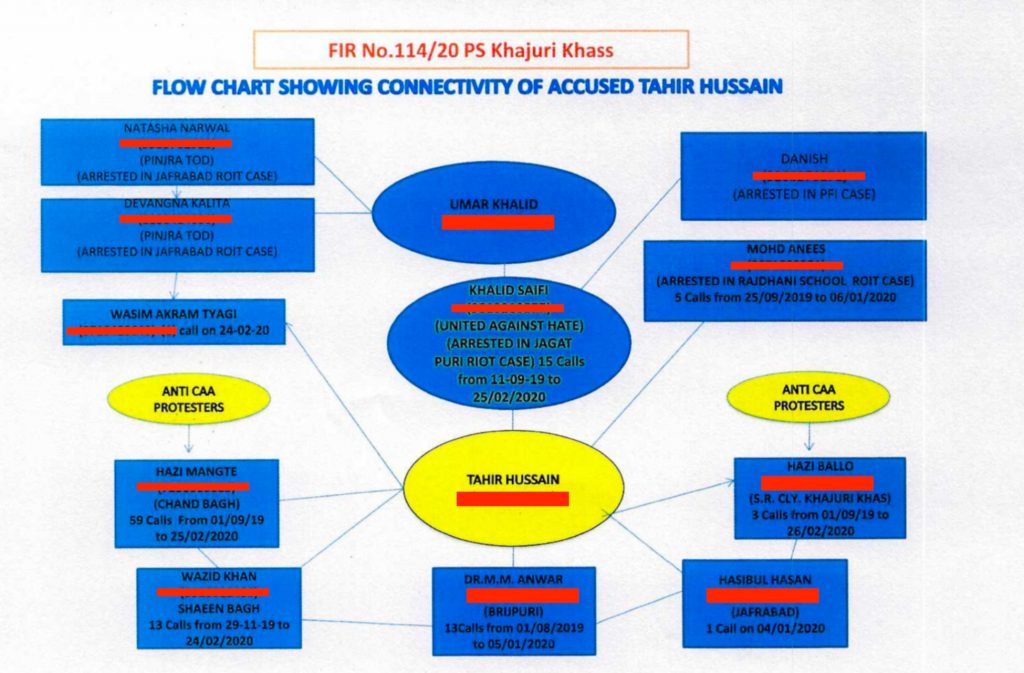
From everything that is alleged in the chargesheet, it is clear that Umar Khalid was perhaps one of the masterminds who was also constantly in touch with Pinjra Tod activists who are also accused of grave sections. Khalid Saifi of UAH, who is also a close associate of Umar Khalid was coordinating with Tahir Hussain after their initial meeting in Shaheen Bagh on the 8th of January. Further, Tahir Hussain was coordinating with other rioters and instigators. Tahir Hussain has now been convicted in the murder of Ankit Sharma, an IB officer stabbed and tortured to death brutally by a Jihadi mob.


