

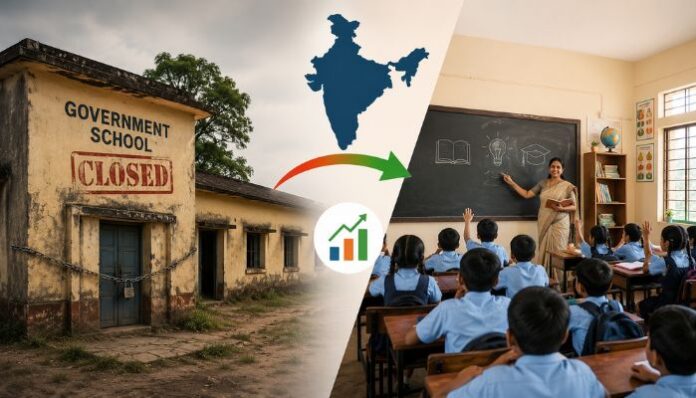
The Congress on Monday, 3rd August, claimed that around 94,000 government schools have been shut down in India over the past decade, and used the figure to attack the Narendra Modi government’s education record. Sharing the claim on X, the party wrote, “Aise Padhega India”, suggesting that the closure of government schools reflects the government’s failure to provide education.
Aise Padhega India? pic.twitter.com/eZGEF2Xk9q
— Congress (@INCIndia) August 3, 2026
The figure of 94,000 government schools, however, does come from government data cited in a recent NITI Aayog analysis. But presenting it on its own gives only one part of the story. The NITI Aayog report presents a much more nuanced picture of what has happened to India’s school education system between 2014-15 and 2024-25.
The report shows that while the number of government schools has fallen sharply, India has also witnessed a decline in the school-age population, lower overall enrolment, an increase in private schooling and a rise in the number of teachers. Several states have also merged or consolidated schools with very low enrolment in an effort to pool resources and provide better facilities.
In other words, the fall in the number of government schools cannot simply be presented as evidence that the government has stopped focusing on education. The data points towards a larger structural change in the country’s school education system.
Congress highlights school closures, but leaves out the larger picture
The Congress’s social media post focused on the decline in government schools and the impact it could have on children’s access to education. There are legitimate concerns around school closures, particularly in rural, tribal and economically weaker areas where a government school may be the only accessible educational institution for children.
However, the NITI Aayog analysis itself asks a larger question: should the success of school education be measured simply by the number of schools, or by whether children have access to a properly resourced school that can provide quality education?
This distinction is important because not every school closure means that children have been left without a school. In several states, schools with very few students have been merged with larger institutions so that teachers, classrooms, laboratories, libraries, sports facilities and other resources can be used more effectively.
The data also shows that the total number of schools in India has not fallen by 94,000. The decline in the total number of schools is much smaller. The country had around 15.16 lakh schools in 2014-15, compared with around 14.71 lakh in 2024-25, a fall of roughly 45,000. The sharp decline was mainly in government schools, while the number of private unaided schools increased.
Therefore, using the 94,000 figure without explaining the demographic and structural changes behind it presents only part of the picture.
What does the NITI Aayog report actually say?
According to the NITI Aayog analysis, the number of government schools declined from around 11.07 lakh in 2014-15 to 10.13 lakh in 2024-25, an 8% fall. During the same period, the number of private schools increased from around 2.88 lakh to 3.39 lakh, an increase of about 18%.
The decline in government schools happened alongside a fall in the number of children enrolled in schools. Overall school enrolment fell from 26.95 crore in 2014-15 to 24.69 crore in 2024-25, a decline of around 2.26 crore students or nearly 8%.
Government school enrolment also declined. The share of students enrolled in government schools fell from around 54.3% in 2014-15 to 49.25% in 2024-25. At the same time, the share of students in private schools increased from 31.7% to 38.8%.
The shift towards private education is therefore another important part of the story. Parents’ changing preferences, urbanisation and migration, along with demographic changes, have contributed to the changing school landscape.
The NITI Aayog analysis identifies three broad reasons for the fall in overall enrolment: “demographic shifts, particularly falling fertility rates leading to a smaller school-age population”, “the effects of school consolidations” and challenges in retaining students at higher levels of education.
India has fewer children entering school
One of the biggest factors behind the changing education landscape is India’s demographic transition.
India’s fertility rate has fallen significantly over the past few decades. The total fertility rate, which was above three in the early 1990s, has now fallen to around two, below the replacement level of 2.1.
This means that fewer children are entering the school system every year. Rising female literacy, urbanisation, better healthcare, wider access to family planning, delayed marriages and changing family aspirations have all contributed to smaller families.
As the number of school-age children declines, schools with very low enrolment become increasingly common. Some schools that once had more than 100 students may now have only a few dozen, or even fewer.
Running separate schools with very low enrolment can also create another problem. A school may have only one teacher handling multiple classes and several subjects. Such schools may technically provide access to education but may struggle to offer subject-specific teaching, peer learning, sports and other activities.
Why are schools being merged?
The NITI Aayog report points towards “consolidation and rationalisation measures” as one of the reasons for the decline in government schools.
Several states have merged schools with low enrolment into larger institutions. A NITI Aayog project launched in 2017 also focused on merging and reorganising low-enrolment schools in states including Jharkhand, Madhya Pradesh and Odisha.
The National Education Policy, 2020, has also promoted the idea of school complexes and clusters, where schools can share teachers, infrastructure and other resources.
The argument behind consolidation is that a larger, properly equipped school can provide a better educational environment than several extremely small schools with only one or two teachers.
However, this does not mean that every school closure is automatically beneficial. The report also acknowledges the risks involved. If a school is merged with another institution located several kilometres away, children may have to travel longer distances. This can particularly affect young children, girls and students living in remote, tribal or disadvantaged areas.
This is why school consolidation has to balance quality, accessibility and equity.
Teachers increased despite fewer schools
Another important part of the data is the number of teachers.
While the number of schools and students declined, the number of teachers increased from around 90 lakh in 2014-15 to more than one crore in 2024-25. This indicates that the decline in the number of schools has not simply been accompanied by a reduction in the teaching workforce. In fact, teacher availability has improved at the national level.
However, the national average hides significant differences between regions. Some rural schools still have only one teacher and very few students, while some urban schools face overcrowding.
The challenge, therefore, is not simply to increase or decrease the number of schools. It is to ensure that schools have enough qualified teachers and resources while remaining accessible to children.
The bigger problem is keeping children in school
The NITI Aayog analysis also identifies another major challenge: retaining children beyond Class 8.
The secondary level has been described as the “most fragile link” in the schooling cycle. The Gross Enrolment Ratio at the secondary level is 78.7%, compared with more than 90% at the primary and upper-primary levels. At the higher-secondary level, it falls further to 58.4%.
The report points out that nearly four out of every 10 children who enter school do not continue until the higher-secondary stage.
One reason is that the Right to Education (RTE) Act guarantees free and compulsory education only up to the age of 14. After Class 8, families may have to bear more of the cost of education, which can become a major barrier for children from poorer households.
The structure of schools can also create problems. Only around 5% of India’s schools offer continuous education from Classes 1 to 12. Children often have to shift schools after Class 5, Class 8 or Class 10 depending on what is available in their area.
The NITI Aayog report notes that this “fragmentation without any established linkage between schools for transitioning” can make it harder for students to continue their education.
At the same time, there has been progress in some areas. Primary-level dropout has fallen sharply from around 4% in 2014-15 to just 0.3% in 2024-25. At the secondary level, dropout has also declined from 17.86% to 11.5%, although it remains the highest among the major stages of schooling.
So, is the closure of government schools a crisis?
The decline of nearly 94,000 government schools is a real figure and deserves scrutiny, particularly where closures or mergers make it harder for children to reach school. But the data does not show that schools are being shut simply because the government is no longer interested in education.
India is going through a demographic change, with fewer children entering school. At the same time, many families are increasingly choosing private schools. States have also been merging schools with low enrolment to pool teachers and infrastructure.
The bigger question is whether these changes are improving education or creating new barriers.
School consolidation can make sense when it gives children access to better teachers, laboratories, libraries, sports facilities and a stronger peer-learning environment. But it can become harmful if children, particularly girls and those from poor or remote communities, are forced to travel long distances or drop out because the nearest school has been closed.
Ultimately, the success of India’s school education policy cannot be judged only by how many schools exist. It should be measured by whether every child can safely reach a well-equipped school, receive quality teaching and continue education beyond Class 8.


