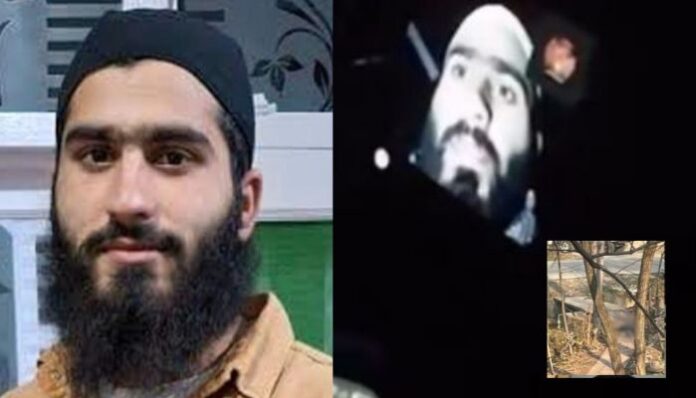
The Indian security forces killed Lashkar-e-Taiba (LeT) commander Lateef Bhat during an encounter in Kulgam on 18th November. At around 10 pm, the dead body of Islamic terrorist Lateef Bhat was buried by family members in the presence of security forces about 160 km away from his house in Jammu and Kashmir’s Kupwara.
In the last few years, the government has maintained a policy of not handing over the dead bodies of slain terrorists to their families. This is to prevent the glorification of terrorists and the fuelling of Jihadist sentiments.
Reports say that Lateef Bhat’s family was taken to the burial site in the Bangus valley of Jammu and Kashmir’s Kupwara district under tight security. The slain terrorist’s family resides in the Kherwan village in Kulgam.
Speaking to Hindustan Times, the slain terrorist’s family confirmed that Lateef Bhat’s burial took place in accordance with Islamic customary rituals.
They said that mobile phones or photography were not allowed.
“We were not allowed to take photographs. Security forces took our phones about 10km away before driving us to a cemetery in a village in Bangus, Handwara, Kupwara district. I was there along with his father, Mustaq Ahmed Bhat, two maternal uncles, his three paternal uncles, and one brother-in-law. He is buried there,” the LeT terrorist’s maternal uncle said.
Who was LeT terrorist Lateef Bhat and how security forces trapped and killed him
Mohammad Lateef Bhat was a resident of Khrewan Chader in Kulgam’s Ashmuji area.
Police said Bhat was a former carpenter who completed Class 12 in 2021 and then dropped out of college early on. In November 2025, Lateef Bhat went missing from his home and joined the LeT and its proxy, the Resistance Front (TRF).
Pakistan-based terrorist Sajjad Gul recruited him into the TRF.
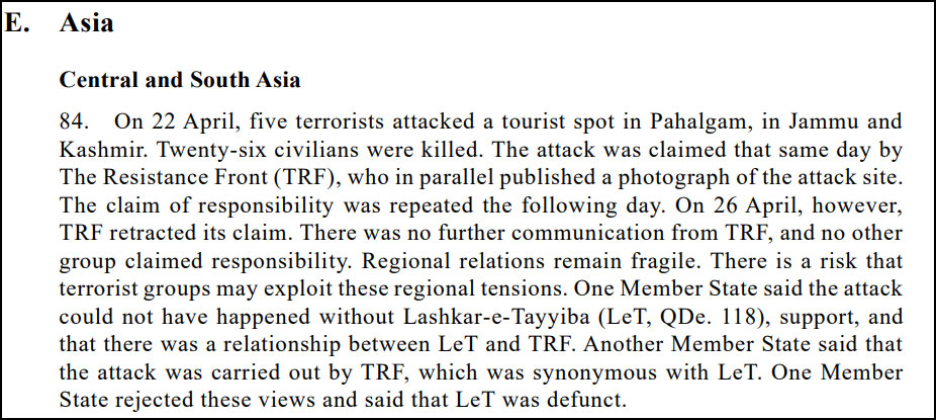
Pertinently, The Resistance Front (TRF) is an offshoot of Pakistan-based Lashkar-e-Taiba. TRF had earlier twice claimed responsibility for the Pahalgam terrorist attack and even published a photograph of the attack site. The claim was, however, retracted four days later, with no other group claiming responsibility since.
In July 2025, the UN Security Council linked the group to the 22nd of April Pahalgam terrorist attack that claimed the lives of 26 innocent Hindus in Jammu and Kashmir.
Lateef Bhat trained in the upper reaches of Kulgam and Shopian.
SSP Chowdhary said Bhat was “heavily self-radicalised” and had become active on 18 November 2025, exactly a year before his death.
Bhat was categorised as an “A” category operative, a designation for active terrorists involved in attacks and other high-priority activities.
He led the LeT’s terror activities in the area and maintained links with the TRF, a proxy of the LeT. He was also linked with the Kashmir Revolutionary Army (KRA).
According to the police, Bhat was receiving instructions from across the border to “disrupt peace, tourism and the economy” after carrying out “three to four ruthless attacks”.
In August 2026, the Jammu and Kashmir Police had announced a ₹15 lakh bounty for information leading to his arrest and put up wanted posters across the Valley.
Bhat was involved in several terrorist attacks before the security forces neutralised him for good.
On 22 July, 2026, he shot dead Jammu and Kashmir Police head constable Ashiq Hussain in a crowded market at Lal Chowk in Anantnag.
On 31 July, he was involved in the murder of two migrant workers from Chhattisgarh at a brick kiln in Kulgam.
Law enforcement agencies identified him from CCTV footage of the Lal Chowk area that captured the cop’s murder.
He also escaped a security operation in Shopian in July and later broke through a cordon in Anantnag in December 2025.
Bhat’s name resurfaced after the 11th of November CRPF checkpoint attack in Kulgam. In this attack, three security personnel were injured.
While fleeing the spot after the attack, Bhat mistakenly dropped his mobile phone.
The security forces used the phone to uncover the network of Jihadi overground workers (OGWs) in South Kashmir, trap and kill Lateef Bhat in the Zunglepora village.
Police said that Bhat was hiding inside a mosque and had refused to surrender despite repeated appeals from security personnel.
Police investigations also revealed that another slain terrorist, Umer Nisar Dar, had helped Lateef Bhat for several months by providing shelter and logistical support. Dar’s family had even filed a missing-person report at a police station in Kulgam after he went missing.
Security forces also tried to reach him by video call and urged him to lay down his arms. During the conversation, an officer was heard telling him, “Hum tumhare sath hain (We are with you).”
However, Bhat refused to surrender and replied, “Mujhe Allah se mulaqat karna hai. Mai bahut khush hu (I want to meet Allah. I am very happy). Mere liye Allah Kafi hai (For me, Allah is enough)”.
HEAR THIS CONVERSATION This is the face of weaponised Islam. This is what India is fighting. History has a lesson: terrorism thrives on division and is defeated when people stand together. Never as individuals. INDIAN ARMY MAN SPEAKS TO ISLAMIST TERRORIST LATEEF. Lateef: reads Quran’s verse. Army officer: how will you?…. Lateef: I have left and I’m very happy, I have to go to Allah. I will see his promised end – ALLAH HU AKBAR. Army officer: we are with you, surrender. why are you doing this? Lateef: ALLAH is enough for me.
— Rahul Shivshankar (@RShivshankar) November 18, 2026
Bhat was firing at the security forces from inside the mosque at 2:45 AM. Fresh gunfire was reported before dawn as security personnel stepped up the operation across several villages in the district.
Since when has the policy of not handing over the bodies of slain terrorists to families existed, and why
The Modi government’s policy of not handing bodies of slain terrorists to families for public funerals in Jammu and Kashmir began in 2020.
Pre-2020, bodies of local terrorists and sometimes even of Pakistanis were handed over to families or local Auqaf committees.
Large public funerals of slain Jihadis with processions and religious and anti-India slogans were common. Such funerals often became sites of mobilisation, radicalisation or Islamisation, and glorification of ‘Azadi’ terrorism against India.
Not to forget, about 2 lakh people in the Kashmir Valley attended the funeral of slain Islamic terrorist Burhan Wani in 2016.
The shift, however, began around 2020. Law enforcement authorities began discreet burials of slain Jihadis in remote locations, sometimes in the presence of family members.
Initially, the measure was taken in the wake of the COVID pandemic; however, it evolved into a norm and security forces stopped returning bodies of slain terrorists for public funerals.
Between 2020 and 2021, dozens of such secluded burials of terrorists occurred.
As human rights ‘activists’ and left liberal sympathisers of separatists and Islamic terrorists described the approach of not handing over bodies of Jihadis to families for public funerals, the matter reached the Supreme Court.
In a 2022 ruling related to the Hyderpora encounter cases, the Supreme Court held that security agencies may refuse to hand over bodies of local terrorists when necessary to maintain public order and security.
The apex court went on to say that courts should generally not interfere in such sensitive matters unless there is substantial ‘injustice’.
“These are all very sensitive matters involving the security of the nation, and as far as possible the court should not interfere unless substantial & grave injustice has been done,” the court said in its 50-page judgment in 2022.
In June 2025, Union Home Minister Amit Shah informed the Lok Sabha, during a discussion on Operation Sindoor, that under the Modi government, “wherever a terrorist is killed, he is buried right there” and there is “no permission to take out funeral procession to glorify terrorists”.
Notably, the practice of not handing over bodies of slain terrorists to their families is not confined to Jammu and Kashmir.
Similar controlled or remote disposals have been applied in other parts of the country, particularly against Maoist/Naxalite terrorists.
In May 2025, when top CPI (Maoist) terrorist Nambala Keshavrao, also known as Basavaraj, was killed in an intense gunfight with security forces in the dense forests of Chhattisgarh’s Abhujmad region, the Naxalite was cremated in Bastar, and permission was denied for transporting his body to his hometown in Andhra Pradesh.
Overall, the reasons for denying the handover of bodies of slain terrorists to their families are to prevent glorification, public veneration and radicalisation; to prevent facilitation of further Jihadi recruitments; to maintain law and order; and to kill the ‘hero’ narrative around the slain terrorists and limit propaganda value for terrorist groups.