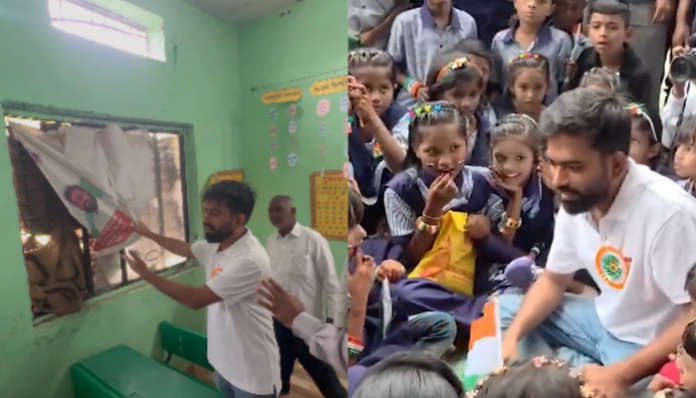
Cockroach Janta Party (CJP), which began as an online phenomenon before making its way onto the streets under the banner of a student movement purportedly seeking to highlight lapses in the Indian education system, seems to have developed a curious appetite for unnecessary theatrics and for throwing its weight around without any actual legal legitimisation.
Its latest “School Thik Karo” (Improve the Schools) program is the latest case in point. While the initiative might appear, at first glance, as a well-meaning, altruistic campaign focused on these educational institutions, it is yet another platform for CJP founder Abhijeet Dipke to assert his non-existent authority and stage a political spectacle, aimed at winning public attention and ultimately impressing voters.
Equipped with cameras, media, supporters and a string of sermons directed at the government, he has selected schools as the next venue for his political stunts with no regard for disrupting the daily classes or affecting the impressionable minds of young students.
Abhijeet Dipke, who authorised you to enter government schools and conduct “audits”? What legal authority do you have? Question the government. Protest peacefully. But don’t barge into public institutions, film officials and behave as though you possess powers the law never gave… pic.twitter.com/7krdGHaUzF
— Bhaavna Arora (@BhaavnaArora) August 19, 2026
The schools are announced as the fresh political background by Dipke as he launched the mission from his native village, Santuk Pimpri, in the Hingoli district of Maharashtra on Independence Day. He was seen inspecting classrooms and speaking to students and teachers as though he were a government official conducting an authorised review of the institution.
But imagine the outrage if an ordinary citizen without political backing or clout attempted to do the same. Would the validity of the actions, the sincerity of the intentions or the relevance of the issues suddenly make such an intrusion acceptable? This sparks a larger question about the kind of political culture CJP and Dipke seek to promote.
Can established procedures, institutional boundaries and the workings of a functioning democracy simply be bypassed whenever someone claims to be acting in the name of public interest or goodwill? If such arbitrary conduct were normalised, where would the line be drawn?
This fraud Abhijeet Dipke went to Hingoli again today for a government school inspection.
— Amit Kumar Sindhi (@AMIT_GUJJU) August 18, 2026
And of course, he didn’t go alone. He brought an entire media setup along with his chamchas and walked into the school while classes were actually going on.
What gives him the right to… pic.twitter.com/q70N8mQRQx
The students were even reportedly instructed to complete CJP forms. This entire episode bears an uncanny resemblance to an attempt to establish a parallel government through street actions, showing complete disregard for the elected government and appointed officials.
There is obviously a proper manner to convey the hardships endured by students and draw the attention of the administration, which could have been achieved without resorting to political drama; however, that was clearly not Dipke’s goal. Most importantly, what gives Dipke the confidence to engage in such activities without any consideration for the potential fallout?
Being a taxpayer does not place anyone above the rules, nor does it grant an automatic licence to enter any institution or interfere with its operations under the pretext of pointing out its flaws or vulnerabilities.
🚨 Class cancelled, students asked to stand outside, and asked to fill CJP forms?
— maithun (@Being_Humor) August 19, 2026
This is New India! It will be run through street power, where anyone can become a CJP leader and enter any government building.
Where will it stop?
Since I pay taxes, can I enter an AC First… pic.twitter.com/vlLelnpJkK
Dipke had told reporters, “We have a form comprising a checklist where it can be mentioned whether there are basic amenities available in the school or not. We will gather the data from schools located in Maharashtra and nationwide. Then we will compile the data.” There are separate channels to make such communication and demand accountability. Paying taxes alone cannot be used as a justification for these antics, but if that had truly been the aim, then the events that unfolded on the school premises would have looked very different.
The possible motive behind Dipke’s actions and the potential risks
It is important to highlight that CJP has been accused of being an offshoot of the Aam Aadmi Party (AAP) as Dipke was a member of the latter’s social media team. Interestingly, AAP and its senior leadership, including national convenor and former Delhi chief minister Arvind Kejriwal, have themselves faced repeated allegations of displaying an anarchist streak.
The episode from 2014 remains particularly telling, when he proceeded to undermine Republic Day celebrations during his sit-in protest near Rajpath (Kartavya Path) in 2024. The same tendencies are quite apparent in CJP and its leaders. Their increasingly disruptive shenanigans echo that very political style, with the line between demonstration, provocation and political spectacle becoming blurred.
It is not to suggest that the country’s education system, schools or other institutions are without problems that demand immediate attention. They certainly are not. Schools continue to grapple with severe challenges such as inadequate infrastructure, a dearth of basic facilities, shortage of competent teachers, lazy staff and outdated pedagogy, among several other concerns.
Dipke, as a citizen, is well within his rights to outline these matters, but he cannot trespass as an uninvited intruder and convert the visit into an elaborate production, particularly when his efforts are only designed to further a political career. The selective nature of this activism makes the intent even harder to overlook. If CJP or Dipke were genuinely worried, then they would have shown the same urgency instead of sheer indifference towards the students of Jharkhand and other states where the Bharatiya Janata Party (BJP) is not in government.
Instead, their interventions are remarkably set on subjects that serve a specific political narrative and bias while leaving similar developments elsewhere untouched. Of course, the concern is filtered through political convenience, and the purpose is to manufacture a complication, generate headlines and remain politically relevant.
It also becomes pertinent to recount that the CJP platform at Jantar Mantar was transformed into a congregation of opposition voices, the display of azadi slogans and anti-Hindu sentiments, along with foul language directed at Prime Minister Narendra Modi. Pakistan had used the violent agitation to spread disinformation and fuel the unrest in India. This was the ugly face of a demonstration that claimed to be fighting for the rights and interests of students.
Furthermore, the profound admiration of Dipke and his party associates for anti-national figures, including Sharjeel Imam and Umar Khalid, who seek to separate the Siliguri Corridor (Chicken’s Neck) from India and are prime accused in the 2020 Delhi riots, is a widely recognised reality. They have even consistently defended these individuals and objected to their incarceration.
Hence, the question arises whether people like Dipke should be given unchecked access to youngsters in schools when their contentious political and ideological positions are already a matter of public record. The potential influence on young and developing minds cannot be taken lightly, especially when it could shape their outlook in ways that could prove detrimental not only to their own future but also to the larger interests of the country.
Conclusion
From Abhijeet Dipke to Rahul Gandhi and his “Chhatron Ki Goonj” (Echo of Students) mission, the opposition hopes to portray itself as the foremost champion of students. However, they only want to turn their concerns into political capital. Their methods might differ, or the strategy could carry different labels, but the underlying objective is to transform the student grievances into electoral currency.
This perhaps explains why Indian National Congress leaders and its youth wing trained their guns on CJP, seemingly wary that the organisation could seize upon student issues and, in the process, eat into their already shrinking political space. The same scenario is visible in the schools of Maharashtra, as each party is vying to capitalise on student issues without genuinely caring to address or rectify them.