

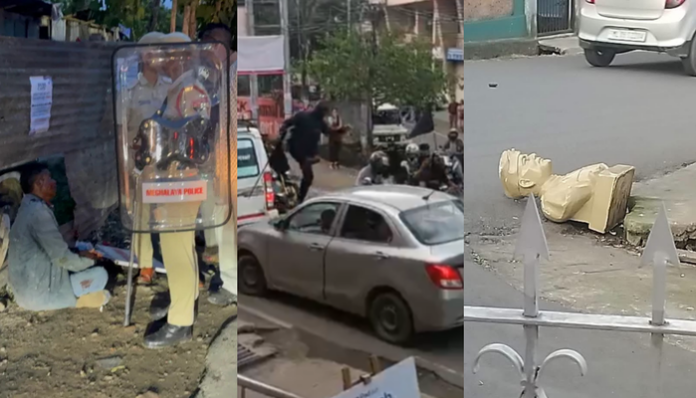
Widespread violence and vandalism were reported during a black-flag bike rally organised by the Khasi Students Union (KSU) in Shillong, Meghalaya on Wednesday (19th August). The rally was organised after the 15-day ultimatum issued by the KSU to the state government to fulfil its five-point demand charter expired.
The bike rally commenced around 4 pm from the KSU office at Jaiaw and passed through Lumdiengjri, Malki, Dhankheti, Umpling, Golf Link and Mawlai Mawroh before returning to Jaiaw.
Many incidents of violence were reported in various areas as masked men participating in the rally attacked government and private vehicles. A government Bolero was torched at Mawlai Nongmali, and several other government vehicles were damaged.
Videos of hooligans committing violence during the rally have been going viral on social media. Viral videos show masked men jumping on vehicles, damaging windshields and windows. Such incidents came to light at Dhankheti, Jylli Shop, Nongrim Hills and other areas.
Shocking visuals from #Shillong, Meghalaya!
— Legal Rights Observatory- LRO (@LegalLro) August 20, 2026
During Khasi Students Union KSU protest rally Netaji Subhash Chandra Bose bust vandalised, Swami Vivekananda statue desecrated, common commuter's car with woman, children on board violently attacked.
As always @MeghalayaPolice remained… pic.twitter.com/FD5QHbr7x4
Statues of Swami Vivekananda and Netaji Subhash Chandra Bose were also desecrated during the bike rally. A common commuter’s car with women and children on board was also reportedl attacks by vandals.
19-8-26. Shillong,Meghalaya.The aftermath of a KSU rally. Vandalised statues of Netaji and Vivekananda. Hooligans caught on film pelting stones at passing cars without a care in the world of any repercussions.@T7NEWS1 @ndtv @republic @EastMojo @PeekTV_in @TOIIndiaNews @htTweets pic.twitter.com/6telkrCf1j
— Arindam Sen (@ArindamSen_) August 19, 2026
According to the police, 31 vehicles were damaged in the violence, and the vehicles of non-local people were particularly targeted by miscreants. Several Assam-registered vehicles were also attacked, which led to the Assam State Driver Association (ASDA) condemning the attack and demanding an apology and compensation. The association warned of possible restrictions on Meghalaya vehicles entering Assam through Jorabat if action is not taken.
Tensions escalated in Shillong during a Khasi Students’ Union protest as several Assam-registered vehicles were allegedly vandalised and passengers attacked. The incident has drawn strong condemnation from the Seven Star Tourist Cab Operators’ Union and other motor vehicle… pic.twitter.com/IpgiO1PLdE
— Pratidin Time (@pratidintime) August 19, 2026
Following the bike rally, many people were found lying injured on the streets of Shillong with blood oozing out of their wounds.
🔴Tension gripped Shillong on Wednesday as the KSU Black Flag Bike Rally moved through the city. Reports emerged of stone pelting and vehicle damage. Several people were also allegedly beaten up at random in different parts of the city.#MeghalayaNews #NewsUpdate #Shillong pic.twitter.com/hEzWL1Hn0v
— Highland Post (@PostHighland) August 19, 2026
In the aftermath of the violence, the Meghalaya Police raided KSU’s central office on Jaiaw Chapel Road late Wednesday and arrested three of its senior leaders. The arrested have been identified as KSU president Raymond Kharjana, vice-president Pynkmenlang Sanmiet and general secretary Reuben Najiar. They were taken to Sadar Police Station for questioning.
According to the police, the three KSU leaders have been booked under various provisions of the Bharatiya Nyaya Sanhita, 2023, including those relating to damage to public property, causing hurt and unlawful assembly.
What is the KSU asking for?
The bike rally in Shillong was announced by the Khasi Students Union general secretary Reuben Najiar on Tuesday during a public meeting. “From tomorrow, we will take to the streets and begin our public agitation. We will start with a black-flag march across Shillong city to put pressure on and condemn the government,” Najiar said, announcing the rally.
The KSU had held demonstrations and public meetings across Shillong on 17th and 18th August. The organisation had given the state government 15 days to respond to its five-point charter. It had opposed a hearing for the proposed Shree Cement project in East Jaintia Hills, which was held on 31st July. The Union alleged that the hearing was pre-arranged and sought action against officials allegedly responsible for the handling of the hearing. The Union has sought action against the Deputy Commissioner and Superintendent of Police of East Jaintia Hills and concerned officials of the Meghalaya State Pollution Control Board.
The Union has sought implementation of the Meghalaya Residents Safety and Security Act (MRSSA), 2016, enforcement of the 2024 amendments relating to migrant workers, changes in government recruitment, including removal of interviews for Grade B, C and D government posts; and the introduction of standard operating procedures for all recruitment boards.
Its other demands include immediate enforcement of amendments to the Meghalaya Migrant Workmen Act, 2020; recruitment reforms at North Eastern Indira Gandhi Regional Institute of Health & Medical Sciences, Shillong (NEIGRIHMS), including an 80:20 female-to-male ratio for nurses and reservation for Khasis, Jaintias and Garos
The organisation further demanded implementation of the Meghalaya Residents Safety and Security Act, 2016, pending the introduction of an Inner Line Permit system in the state and fulfilment of the Government’s earlier commitment to oppose uranium mining.
Background and ideology of the Khasi Students Union
Formed in 1978, the Khasi Students Union is a hardcore indigenous socio-political student organisation in Meghalaya, which claims to represent and fight for the rights of the Khasi indigenous group. In the name of protecting the rights of the Khasi people, the union has openly displayed racism towards people from different states of the country coming to Meghalaya.
The Union has been vehemently opposing the immigration of people into the state, not just from the neighbouring countries of Nepal and Bangladesh but also from “mainland India”. The organisation believes that “massive flow of migrants into the state from Bangladesh, Nepal and mainland India since the 1970’s” has been threatening the existence of indigenous communities of Meghalaya.
The KSU has also been opposing the Centre’s proposed uranium mining project in Meghalaya, called the Kylleng-Pyndengsohiong, Mawthabah (KPM) Uranium Mining Project (formerly known as the Domiasiat project). It is managed by the Uranium Corporation of India Limited (UCIL) and is located in the South West Khasi Hills district. Various indigenous groups in Meghalaya, including the KSU, have been pressuring the state government not to allow the Centre’s uranium project in the state.
The organisation has been overtly emphasising its indigenous identity and has been averse to the Khasi community being viewed as part of the larger national identity. Recently, the KSU refused to accept all six stanzas of the national song of India, Vande Mataram, arguing that the later verses of the song invoke Hindu deities and amount to “a process of assimilation” that is contrary to Khasi traditions.
Earlier in July, the Union was in the news for locking an under-construction temple located on the premises of the Central Bureau of Investigation (CBI) office in the Mawdiangdiang area of New Shillong Township.


