

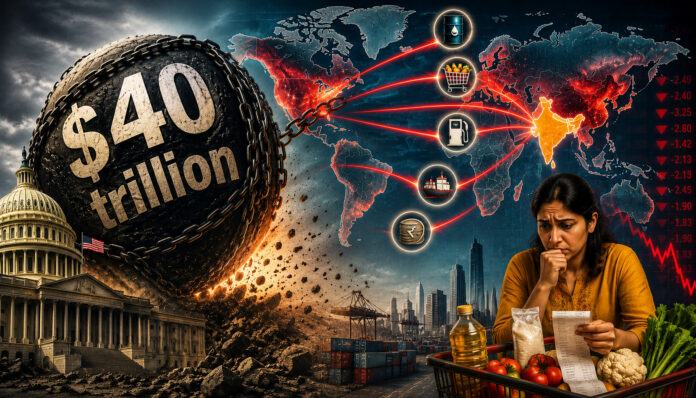
Neha, a 34-year-old in Gurugram, checks her mutual fund app every morning before work. For three months straight, it’s been red. Nothing’s crashed, but it’s enough to make her pause over her coffee. The real reason has little to do with anything happening in India. It’s sitting in Washington, where US government debt just crossed $40 trillion, growing by roughly $8.46 billion every single day.
That number alone doesn’t tell the full story. What actually worries markets is the debt held by public lenders, pension funds, foreign governments, banks, money the US must keep refinancing at whatever rates the market demands. The CBO projects this will jump from 101% of GDP now to 120% by 2036, blowing past the post WWII record. Interest payments alone could hit $2.1 trillion a year by then, nearly a fifth of federal spending, just to service old debt.
This isn’t America going bankrupt, it borrows in its own currency, and the dollar remains the world’s safe haven. The real risk is subtler, a slow erosion of confidence, rising rates, and creeping inflation that chips away at the dollar’s dominance over time.
And this doesn’t stay contained to Wall Street. It travels to India through four channels. First, equities, foreign investors pulled nearly ₹2.3 lakh crore from Indian stocks in early 2026, though domestic SIP money absorbed almost 90% of that selling, which is reassuring but also means ordinary retirement savings are now absorbing global shocks. Second, the rupee weakened to nearly ₹95.7 per dollar, pushing up oil and fertiliser costs. Third, that translates into inflation, wholesale prices jumped from 2.1% to nearly 9.9% within months, driven largely by fuel. Fourth, American corporate caution over tech spending slows hiring at IT firms in Bengaluru and Gurugram, since over half of India’s software exports go to the US.
None of this means India should panic. Its foreign exchange reserves dipped under pressure but recovered to nearly $693 billion by July, showing real resilience. And a stable US genuinely benefits India, nobody should want American decline. But the bigger point is this, India can’t treat Washington’s fiscal mess as someone else’s problem. It shows up here too, in fuel prices, in a farmer’s fertiliser bill, in a red number on someone’s phone. Big economies rarely collapse overnight. More often, they leak slowly, and the countries standing nearby feel it first, sometimes before the source even notices.
Read the full article available on Chapter One Mag.


