

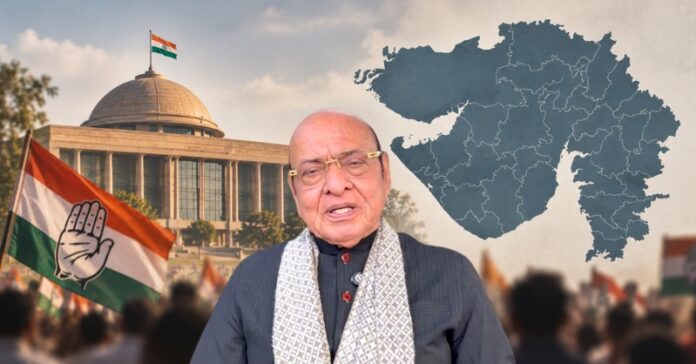
Gujarat’s politics had been quiet for some time. Former Chief Minister Shankarsinh Vaghela has now thrown a stone into that still water, stirring up the state’s caste politics with a controversial remark about three communities– Brahmins, Patels and Vanias. His remarks have triggered a backlash, with reactions pouring in across the media and social media. Vaghela, however, has refused to apologise. He says he said what he meant to say and that those criticising him have simply failed to understand his point.
On October 2, Shankersinh was in Sagbara in Narmada district to address a gathering of the tribal community. Congress leaders were also present. During his speech, he said reservation was given to the tribal community as compensation for what it had suffered for decades and that it was their right. He also accused the BJP government of being opposed to reservation.
Vaghela then said that anyone opposed to reservation should take up the job of carrying out manual scavenging, and that he was ready to pay them ₹50,000. It was while making this remark that he named Brahmins, Patels and Vanias.
The backlash followed quickly. Members of these communities came out against him. Vaghela offered a clarification but refused to apologise. And Gujarat was once again talking about caste politics.
It would be difficult to dismiss Vaghela’s remarks as a slip of the tongue. He knew what he was saying. He meant exactly what can be heard in the video. The timing of the statement is important too.
Just two or three days before the video surfaced, reports emerged that Vaghela could return to the Congress. Such claims have been made several times since he left the party in 2017. This time, however, there was confirmation from both sides.
Vaghela said he had repeatedly stated in public that he was willing to work for the Congress to defeat the BJP. Congress leaders also confirmed that they had met him and said the matter would now be discussed with the party high command.
This is where Vaghela’s remarks acquire a larger political context.
Vaghela knows Gujarat’s political arithmetic. The communities he named have largely been part of the BJP’s core General Category support base. At the same time, the BJP has been strengthening its position in the tribal belt.
If the BJP’s support among tribal voters is to be disrupted, creating a sharper political divide between these communities and the BJP is one possible route. Caste mobilisation can serve that purpose.
Gujarat has seen what happens when caste becomes the dominant political language.
Go back a decade. The last time the Congress came close to power in Gujarat was in the 2017 assembly elections. Two years earlier, the Patidar reservation agitation had erupted, followed by protests by other communities against the government. Gujarat was going through a period of political unrest, and caste politics had overshadowed almost every other issue.
The impact was visible in the 2017 Assembly election. The Congress reached 77 seats, while the BJP retained power with a very narrow margin. The majority mark was 91. BJP got 99 seats.
But then the BJP corrected its mistakes, while the Congress continued to weaken. By 2022, the picture had changed dramatically. The BJP won 156 seats out of 182, and the Congress was reduced to just 17.
Now, with the 2027 Assembly election approaching, the opposition ecosystem has to reckon with a basic political reality: the BJP remains deeply entrenched in Gujarat.
There can be dissatisfaction on some issues with the government, as there is with any government that has been in power for a long time. But dissatisfaction alone does not automatically translate into a desire for an alternative. For many voters in Gujarat, the BJP still carries the credibility of having delivered on a substantial part of its development agenda. There is also a perception that, whatever the problem, the BJP is more capable of finding a solution than the alternatives currently available. And then there is Narendra Modi, whose political connection with Gujarat remains a factor that cannot be ignored.
This is not merely an argument based on political perception. Gujarat’s election results tell the same story. The BJP won 156 of 182 Assembly seats in 2022, its biggest-ever tally in the state. In the 2024 Lok Sabha election, it won 25 of Gujarat’s 26 seats, with the Congress taking Banaskantha.
That is the challenge facing the opposition. It cannot simply wait for dissatisfaction with the BJP to turn into a vote against it. It needs to create a political alternative strong enough to overcome the BJP’s organisational strength, its record in government and the Modi factor. It is this frustration that makes caste politics tempting again.
There have also been attempts to create an atmosphere of unrest in Gujarat in the guise of agitations. The Aam Aadmi Party, which has been increasingly focusing on the Patidar community, tried to organise a Kisan Mahapanchayat in Botad, a part of Saurashtra where Patidars have a significant presence. The gathering was held without police permission, and when the police arrived to stop it, stones were thrown at them. The Congress later attempted to organise a farmers’ rally in Gandhinagar, but failed to generate much momentum.
There is a political value in keeping a state in a constant state of agitation– every grievance becomes a confrontation, communities begin to mobilise separately, ly and governance itself becomes part of the conflict. That was the broader atmosphere Gujarat witnessed between 2015 and 2017.
Then there is the wider YouTube media ecosystem. Look at its coverage and one thing stands out: caste politics is repeatedly being pushed to the forefront.
The larger political objective is to recreate, in some form, the atmosphere of 2015, when caste mobilisation overshadowed issues such as development and the economy, communities became divided, and elections increasingly revolved around caste.
The Congress has used this political route before. When there are fewer conventional issues on which to challenge the BJP, caste becomes an obvious political instrument. Rahul Gandhi’s repeated ‘Jitni abadi, utna haq’ argument is one example.
The same conversation has now begun in Gujarat as well, and attempts in this direction have been visible for some time.
There is, however, another reason why Vaghela’s timing may not be ideal for him and the Congress.
In January, a major controversy erupted over a regulation published by the University Grants Commission (UGC). It triggered considerable debate on social media, which eventually led to the discussion around changes to the reservation system. For a while, there appeared to be some discontent among sections of the General Category towards the BJP. But Shankersinh’s statement has changed the scenario.
He may not have made the statement as a Congress leader, but his proximity to the party is clear. Congress leaders were present at the gathering, and none have so far publicly condemned his remarks. Politically, therefore, the statement will inevitably be viewed through the Congress lens. That creates another hurdle for Vaghela’s proposed return to Congress.
There will likely be more attempts to bring caste to the centre of Gujarat’s politics as 2027 approaches. The 2022 election showed that the opposition has struggled to take on the BJP effectively on most other issues. Caste, therefore, remains the easiest political terrain on which to try.


