

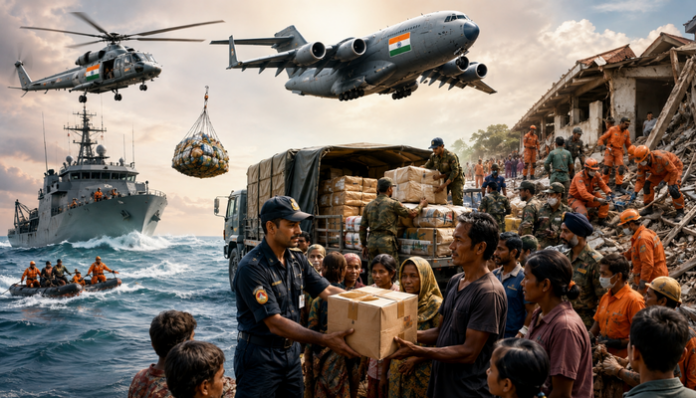
As the neighbouring Nepal is grappling with ravaging flash floods, India rose to the occasion and extended swift humanitarian assistance to the Himalayan country. India sent 62 tonnes of emergency aid to Nepal. India was the first country to provide physical assistance to the country in the middle of the deadly disaster.
As the death toll from the catastrophic flash floods rose above 600 and the number of missing people crossed 2000, India is actively taking part in the intensified rescue and relief operations, along with local authorities in Nepal. The Indian government is also sending consignments of relief material to Nepal.
On Saturday (29th August), India sent a fourth tranche of relief material to the country along with an 11-member team of doctors, paramedics and tunnel rescue specialists. According to the Indian Ministry of Foreign Affairs, the Indian government has also offered a tunnel rescue team, a medical team and personnel from its National Disaster Response Force to the disaster-hit country.
India has been among the first responders whenever its neighbours faced any natural disaster or any other calamity. It has stood by its Himalayan neighbour, which often faces natural disasters, through thick and thin. The Indian government extended similar support to Nepal following the devastating 2015 earthquake. The Indian government and the Indian armed forces launched a massive rescue and relief operation under Operation Maitri.
During the operation, the Indian Air Force and the Army flew 2223 sorties, rescued/evacuated about 11,200 people (including 780 casualties) to safer places and transported and dropped about 1700 tonnes of relief materials. Besides, the Rapid Action Medical Teams of the Indian armed forces extended medical assistance to 4762 injured.
Let’s take a look at how India has emerged as the ‘first responder’ and a true friend in need during times of crisis for not just its neighbours but also for countries located afar.
Operation Amistad after twin earthquakes in Venezuela
About two months ago, in June 2026, the South American country of Venezuela was jolted by twin apocalyptic earthquakes. The calamity caused horrifying visuals of high-rise buildings turning into rubble, huge loss of life and devastation. The Modi government presented an example of friendship and support in times of crisis by sending urgent humanitarian assistance to Venezuela under Operation Amistad (the word Amistad means friendship in Spanish).
Under the operation, which was part of India’s HADR mission, the Indian government dispatched two Indian Air Force C-17 Globemaster aircraft carrying humanitarian relief supplies and a 41-member rescue team to assist the ongoing relief and rescue efforts in the Bolivarian Republic of Venezuela. The relief consignment included a self-reliant Indian medical task force, an Indian Army Field Hospital unit with HADR pallets and medicines, 30 tonnes of relief supplies, 6 tonnes of medicines and medical equipment and two BHISHM cube portable hospitals.
The Indian government expressed solidarity with the people of Venezuela and assured the government of Venezuela of all possible assistance in the time of crisis.
Operation Sagar Bandhu after Cyclone Ditwah hit Sri Lanka
In November 2025, a deadly cyclone hit the coasts of Sri Lanka, causing massive floods, loss of life and destruction. The Indian government launched Operation Sagar Bandhu to provide urgent emergency assistance to the country. Two Indian Navy ships immediately transported food supplies and relief material, tents, tarpaulins, blankets, hygiene kits, ready-to-eat food items, medicines and surgical equipment to Colombo.
India deployed troops from the National Disaster Response Force (NDRF) and the Air Force to provide search, rescue, and relief assistance. A 5-member medical team for on-site training and an 80-member special Urban Search and Rescue (USAR) team of the NDRF were sent to assist in rescue efforts. Chetak helicopters from INS Vikrant and MI-17 helicopters of the Indian Air Force joined the Sri Lankan Air Force in conducting search and rescue operations.
India’s unwavering support and humanitarian efforts in the middle of a crisis touched the people of Sri Lanka, who expressed their gratitude to the Indian troops deployed in the rescue work.
Operation Brahma for earthquake-hit Myanmar
In March 2025, when Myanmar was hit by a ravaging earthquake, India stepped up as a good neighbour and helped it in the rescue and relief work. The 7.7 magnitude earthquake wreaked havoc, killing over 5000 people and injuring over 11,000. The Modi government launched Operation Brahma to extend support to the disaster-torn neighbour.
The Indian government sent IAF aircraft carrying the National Disaster Response Force (NDRF) personnel and tonnes of relief material to the country. In addition to that, India deployed two of its Naval ships for rescue work. Another aircraft carried 118 personnel from the Indian Army’s Field Hospital Unit, including Women and Child Services and relief material to Myanmar.
India also provided disaster relief support to Myanmar after it was hit by Cyclone Komen in July-August 2015, causing floods and landslides. The cyclone affected 250,000 people and destroyed over 500,000 acres of farmland. The government provided emergency relief assistance to the country and transported relief materials to the country.
Operation Dost following earthquakes in Turkey and Syria
India extended humanitarian support after devastating earthquakes hit Turkey and Syria in March 2023. India launched Operation Dost to help in the rescue and relief operations in the two countries. Within hours of receiving requests for assistance from Turkey, the Indian government dispatched relief material along with three teams of the National Disaster Response Force (NDRF) to help the disaster-hit country. The Indian Army set up an on-field hospital to offer medical assistance to the injured. Similar assistance was provided by India to Syria, where the Indian government sent Indian Air Force aircraft carrying emergency relief assistance.
India aid after volcanic eruption in Papua New Guinea
In November 2023, Papua New Guinea, an island country in Oceania, was hit by a major eruption at Mount Ulawun. The volcanic eruption forced the government of Papua New Guinea to evacuate around 26,000 people from the affected area. India was quick to extend humanitarian aid to the country, which is its development partner under the Forum for India-Pacific Islands Cooperation (FIPIC).
The Indian government announced $1 million in immediate relief assistance for the country. India sent 11 tonnes of disaster relief material, including tents, sleeping mats, hygiene kits, meals ready to eat, and water storage tanks and 6 tonnes of medical aid material. Prime Minister of Papua New Guinea James Marape thanked the Modi government for sending humanitarian aid during the humanitarian crisis caused by the volcanic eruption.
This was not the first time that India extended support to the country. It also provided humanitarian assistance to Papua New Guinea following the 2018 earthquake and the 2019 volcanic eruption. Due to the Indian government’s unconditional support to the country in times of crisis, the relations between the two countries grew stronger and warmer. This was reflected when PM Marape welcomed PM Modi and touched his feet out of respect at the airport during the latter’s visit to the country in May 2023.
Operation Samudra Maitri for earthquake and Tsunami-hit Indonesia
In October 2018, a catastrophic earthquake and subsequent Tsunami hit the island country of Indonesia. The 7.5 magnitude earthquake combined with the tsunami caused widespread destruction in the country, leaving over 4000 people dead. The Modi government launched Operation Samudra Maitri to help its neighbour in tough times.
Under the operation, the Indian government sent two Indian Air Force aircraft, C-130J and C-17, carrying relief material, including medicines, tents, and generators, along with medical personnel and equipment to set up a field hospital. India also deployed three Indian Navy ships, INS Tir, INS Sujatha and INS Shardul, which carried additional humanitarian supplies.
Over the years, India has time and again proved that it is a reliable neighbour and a generous friend to countries in times of natural disasters. India’s response to disasters at the domestic as well as international level has demonstrated the effectiveness of its Humanitarian Assistance and Disaster Relief (HADR) framework.


