

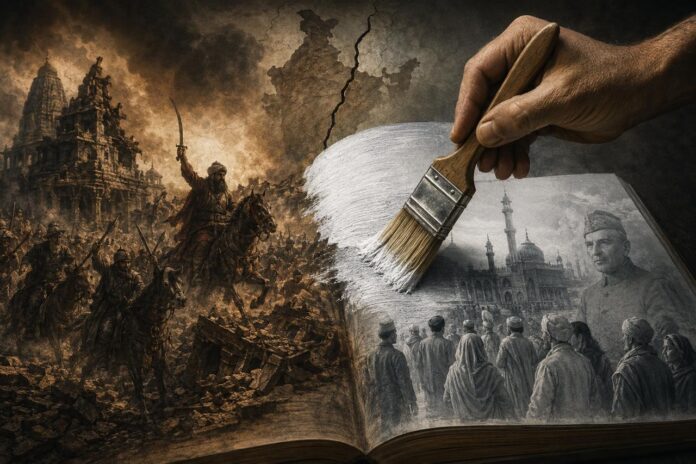
Marxist historiography in India emerged to defend the idea of Muslim separatism. It grew alongside the demand for a separate Muslim homeland. The Muslim League under Mohammad Ali Jinnah argued that if Muslims were not given a state of their own, the Hindu majority would sweep them away after the British left India. After the partition, over 3.5 crores of Muslims were left in India. Either they lacked the means to move from across India to Pakistan, or they did not want to leave their hearths and homes, built by their ancestors. Roughly 75 lakhs of Muslims left India for Pakistan.
The partition did not solve India’s Muslim problem. However, it provided a springboard for Marxist historians. They became their spokespersons. They tell us that those Muslims who did not migrate were as much Indians as their Hindu neighbours, thereby repudiating the two-nation theory. By this logic, the concessions given to them should not be withdrawn as a reward for their staying back.
The Congress party had made several compromises with Muslims to avoid being labelled a Hindu party. In 1937, for example, the party decided to chop off three stanzas from Vande Mataram, because Muslims found the verses sacrilegious. However, the effort to attract Muslims was unsuccessful. The 1937 and 1946 provincial elections showed that Muslims favoured the Muslim League rather than the Congress.
The failed compromises made towards Muslims to win them over to the Congress during colonial times persisted in independent India, and the very ideas that fuelled Muslim separatism received constitutional recognition. Vande Mataram should have been restored in its entirety, but the song continued in truncated form, with the same argument that Muslim sentiments were frayed by the full song.
Muslims continued to have their way, both in colonial India and in free India. The competitive compromises became a test of secularism.
As these events were unfolding, Marxist historians were quietly laying the groundwork to justify the concessions made to Muslims. Mohammad Habib of Aligarh Muslim University had turned to Marxism after the Anglo-Soviet Pact of 1941. Previously banned communist literature was allowed to enter India, and Habib was among the early influential converts. He was the first to propound the notion (Sultan Mahmud of Ghazanavi, 1927) that Muslim rulers of medieval India razed temples out of avarice and greed and that they had no religious duty to do so.
Habib was a friend of the Nehrus. He was a protégé of Motilal Nehru, as the Swaraj Party had roped him in to contest the 1926 elections from a reserved constituency. The ideas Habib set out in his 1927 monograph on Mahmud were echoed in Jawaharlal Nehru’s The Discovery of India (1945), where he described Mahmud as ‘far more a warrior than a man of faith’, interested in ‘encouraging cultural activities’, and, if he broke temples, it was mainly ‘to carry off building materials’ to his home town to erect big buildings.
After Nehru became prime minister, he relied on Marxist historians to justify his pro-Muslim policies. However, merely criticising colonial and nationalist historians was not enough; Marxist historians needed to develop theories to support their claims. Nehru had given them ample clues. The first praxis was to demand that class become the organising principle in India with socialism as a state goal.
In his presidential address to the Indian History Congress (1947), Habib called upon historians to use their pens to fashion a society based on class:
Most writers of Indian history in the past, it has to be frankly confessed, have belonged to the ‘bourgeois culture group’, and this fact has inevitably coloured their vision. Modern works on Indian history (show) their attitudeof uncriticall adulation towards the higher classes… The tendency towards socialism will gain in weight and volume as with every succeeding year the working classes strive to come to their own. The historian must not fail to do his duty (to lead India) to the shrine of her new-found, classless God.
The notion of class was as academic as it was political. Historians and leaders such as Nehru have increasingly argued that a class-based society had fewer fault lines, for poor Muslims and poor Hindus had more in common with each other than with an affluent Hindu. This would also help Hindus to seek more common ground with Muslims, and the horrendous past of Islam in India would pose no hindrance.
The second praxis is to explain Muslim presence in India after the partition. Romila Thapar took the lead here. She accused colonial historians of painting a bleak communal situation in India to perpetuate their stranglehold. In her essay, Communalism and Ancient India History (1969), she says:
The creation of Pakistan did not, however, solve the problem for the communal historian. The Hindu communalist still has to contend with the reality of Muslim culture. Hence the attempt to either belittle its importance or emphasise its foreignness.
According to her view, the past was not negative; Muslim rulers generally did not demolish temples. While there were some exceptions, things were mostly fine. Muslim governance rarely affected ordinary people’s lives. If Muslim rulers are criticised, it should also be noted that Hindu rulers destroyed temples and places of worship of other faiths. So, Hindus must not complain, for they themselves had blood on their hands.
Accusing Hindus, especially nationalist leaders, for the partition is the third praxis. Therefore, they insisted that it was Hindus who had cornered Muslims so much that they felt staying back in India would annihilate their culture and religion. It was Hindus who were originators of the two-nation theory, and the demand for Pakistan by the Muslims was an attempt to escape the inevitable Hindu rule. These historians plucked statements from Bankim, Tilak, Savarkar, and the shuddhi movement, and amplified them to provide cover for the prime accused.
Right after the British took over India, half a dozen orthodox Muslim organisations sprang up with the singular aim of weaning Muslims away from the social corruption that had become ingrained in them through their contacts with Hindus, and of driving away the new colonisers to hark back to the golden age of Islam in India. Syed Ahmed Khan chiefly put these orthodox concerns in language the British could understand.
There is plenty of literature to support the claim that the idea of Muslim separatism dates to the 1870s. But these documents, which contain unmistakable evidence of the Muslim skulduggery, have been hailed by Marxist historians as a colonial ploy to divide Hindus and Muslims.
A general survey of Marxist historiography in India substantiates that it has unabatedly offered its services to Muslim fundamentalism. The indomitable Sita Ram Goel has rightly (Stalinist Historians Spread the Big Lie, 1993) described their alliance:
Islam has never learnt to argue its case with facts and logic. All through its history, it has relied on the sword and street riots. In India, it used the sword for several centuries. After the loss of its political power, it has relied on street riots. The weapon has yielded and continues to yield rich results. It is, therefore, not an accident that Islam in India has always left it to Stalinists to argue its case.
The author’s latest book, India’s Rogue Historians (2026), explores Marxist historiography with reference to the Ram Janmabhoomi.


