

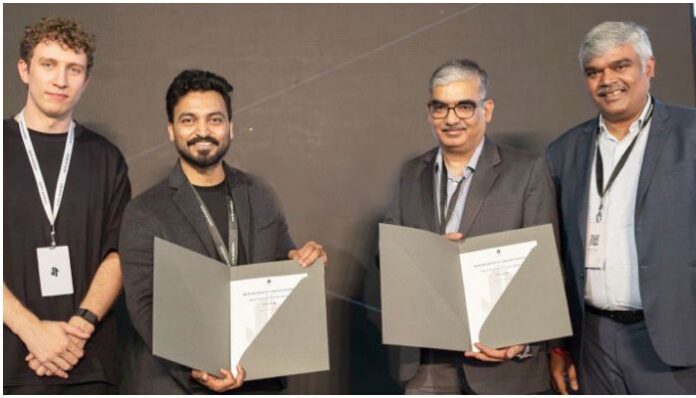
On Tuesday, 1st September, Design and technology services firm Tata Elxsi announced that it has signed a Memorandum of Understanding (MoU) with Bengaluru-based startup Sarla Aviation to collaborate on developing its Shunya electric air taxi. The partnership comes as Sarla Aviation moves ahead with its plans to develop an Indian-made electric vertical take-off and landing (eVTOL) aircraft for urban air mobility.
Under the memorandum of understanding (MoU), Tata Elxsi will provide engineering support for several important parts of the aircraft programme. Its work will cover avionics, flight-control systems, software integration, testing, verification and validation, as well as certification support.
Tata Elxsi and Sarla Aviation partner to accelerate development of #Shunya, India's first indigenous #eVTOL aircraft.
— Tata Elxsi (@tataelxsi) September 1, 2026
Learn more: https://t.co/8O6D18vfSv pic.twitter.com/3Y5mz6IPoJ
Sarla Aviation, meanwhile, will remain responsible for the overall design and development of Shunya. The company will also lead the type certification process for the aircraft. The two companies could later expand their partnership to areas such as sensor-fusion-based navigation software, structural and industrial design and airworthiness testing.
Tata Elxsi to support Shunya’s flight-control and certification work
The agreement comes at an important stage in Sarla Aviation’s development journey. The company is now moving beyond technology demonstrations and towards building a full-scale aircraft that can eventually carry passengers.
Tata Elxsi’s support will focus on areas that become especially important as an aircraft moves closer to commercial operations. Flight-control systems, avionics integration, software testing and certification require extensive engineering and validation before an aircraft can be cleared for passenger operations.
The partnership could also help Sarla Aviation build capabilities for other future applications. According to Tata Elxsi, the collaboration is expected to strengthen technologies that could eventually be useful in logistics, air ambulance services and defence-related applications.
Manoj Raghavan, CEO and Managing Director of Tata Elxsi, said the development of advanced air mobility will require both engineering capabilities and a wider ecosystem of supporting technologies.
“Every major shift in transportation has been enabled by a combination of engineering innovation and ecosystem readiness. Advanced air mobility is no different, and Sarla Aviation’s vision for Shunya reflects the ambition driving this transformation. “Initiatives like this create opportunities to apply expertise built across aerospace, mobility and digital technologies to entirely new aviation platforms,” Raghavan said.
Sarla Aviation co-founder and CEO Adrian Schmidt also highlighted the challenges involved in developing a completely new category of aircraft.
“Building a new class of aircraft is not simply an engineering challenge,” Sarla co-founder and CEO Adrian Schmidt said. “It requires bringing together people and organisations willing to solve problems that have never been solved before in this market.”
Schmidt said Tata Elxsi’s experience in complex aerospace systems would give Sarla access to the engineering capabilities needed to take Shunya “from concept to reality”.
Shunya designed to fly more than 300 km
Shunya is being developed as a seven-seater electric air taxi, including one seat for the pilot. The aircraft is designed for flight operations of more than 300 km and combines vertical take-off and landing capability with the efficiency of fixed-wing flight.
This combination is important because an eVTOL aircraft can take off and land vertically without needing a conventional runway, while its fixed-wing configuration can help it become more efficient during longer-distance cruising.
Sarla believes this design could make Shunya suitable for point-to-point air travel, particularly on routes where road journeys take a significant amount of time.
The company is targeting the first flight of Shunya within the next 18 to 24 months. Certification activities are expected to follow as the aircraft progresses through development and testing. For Sarla, the immediate goal is to turn the technologies tested on its smaller demonstrator aircraft into a full-scale passenger-carrying platform.
Sylla demonstrator helped test Shunya technologies
Before developing Shunya, Sarla Aviation conducted flight tests using Sylla, a smaller technology demonstrator. Earlier this year, the company completed a six-month flight-test campaign involving more than 500 test points and over 18 hours of flight time.
The company is now working on Sylla 2.0, which is expected to focus on another major challenge in eVTOL development, the transition from vertical flight to normal wing-borne flight.
Data collected during the first Sylla campaign is being used to improve the next demonstrator as well as the Shunya programme. Sarla CTO and co-founder Rakesh Gaonkar has said that the first aircraft provided the company with the data it was looking for and that the lessons from those tests are now influencing the next stage of development.
Tata Elxsi brings aerospace engineering experience
The partnership also gives Sarla access to Tata Elxsi’s existing experience in aerospace and advanced mobility technologies.
Tata Elxsi has worked on areas including battery management, flight controls, avionics software, systems integration and certification support. The company had also agreed with the CSIR-National Aerospace Laboratories in January 2025, covering areas such as unmanned aerial vehicles, urban air mobility and eVTOL technologies.
For Sarla, this experience could be useful as Shunya moves from an engineering concept towards an aircraft that needs to meet aviation safety and certification requirements.
Jayaraj Rajapandian, Head of Aerospace at Tata Elxsi, said the Shunya project reflects how quickly aviation technology is changing.
Sarla’s plan to use Shunya for airport transfers and medical flights
Shunya is part of a larger urban air mobility plan that Sarla Aviation outlined in 2024. The company has chosen a relatively large aircraft for its first commercial platform, with six passenger seats and one seat for the pilot.
The idea is to spread the cost of operating the aircraft across more passengers and eventually offer fares that can compete with premium ground transportation.
Sarla’s first phase would focus on passengers who place a high value on saving time. Airport transfers, especially for business travellers, are expected to be one of the key uses.
Bengaluru is an important example for the company.
Medical transport is another important part of the initial plan. Sarla’s 2024 proposal envisaged commercial passengers paying for flights while medical missions could be provided free of cost.
From premium air taxis to wider urban connectivity
Once the first phase becomes operational, Sarla plans to expand its network. The company intends to use revenue from its early operations to increase aircraft production and reduce costs through larger-scale manufacturing.
The second phase would move the service beyond premium airport transfers. Sarla wants to connect residential areas with offices, schools, universities, parks, sports facilities and other frequently used locations.
The company has also discussed residential communities with dedicated landing facilities, which could allow people to travel directly between their homes and important destinations without relying on congested roads.


