

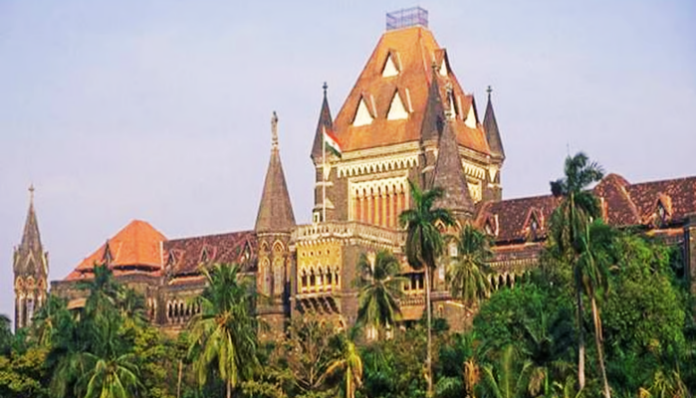
The Bombay High Court recently took suo motu cognisance of noise and environmental pollution being caused by various factors, including the bursting of firecrackers and the use of amplified music systems during festivals in public places. A Bench of Justices G. S. Kulkarni and Dr Neela Gokhale, on September 22, 2026, examined the factors contributing to the pollution and issued directions to the concerned authorities to curb it.
Celebrations need to be more “dignified” and “civilised”: HC.
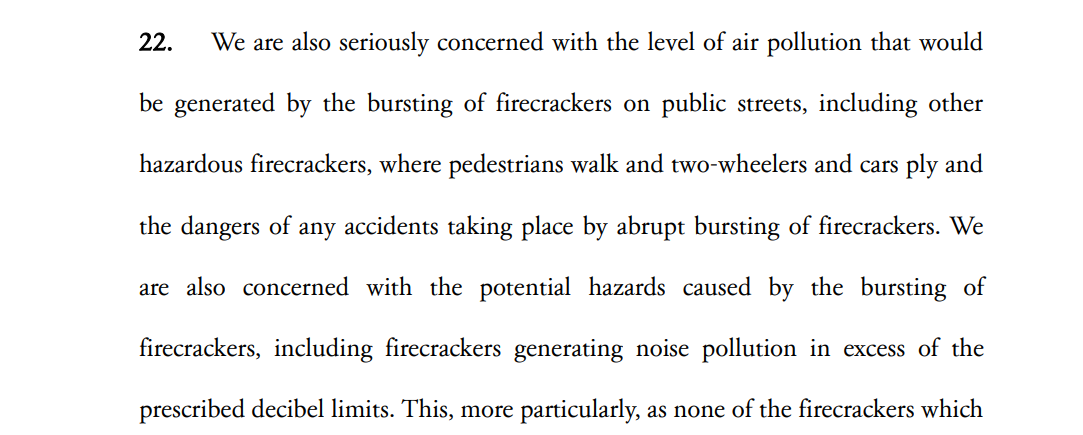
The High Court expressed concern over the noise and air pollution caused by the use of firecrackers and loud music systems during festivities in public places. “We are also seriously concerned with the level of air pollution that would be generated by the bursting of firecrackers on public streets…We are also concerned with the potential hazards caused by the bursting of
firecrackers, including firecrackers generating noise pollution in excess of the prescribed decibel limits,” the court said.
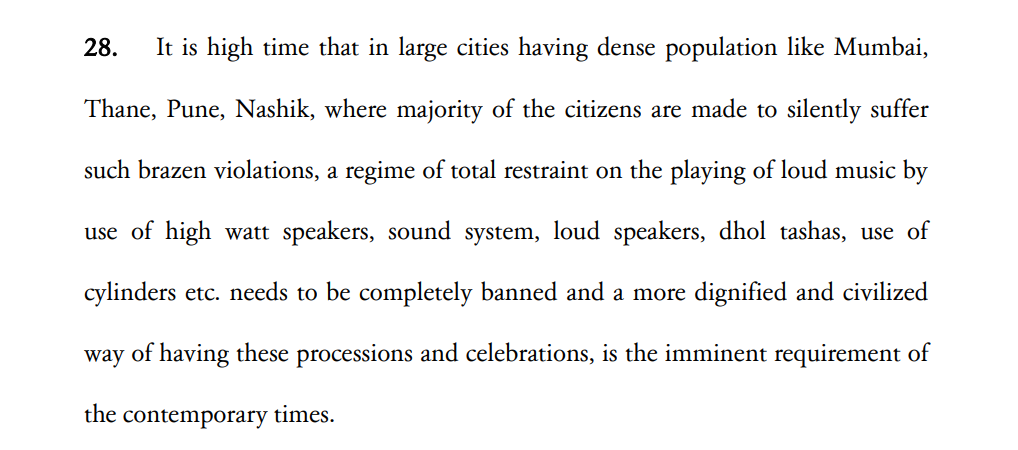
The High Court observed that the manner of celebrating festivals needs to change and become more “dignified” and “civilised”, keeping in mind the requirements of contemporary times. The Court said that the problem is magnified in large cities with huge populations, where the majority of people become silent sufferers of the brazen violations.
“It is high time that in large cities having dense population like Mumbai, Thane, Pune, Nashik, where majority of the citizens are made to silently suffer such brazen violations, a regime of total restraint on the playing of loud music by use of high watt speakers, sound system, loud speakers, dhol tashas, use of cylinders etc. needs to be completely banned, and a more dignified and civilised way of having these processions and celebrations is the imminent requirement of the contemporary times,” the court stated.
Rules have remained as mere paper provisions: HC.
The court adopted a strict stance and pulled up the authorities for insufficient implementation of the Noise Pollution (Regulation and Control) Rules, 2000 and the failure to act on violations under the rules. “…although robust provisions are available in law to control and regulate the levels of noise pollution being generated by the processions and venues in the festivities, mostly they have remained to be paper provisions, much less being effectively implemented in letter and spirit,” the High Court observed.
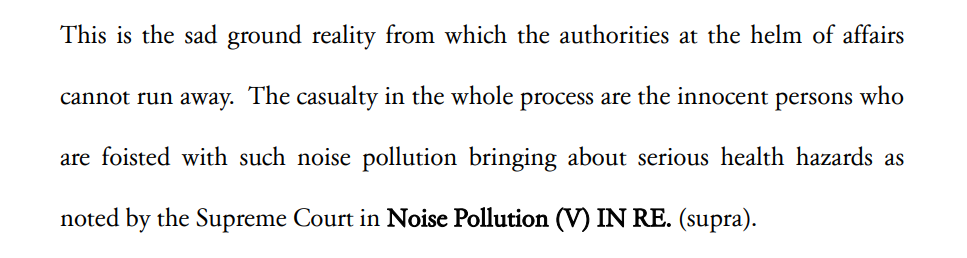
The court said that due to the laxity displayed by the concerned authorities in implementing the laws, the ordinary citizens are left to suffer the effects of noise and environmental pollution. “This is the sad ground reality from which the authorities at the helm of affairs cannot run away. The casualties in the whole process are the innocent persons who are subjected to such noise pollution, bringing about serious health hazards…” the court noted.
The High Court said that the authorities need to become proactive and take preventive measures to curb the problem instead of swinging into action only after a complaint is filed. “…there is no warrant in having a mechanism that only after complaints of violations and breaches are made, and only then the official machinery would step in to set into motion to impose petty penalties. This would be a situation when enormous damage has already been caused…” the court remarked.
The court added that the existing mechanism to address the problem of pollution cannot be reduced to a mere formality with the authorities silently allowing violations.
The High Court’s directions
The High Court issued a set of directions to the state authorities to prevent air and noise pollution across the State, which included a total ban on bursting firecrackers, use of laser lights, high-intensity lumen lights and beams during festivities or processions in public places. It ordered the authorities to take all measures, from preventive actions to punitive actions, to implement the direction.
The court directed the police and the concerned authorities to measure decibel levels during any festivity to catch violations and also empowered them to seize the offending devices or instruments.
The court also directed the authorities to consider collecting a security amount from individuals and groups seeking permission to use noise-causing instruments during festivities or processions. The court said that individuals should deposit at least ₹50,000 and groups at least ₹1 lakh while seeking such permission. If the individuals or groups violate the rules, the deposited amount will be forfeited by the authorities.
The court directed the organisers of such festivities or processions to furnish an undertaking that the sound systems to be used are fitted with internal sound compressors. Besides, the organiser will be required to install ‘Decibel Measurement Meters’ at every venue or procession. The court ordered the authorities to maintain a record of the decibel levels at all the festivities permitted under the 2000 Rules.
The High Court directed the authorities to take necessary action as per the existing laws in case of violations. Furthermore, it urged citizens to recognise their collective responsibility towards society.


