

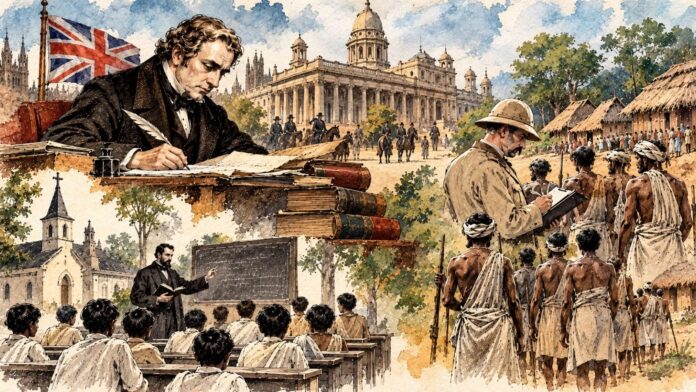
Leftists have been trying for a long time to claim that the tribals of India are ‘not Hindu’. This is not a modern phenomenon. This is a systematic social engineering that was codified and worked into a brilliantly designed machine by the British rulers of India in the 1800s.
The game has two primary tools: syllabus and census. In 1835 Macaulay put English at the centre of higher education. Sanskrit and Arabic funding shrank. A year later, in a letter home, he wrote, “No Hindu who received an English education stayed sincerely attached to his religion. Not by force, he added, but by “knowledge and reflection.”
Shame first. Conversion later. That syllabus reached the forests. At Chaibasa, Birsa sat in a German mission classroom built on the same idea: “your gods are superstition; the West is the future.” Birsa walked out of that frame. He went to a Vaishnav teacher, took the sacred thread, and returned to Singbonga, the ancient God of his land. The classroom had failed him. But the game that was played in the classroom was already evolving into administrative reality in the British Raj.
Census. The British played a long game to forcefully separate the tribal identity from the Hindu identity of Indians. In 1871, tribals were parked in the ‘Others’ category. In Chhotanagpur, they were still mostly counted with Hindus; their own report even admitted the line between “Hindooism” and tribal faith was almost impossible to draw.
Then census grouping kept changing: Aboriginal, Animist, Tribal Religion. The same work continued for sixty years. By 1881, many tribal families told enumerators they were Hindu. Officials still hesitated to write it down. “What is a Hindoo?” a Bengal officer asked, and answered that no definition existed, and the counting continued anyway. By 1931 the split was complete on government papers. Tribals were officially listed as ‘not Hindu’, and therefore, the Raj subtly implied, ‘available’.
It was a long, calculated game to legally declare an entire population “not Hindu.” To create on paper a category of Indians who were officially outside the boundaries of Hindu civilisation and therefore officially available for conversion.
The full article can be read here on Chapter One Magazine.


