Dalal Street finally had something to cheer about on Tuesday as Indian equity markets staged a powerful comeback, reversing losses and adding approximately Rs 4 lakh crore to investors’ wealth.
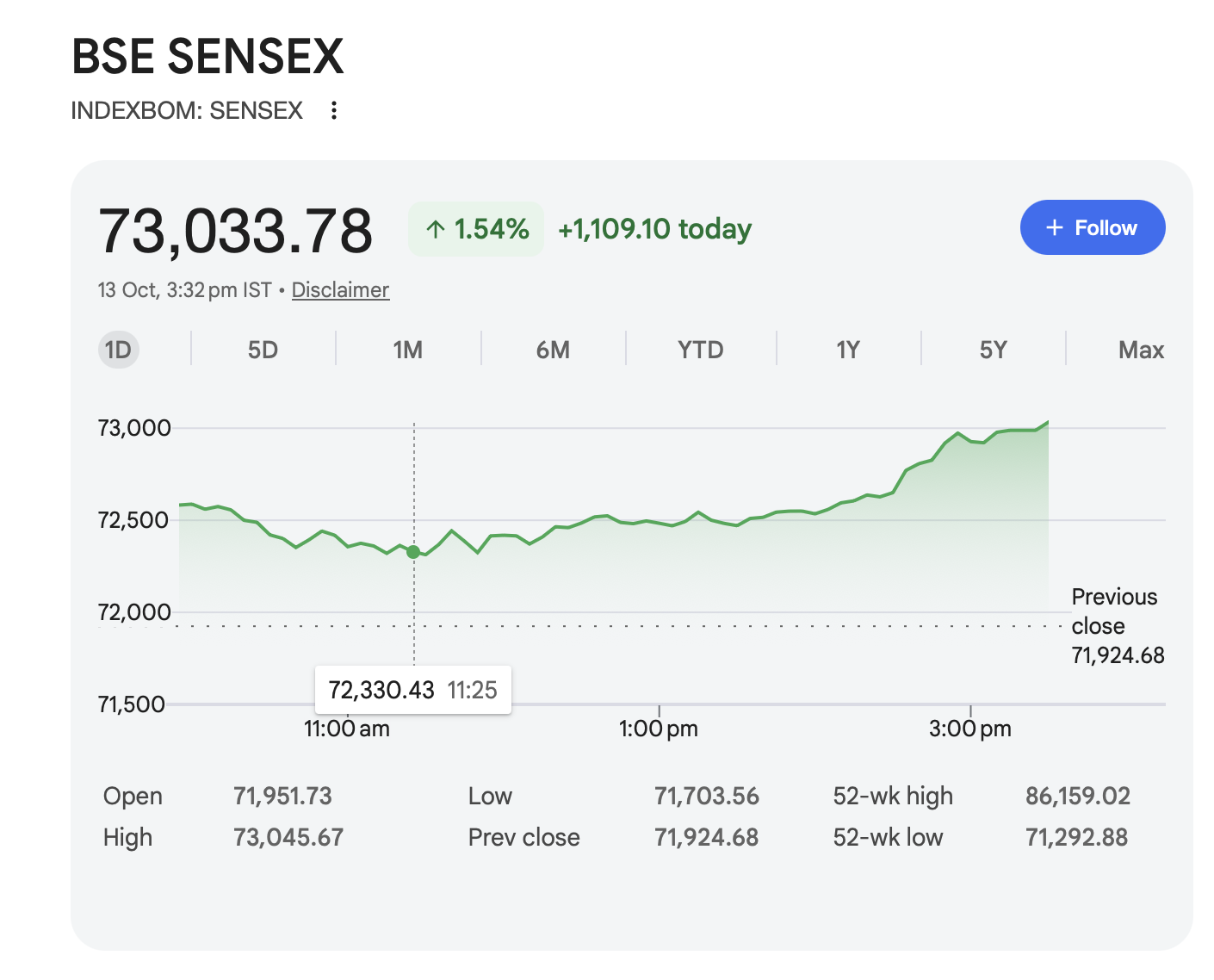
The BSE Sensex jumped 1,109.10 points, or 1.54%, to close at 73,033.78, while the NSE Nifty 50 advanced 358.60 points, or 1.60%, to settle at 22,721.95.
The rally came against a backdrop of persistent concerns over foreign investor outflows, elevated crude oil prices and uncertainty surrounding the global economy. Yet, a combination of encouraging corporate earnings and renewed hopes of a more accommodating approach to equity taxation helped change the mood on Dalal Street.
The immediate trigger was the strong performance of IT stocks following HCLTech’s quarterly results. Finance Minister Nirmala Sitharaman’s remarks on the debate surrounding long-term capital gains (LTCG) tax and securities transaction tax (STT) provided an additional boost, while the recovering rupee and softer crude prices offered further support.
But how much of Tuesday’s rally reflected an improvement in corporate fundamentals, and how much was driven by expectations?
1. Sitharaman’s tax remarks revive hopes of relief ahead of Budget 2027
One of the most significant developments on Tuesday came from Finance Minister Nirmala Sitharaman, who acknowledged the ongoing debate surrounding LTCG tax, STT and the taxation of different asset classes.
Speaking at the Bloomberg New Economy Forum in New Delhi, the Finance Minister said investors in India and abroad had been commenting on capital gains taxation and the transaction tax imposed on securities markets.
#Breaking | FM Nirmala Sitharaman says the government will hear stakeholder views on LTCG tax, STT and the treatment of different asset classes as Budget preparations begin. Here’s what she said. https://t.co/UxrvaGm6GR
— NDTV Profit News (@NDTVProfit) October 13, 2026
She described the debate as healthy and said she would be keen to hear the arguments.
Her remarks attracted attention because investors have been demanding a reassessment of the tax burden on equity investments.
The government raised LTCG tax on eligible listed equity investments from 10% to 12.5% in the July 2024 Union Budget, while increasing the annual exemption threshold from Rs 1 lakh to Rs 1.25 lakh. Budget 2026 subsequently increased STT on equity derivatives.
Investors argue that these levies increase the cost of participating in India’s capital markets, particularly when foreign investors are already reassessing their exposure to Indian equities.
Sitharaman’s comments therefore raised hopes that the government might be more receptive to these concerns during consultations ahead of the Union Budget scheduled for February 1, 2027.
The market reaction was particularly encouraging for capital-market-related stocks, as investors began pricing in the possibility of a more favourable policy environment.
However, there is a crucial distinction between the Finance Minister acknowledging an issue and the government committing to resolve it.
Sitharaman announced no tax cut, promised no exemption and did not confirm that any particular proposal was under consideration. Tuesday’s rally reflected expectations of a possible policy review, not an actual change in taxation.
2. IT stocks lead the charge as HCLTech delivers strong earnings
If the Finance Minister’s remarks provided a policy catalyst, IT earnings supplied the rally’s strongest immediate fundamental trigger.
HCLTech shares jumped 8.28% after the company reported a consolidated net profit of Rs 5,132 crore for the July–September quarter of FY27, representing year-on-year growth of approximately 21.2%.
The results helped revive confidence in a sector that has faced sustained concerns over slowing growth, moderating client spending and the potential disruption of conventional outsourcing by artificial intelligence.
The buying quickly spread across the sector.
Tata Consultancy Services rose 6.59%, Tech Mahindra gained 4.90%, and Infosys advanced 4.44%. The Nifty IT index surged approximately 5.2%, recording its strongest session in more than 17 months, according to Reuters. <Cite refs={[“turn120305news9”]}/>
The rally is significant because IT stocks have been among the market’s more troubled segments this year.
Investors have questioned whether generative AI and increasingly capable automated systems could undermine traditional software services, reduce demand for labour-intensive outsourcing and place pressure on the industry’s established business model.
HCLTech’s results offered a counterpoint to this pessimism. Stronger profitability and developments in AI-related business gave investors reasons to reconsider the sector’s near-term earnings prospects.
However, the rally should not be interpreted as proof that the industry’s structural challenges have disappeared.
Arun Malhotra, fund manager at CapGrow Capital, offered a more cautious interpretation of the gains.
According to Malhotra, the rally in IT stocks did not represent a structural reversal for the sector. Instead, better-than-expected earnings from TCS and HCLTech had created an opportunity for value buying.
That observation is important. After a period of substantial weakness, even a relatively modest improvement in earnings expectations can trigger aggressive buying as investors look for undervalued opportunities.
The latest results may have improved sentiment, but the sector will need sustained revenue growth, healthy deal pipelines and resilient margins to establish a durable recovery.
3. Rupee recovery and RBI measures ease currency concerns
The Indian rupee’s recovery provided another supportive factor.
The currency strengthened for a third consecutive session, with the RBI’s measures aimed at easing dollar demand and curbing excessive positioning in the foreign exchange market contributing to the improvement.
A weaker rupee can increase the cost of imported commodities, intensify inflationary pressure and reduce the dollar-denominated returns foreign investors receive when converting their Indian equity investments.
A recovering currency can help ease these concerns and improve confidence in the domestic financial environment.
The benefits, however, are not uniform across sectors. A stronger rupee can reduce the domestic-currency value of overseas earnings for export-oriented companies, including IT service providers.
Tuesday’s simultaneous rally in the rupee and IT stocks indicates that investors were more focused on earnings performance and improving sentiment than on this potential headwind.
4. Lower crude prices offer relief, but the oil threat remains
Brent crude declined approximately 1.65% to around $104.89 per barrel on Tuesday, offering some relief to a market concerned about India’s vulnerability to high energy prices.
India imports a substantial share of its crude oil requirements. Expensive oil increases the import bill, puts pressure on the rupee and can raise costs for businesses across multiple sectors.
Lower crude prices can consequently improve the outlook for inflation, corporate margins and the external balance.
However, oil prices remained above $100 per barrel amid tensions in the Middle East.
Malhotra warned that the broader market outlook remained hostage to global macroeconomic conditions, with geopolitical uncertainty and elevated oil prices likely to constrain a sustained recovery.
His assessment offers a useful counterweight to the enthusiasm generated by Tuesday’s rally. A single session of lower oil prices does not remove the risks posed by an extended period of expensive energy imports.
5. IMF’s growth projection reinforces confidence in India
The International Monetary Fund’s projection of 7% growth for India provided another favourable backdrop for investor sentiment.
The assessment reinforced India’s position as the fastest-growing major economy, supported by domestic demand and economic activity.
Strong economic growth can support consumption, investment, credit demand and corporate earnings. It also strengthens the longer-term investment case for Indian equities.
Yet, economic growth and stock-market performance are not interchangeable. Investors must also consider valuations, the pace of earnings growth, foreign capital flows and global risk appetite.
The IMF’s assessment therefore supported the broader narrative around India’s economic resilience, but it was not, by itself, sufficient to explain a 1,100-point rise in the Sensex.
6. Market observers see earnings-led buying, not a universal recovery
The participation of banking, financial services, consumer and automobile stocks helped lift the benchmark indices. Gains were recorded in HUL, Titan, Bajaj Finserv, SBI, HDFC Bank, Mahindra & Mahindra and ICICI Bank.
However, market observers cautioned against treating the advance as an indiscriminate recovery across the entire market.
Hariselvan Radhakrishnan, founder and CEO of HST Wealth, said earnings-led buying in technology stocks, easing US Treasury yields and improving domestic sentiment outweighed concerns about elevated crude prices.
He also highlighted an important feature of the session: the Sensex and Nifty outperformed Bank Nifty, while participation across the broader market remained uneven. The advance was driven largely by large-cap technology companies and other heavyweight stocks, rather than an equally strong recovery across all segments.
Vinod Nair, head of research at Geojit Investments, similarly attributed the market’s advance to stronger-than-expected technology earnings, currency stability and easing bond yields, which also helped bring financial stocks into focus.
These observations suggest that Tuesday’s rally was supported by identifiable catalysts, rather than simply a broad return of risk appetite.
For investors, the distinction matters. A rally led by companies delivering better earnings can have a stronger fundamental basis than one driven entirely by speculation. But when gains are concentrated in a few heavyweight stocks, the broader market may remain vulnerable.
What happens next?
Three developments will determine whether Tuesday’s rebound can develop into a more durable recovery.
First, Budget 2027. Investors will be watching for concrete proposals on LTCG tax and STT. Until the government announces a decision, any anticipated relief remains speculative.
Second, the earnings season. HCLTech’s results have encouraged buyers to revisit IT stocks, but the sector’s recovery will depend on whether other companies deliver comparable results and provide reassuring guidance.
Third, global conditions. Crude oil prices, geopolitical tensions, the rupee and foreign investor flows will remain critical variables. A renewed surge in oil or further deterioration in global risk appetite could undermine the recovery.
The market’s next move will therefore depend on whether the positive developments behind Tuesday’s rally persist beyond a single trading session.
A relief rally, but the jury is still out
The Sensex’s 1,109-point surge reflected the combined impact of strong IT earnings, a recovering rupee, lower crude prices, encouraging growth projections and renewed hopes of a review of equity taxation.
Sitharaman’s remarks gave investors a reason to anticipate a potentially more accommodating policy approach, while HCLTech’s results supplied a tangible earnings catalyst.
But the rally should not be mistaken for confirmation that Indian equities have overcome their underlying challenges.
As market observers have pointed out, value buying after strong results is not the same as a structural recovery. Nor does the Finance Minister’s willingness to hear arguments amount to a commitment to reduce taxes.
Dalal Street has found reasons to cheer, but the sustainability of the gains will depend on corporate earnings, global economic conditions and the government’s eventual policy decisions.
For now, the rally signals a change in sentiment. Whether it marks a genuine turning point for the market remains to be seen.