

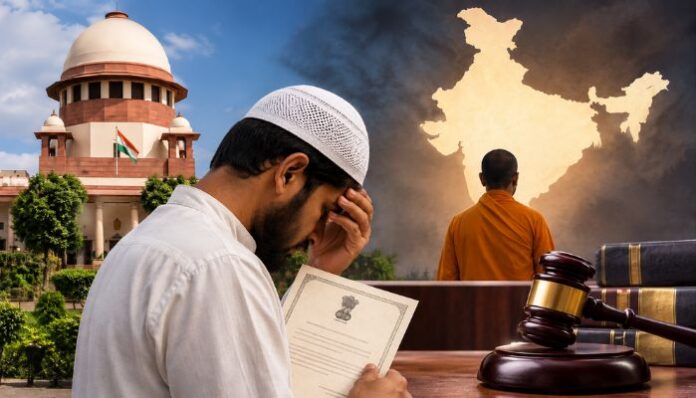
A landmark ruling against automatic reservation entitlement after conversion exposes the dangers of executive shortcuts, competitive-pool switching and vote-bank-driven classification — and invites a wider audit of OBC entries across states.
On 15 October 2026, the Supreme Court upheld the Madras High Court’s decision, striking down Tamil Nadu’s G.O. (Ms) No. 31 of 9 March 2024. The decision transforms the Sameer Ahmed dispute from a pending constitutional question into an important judicial affirmation: changing religion does not, by itself, make a person a member of a notified backward community in the adopted religion. Nor can an executive order or a private religious body manufacture the legal foundation for that entitlement.
The judgment does not restrict religious conversion. Instead, it prevents governments from making conversion an automatic route to reservation benefits. It also raises a serious political question: why are governments creating such pathways instead of ensuring that reservation is granted only on the basis of objectively established social and educational backwardness?
The case and the Supreme Court ruling
Sameer Ahmed, formerly Paramasivam, converted from Hinduism to Islam in 2015 and sought a Muslim Lebbai certificate to claim Backward Class Muslim (BCM) reservation. After his application was rejected, Tamil Nadu’s G.O. No. 31 came under challenge. The order allowed converts from BC, MBC, Denotified Communities and Scheduled Castes to be classified within one of seven notified Muslim backward communities. The Madras High Court quashed it on 25 June 2026.
Tamil Nadu argued that a person’s earlier disadvantage should not disappear after conversion. But the Supreme Court, through Justices Prashant Kumar Mishra and Shree Chandrashekhar, upheld the central finding: conversion alone cannot establish membership of a particular Muslim backward community. A community certificate records an existing status; it cannot create that status. Nor can a private religious body conclusively decide a statutory reservation entitlement.
The Court also addressed the separate Scheduled Caste rule under the Constitution (Scheduled Castes) Order, which limits SC status to persons professing Hinduism, Sikhism or Buddhism. Claims following reconversion require examination of their own facts, not automatic restoration.
Why this judgment matters
The distinction is straightforward. Article 25 protects the freedom to choose one’s religion; Articles 15 and 16 govern affirmative-action classifications. Exercising the first right does not, by itself, establish eligibility under the second. A government cannot simply transfer a person from an earlier caste or community category into a new reservation-bearing group through an executive order.
This is a significant check on arbitrary reservation policy. It requires the State to establish the legal and social basis of membership, rather than treat a change of religious label as sufficient proof. Comparable rules elsewhere may now face challenges, although this judgment does not automatically cancel them.
Reservation arbitrage and the risk of double benefits
Tamil Nadu has a separate 3.5% BCM quota. This makes the possibility of “reservation arbitrage” worth examining: a convert could, under an automatic certification rule, enter a different competitive reservation pool without independently proving membership of the notified group. The Court has rejected that shortcut.
There is also a legitimate need to examine whether benefits claimed before and after conversion overlap, or whether incompatible concessions are being obtained through different certificates. But the ruling does not establish that converts generally receive double benefits or that an organised conversion racket exists. Such allegations require evidence. The policy concern remains serious even without assuming that every conversion is motivated by reservation.
The political question: Social justice or vote-bank policy?
G.O. No. 31 attempted to create a broad administrative route into seven Muslim backward communities. Its rejection raises a question for political parties: are reservation policies based on verifiable disadvantage, or are governments using convenient identity rules to expand electoral support? Social justice cannot become a justification for bypassing eligibility tests. The Court’s legal finding concerns the order’s validity; vote-bank motivation is a political criticism, not a judicial finding.
Mandal Commission and the basis of non-Hindu OBC classification
The Mandal Commission considered backward groups among Muslims and Christians, including occupational communities and parallels with groups among Hindus. But neither religious identity nor occupation alone should replace evidence of an identifiable socially and educationally backward group. Equally, the egalitarian teachings of a religion do not prove that social disadvantage cannot exist among its followers.
The Supreme Court’s reasoning makes the distinction between religion and community membership especially important. A convert does not automatically acquire the history, characteristics or recognised membership of a particular backward group merely by adopting its religion.
A question mark over Muslim OBC lists in other states
The wider significance now goes beyond Tamil Nadu’s certificate policy. If conversion cannot automatically confer membership of a notified Muslim backward community, what is the basis on which Muslim groups have been included in OBC lists in other states? Were individual communities identified through evidence of social and educational backwardness, or did any entry or certification process rely mainly on religious identity? Are those original grounds still valid?
These are questions that can now be brought before Backward Classes Commissions and courts. State-specific OBC entries, particularly those based on broad religious labels or automatic post-conversion classification, may face closer judicial scrutiny. The same test should apply to Christian entries and, indeed, every other listed community.
The judgment does not strike down Muslim OBC reservation as a whole, nor does it declare Muslims ineligible for OBC status. Its significance is that it strengthens the case for examining each classification on objective evidence rather than accepting religion or conversion as a substitute for community membership. Where that evidence is missing, inclusion should be open to challenge.
Conclusion: A wider test for reservation policy
The Sameer Ahmed judgment is a landmark against automatic reservation entitlement through religious reclassification. Faith remains a matter of individual freedom; a reservation certificate must reflect a legally established social status.
It also puts political shortcuts under the spotlight. Governments should examine possible reservation arbitrage, overlapping benefits and weak certification rules instead of using conversion as an administrative gateway to a new quota. Most importantly, the ruling opens the door to wider scrutiny of Muslim and Christian OBC entries across states: every group should meet the same transparent constitutional test. Reservation must rest on demonstrated backwardness, not merely on a change of faith or an executive decision.


