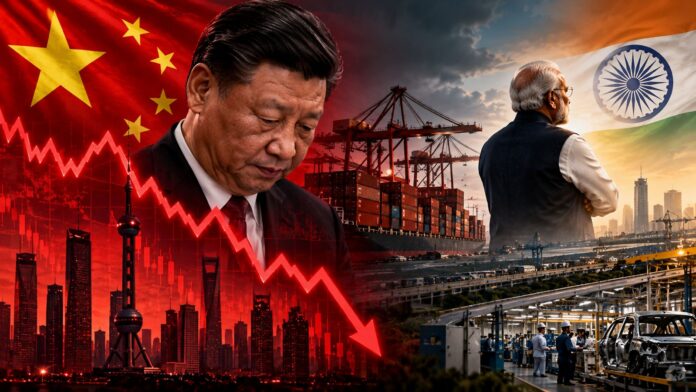
China’s stock market is sending a warning that Beijing would rather not hear. After months of investor enthusiasm over artificial intelligence (AI), technological breakthroughs and expectations of government support, Chinese equities are sliding sharply, exposing the fault lines in an economy that continues to struggle with weak domestic consumption.
The CSI 300 Index, which tracks 300 major companies listed in Shanghai and Shenzhen, has fallen around 20% from its June peak, entering bear-market territory. Hong Kong-listed Chinese stocks have also taken a beating, with technology shares leading the decline. The Hang Seng Tech Index plunged 5% on Thursday, October 22, while the broader Hang Seng Index fell 3%.
The sell-off comes despite China reporting 4.6% economic growth in the first three quarters of the year, keeping the country within reach of its annual growth target. Clearly, headline GDP numbers are not enough to convince investors that China’s economic recovery is on firm ground.
The problem is that China’s growth story increasingly rests on a contradiction. Beijing wants to position the country as a global technological superpower, pouring resources into strategic industries such as AI, electric vehicles, batteries and advanced manufacturing. Yet beneath this ambition lies a domestic economy where consumers remain reluctant to spend, corporate earnings disappoint investors, and expectations of another major government stimulus package are fading.
For India, this presents both an opportunity and a warning. China’s troubles could strengthen the case for diversifying manufacturing supply chains away from Beijing. However, a prolonged Chinese slowdown could also unleash a fresh wave of cheap exports, intensify competition for Indian manufacturers and trigger volatility across emerging markets.
The question is not simply why Chinese stocks are falling. It is whether India’s policymakers and businesses can turn China’s economic vulnerabilities into a long-term strategic advantage.
China’s AI euphoria meets the reality of corporate earnings
For much of the year, Chinese technology stocks benefited from investor optimism surrounding AI. Beijing’s push for technological self-reliance, the emergence of domestic AI companies and expectations of breakthroughs in advanced computing helped fuel enthusiasm for the sector.
Investors were betting that China’s technology companies would emerge as major beneficiaries of the AI revolution, even as US restrictions and geopolitical tensions complicated Beijing’s efforts to access advanced technology.
However, the stock-market rally appears to have run ahead of what businesses can actually deliver.
Investors are now asking uncomfortable questions about valuations, profitability and the returns generated by enormous investments in AI infrastructure. A promising technology is not automatically a profitable business, and a company’s strategic importance to the Chinese Communist Party does not guarantee that its shareholders will make money.
This reassessment is not confined to China. Investors worldwide have begun questioning whether the enormous sums being committed to AI infrastructure will generate sufficient returns. Higher US Treasury yields have also made investors more cautious about paying elevated prices for growth stocks.
Chinese companies face an additional disadvantage. Their valuations are being reassessed at a time when domestic demand remains weak, and hopes of a substantial economic stimulus package have diminished.
The result is a double blow: global investors are becoming more selective about AI stocks, while China-specific economic concerns are making its technology companies less attractive.
The decline in shares of companies such as Alibaba and Tencent reflects these concerns. Both have significant exposure to China’s internet economy, where consumer spending and advertising demand are important drivers of business performance.
The experience is a reminder that technological ambition, however impressive, cannot indefinitely compensate for weak demand and uncertain earnings.
Beijing’s growth numbers cannot hide the weakness in domestic consumption
China’s economic predicament goes beyond the stock market.
The country’s growth figures have held up, but the performance of different parts of the economy remains uneven. Exports have been relatively robust, while domestic demand continues to languish.
That distinction matters because a sustainable recovery requires more than factories producing goods for overseas markets. Chinese households must also be willing to spend, businesses must be able to generate healthy profits, and consumers must have enough confidence in their economic prospects to increase discretionary purchases.
When households remain cautious, the effects spread across the economy. Retailers struggle to increase sales, e-commerce platforms face pressure on revenue growth, and companies find it harder to justify fresh investments.
This is particularly relevant for China’s major internet businesses, whose fortunes are closely linked to consumer activity.
The problem also complicates Beijing’s attempt to rebalance its economy. China has long relied heavily on manufacturing, investment and exports. Weak household consumption makes it more difficult to create a recovery driven by domestic demand rather than external markets and state-directed investment.
For investors, meeting an annual GDP growth target is therefore not the same as witnessing a broad-based improvement in corporate profitability.
Markets are forward-looking. They respond not merely to how quickly an economy has grown, but to whether businesses are likely to earn more money in the future.
Until China demonstrates a more convincing recovery in domestic demand, investors may remain reluctant to buy into the country’s growth story.
Government stimulus is no longer enough to excite investors
Another factor behind the sell-off is the fading expectation of a major new stimulus package.
Government support has played an important role in China’s economic and market narrative. Whenever investors feared that growth was weakening, expectations of policy intervention helped create optimism that Beijing would step in to stabilise the situation.
However, incremental measures have disappointed investors hoping for a more decisive response.
Chinese authorities have taken steps to support the stock market and curb selling pressure. Yet state-backed buying can only do so much. It may stabilise prices temporarily, but it cannot manufacture consumer confidence or guarantee better earnings.
Investors want policies that address the underlying problems: weak household spending, uncertain business prospects and inadequate momentum in parts of the economy.
The distinction is important. Supporting a stock index is not the same as strengthening an economy.
If investors believe that the government is unwilling to introduce measures substantial enough to improve the growth outlook, they may conclude that waiting on the sidelines is preferable to buying into a falling market.
This is particularly damaging when expectations of policy support have already been a major part of the investment case.
Beijing now faces a difficult balancing act. It must support economic activity without creating further distortions, while persuading investors that its policies can generate sustainable growth rather than short-lived rallies.
CATL’s slowdown exposes the limits of China’s industrial success
China’s difficulties are not confined to internet companies and AI developers. Its strategically important manufacturing sectors are also facing scrutiny.
Contemporary Amperex Technology Limited (CATL), the world’s largest battery maker, suffered a sharp sell-off after reporting slower-than-expected quarterly profit growth. Its shares fell heavily as investors reassessed its earnings momentum and the implications of fading policy support.
CATL is a particularly important example because batteries and electric vehicles have become central to China’s industrial ambitions.
Chinese manufacturers have developed enormous production capabilities, benefited from established supplier networks and built formidable positions in global markets. Yet even companies operating in industries backed by government priorities must contend with competition, pricing pressure and the challenge of maintaining profit growth.
The broader lesson is that industrial dominance does not make a company immune to market realities.
China’s manufacturing strength is genuine, but investors are increasingly distinguishing between the country’s ability to produce goods at scale and the ability of individual companies to generate attractive returns for shareholders.
This distinction will matter for India as well. Chinese companies facing pressure at home may become more aggressive in overseas markets, seeking additional customers to compensate for slower growth domestically.
For Indian manufacturers, that could mean greater competition from companies that possess scale, established supply chains and the capacity to cut prices.
What China’s stock-market decline means for India
China’s market turmoil does not automatically mean that India will emerge as the winner. However, it reinforces several strategic considerations for New Delhi.
1. The China+1 opportunity becomes more important
For years, multinational companies have explored ways to reduce excessive dependence on China. The objective is not necessarily to abandon Chinese manufacturing, but to avoid relying on a single country for critical production and supply chains.
Prolonged uncertainty surrounding China’s economic outlook could strengthen this incentive.
India has the potential to attract investment in electronics, pharmaceuticals, automotive components and selected industrial sectors. But companies will not shift production simply because Chinese stocks are falling. They need reliable infrastructure, efficient logistics, access to skilled workers, competitive costs and predictable regulations.
India must therefore compete on fundamentals rather than assume that China’s difficulties will automatically deliver investment.
The opportunity is substantial, but it has to be earned.
2. Cheap Chinese imports could become a bigger challenge
Weak domestic demand can encourage Chinese businesses to pursue overseas sales more aggressively. When manufacturers have large production capacities but struggle to grow sales at home, international markets become increasingly important.
For India, this presents a complicated picture.
Indian businesses dependent on Chinese components and industrial inputs could benefit from lower prices. Consumers may also gain access to cheaper products.
However, domestic manufacturers could face greater pressure if Chinese companies discount goods to defend or expand their market share.
This is particularly relevant in industries where Chinese producers enjoy substantial economies of scale and established supply chains.
India must ensure that lower-cost imports do not undermine the development of domestic manufacturing capacity. Trade policy, enforcement against unfair trade practices and the competitiveness of Indian businesses will all matter.
The objective should not be to shut India off from global trade. It should be to ensure that Indian manufacturers have a fair chance to compete while retaining access to essential inputs.
3. India must build manufacturing ecosystems, not merely attract assembly lines
China’s industrial strength was not created overnight. It rests on decades of investment, dense supplier networks, infrastructure, manufacturing expertise and the ability to produce components at scale.
India cannot replicate that ecosystem merely by offering incentives to companies willing to set up factories.
The country needs to move beyond assembly operations towards deeper domestic manufacturing, including components, machinery, materials and supporting industries.
This is especially important in sectors such as electronics, batteries, solar equipment and electric vehicles, where Chinese companies have developed considerable advantages.
If India wants to benefit from supply-chain diversification, it must make manufacturing commercially viable over the long term.
That means improving logistics, reducing avoidable compliance burdens, ensuring reliable power and making it easier for businesses to expand production.
China’s current troubles could create an opening. Whether India captures it will depend on its ability to offer an efficient alternative.
4. Indian stock markets could still come under pressure
There is a temptation to assume that money leaving China will automatically flow into India. That would be an oversimplification.
Global investors can move their money into US equities, bonds, other Asian markets or cash. They are not obliged to choose India simply because Chinese stocks have become less attractive.
Moreover, if China’s decline becomes part of a broader global risk-off episode, Indian equities could also suffer.
Foreign portfolio investors may reduce exposure to emerging markets, putting pressure on share prices. Companies linked to international demand, technology spending and global financing conditions could face additional uncertainty.
Indian investors must therefore distinguish between the long-term structural opportunity and short-term stock-market movements.
China’s weakness may strengthen India’s relative investment appeal, but it does not guarantee an immediate rally in Indian equities.
5. A Chinese slowdown could affect commodity prices
China’s enormous industrial base makes it a major consumer of industrial commodities. A deeper slowdown affecting construction, manufacturing and investment could weaken demand for materials such as iron ore and copper.
For India, lower commodity prices could reduce the cost of certain imported inputs and help ease inflationary pressures.
But the effects would vary across sectors. Commodity producers could face lower earnings, while companies dependent on Chinese demand could suffer.
If the slowdown spreads beyond China and weakens global economic activity, the impact could be more complicated still.
India should therefore view this development through the lens of both opportunity and exposure, rather than treating every negative development in China as a positive for its own economy.
China is not finished, and India should not become complacent
The temptation to declare the end of China’s economic rise whenever its markets fall would be misplaced.
A bear market is a measure of stock-price performance, not proof that an economy has collapsed. China retains considerable manufacturing capacity, technological expertise, infrastructure and established global trade relationships.
Its current difficulties may persist, but a market correction could also create opportunities for investors willing to buy selected companies at lower valuations. Beijing retains policy tools that it can deploy if economic conditions deteriorate further.
India should not confuse China’s present vulnerabilities with an assurance of its own success.
The Indian economy has its own structural challenges, including the need to create productive employment, improve manufacturing competitiveness and deepen domestic supply chains. These challenges will not disappear because Chinese stocks are falling.
Nor should India assume that every foreign company seeking diversification will automatically choose it. Other economies are competing for the same investments.
The real test is whether India can translate its relative advantages into sustained industrial growth.
India’s opportunity lies in turning China’s troubles into its own advantage
China’s stock-market sell-off exposes a growing disconnect between technological ambition and economic confidence. The AI boom has failed to shield Chinese equities from weak consumption, disappointing earnings and fading expectations of a major stimulus package.
The immediate consequences are visible in falling stock prices. The longer-term implications could be more significant, particularly if Chinese companies intensify their push into overseas markets or multinational businesses accelerate supply-chain diversification.
For India, this is a moment to strengthen its manufacturing base, attract productive investment and reduce excessive dependence on a single source of critical industrial inputs.
But the opportunity is not automatic. If India fails to improve its competitiveness, Chinese companies may continue to dominate key industries even while their domestic stock market struggles.
The lesson for New Delhi is clear: China’s weakness may open the door, but only India’s own economic performance can determine whether it walks through it.