

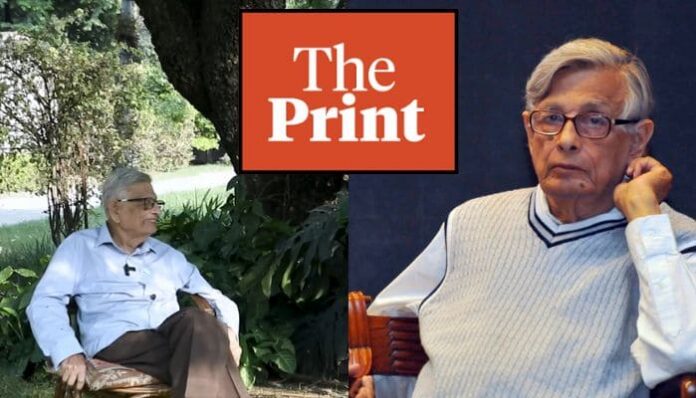
In another attempt by leftists to distort the history of the sacred Ram Mandir in Ayodhya, Shekhar Gupta’s ThePrint platformed Marxist historian Irfan Habib and published an interview with him on Friday, 30th October. The Marxist historian claimed that the Supreme Court’s 2019 Ram Janmabhoomi–Babri Masjid verdict was “totally illegitimate”.
During the interview, Irfan Habib claimed that the Supreme Court’s 2019 Ram Janmabhoomi–Babri Masjid verdict was “totally illegitimate” and questioned the archaeological evidence presented in support of the temple that existed at the disputed site.
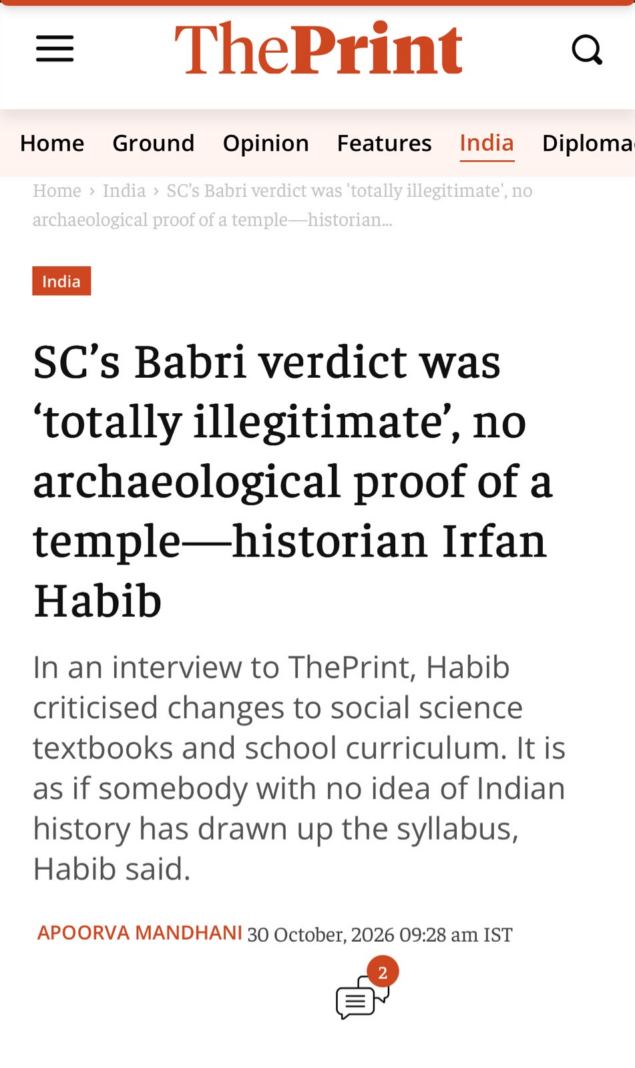
Speaking to ThePrint in Aligarh, the 95-year-old historian claimed, “It is illegitimate because there is no proof that there was a temple there. They assumed, but archaeologically, there was no proof… The evidence for Babri Masjid being a temple is very slight.”
Supreme Court’s Babri Masjid verdict was “totally illegitimate” from a historian’s point of view, says historian Irfan Habib in a conversation with @dksingh73 and @MandhaniApoorva. https://t.co/OvJ1iQLEET
— ThePrintIndia (@ThePrintIndia) October 30, 2026
Habib further alleged that the Archaeological Survey of India (ASI) had selectively interpreted the findings from the excavation. He claimed that bricks associated with Muslim construction were discarded while stones were presented as parts of Hindu idols. “You first destroy a mosque, and then you start digging. So when a brick comes out of Muslim construction, you throw it away. But when a stone comes out, you say it is a part of an idol,” he said.
He also questioned whether the archaeological findings could establish that a temple had existed at the exact location. According to him, stones recovered from the site could have been brought from elsewhere and reused in the construction of the mosque. He claimed that no archaeologist of repute had supported the conclusion that a temple stood beneath the Babri Masjid.
Pre-excavation manoeuvres: Unmasking Habib’s earlier stance
This latest commentary is a continuation of his long-standing strategy to derail historical truth. Habib’s position on the Ayodhya dispute was discussed by a veteran journalist, Arvind Singh, in his book, “India’s Rogue Historians – How They Fought Against Hindus at Ayodhya & Lost.”
The book describes how, even before the ASI excavation began, Habib had written an article in Hindustan Times arguing that the archaeological team should not dig deeper than two metres.
Irfan Habib wrote an article in HT before the excavation started. He argued that the ASI should not go deeper than 2 metres because the dispute pertains to medieval India and any depth more than that would yield material culture of the ancient India and a brick of the Kushan period could be used as a evidence of a Hindu structure. The Muslim side took the cue and pleaded with the HC to prescribe a 2-metre depth limit to the ASI. The court asked the ASI to reply. The agency argued that limiting the depth would be against the principles of archaeology. It would be an incomplete and meaningless exercise. A couple of months before, Habib had admitted of a structure beneath the earth but called it ‘a residential quarter for marginalised sections.’ All his roguery has been unmasked in my book India’s Rogue Historians. Here is the link. https://t.co/585kmhXZ2i
— Arvind Singh 🇮🇳 (@arvindsingh_dev) November 1, 2026
According to the account in the book, Habib argued that the dispute concerned medieval India and that digging beyond two metres could take the excavation into much older historical layers. He suggested that the ASI might then discover remains from ancient India, including bricks from the Kushan period. Such discoveries, he feared, could be presented as evidence of an earlier Hindu structure at the site.
The Muslim side even adopted Habib’s argument and asked the High Court to restrict the ASI’s excavation to two metres. The court then asked the ASI to respond.
The ASI opposed the demand, arguing that imposing an arbitrary depth limit would violate established archaeological principles and make the excavation incomplete and meaningless. Archaeologists need to examine the layers of earth to understand the history of a site. Restricting the excavation in advance could prevent archaeologists from examining important evidence lying beneath the surface.
The book also points out that, a couple of months before the excavation, Habib had admitted the existence of a structure beneath the ground but described it as a “residential quarter for marginalised sections”.
Constant subversion of Archaeological evidence
This is not the first time Habib has openly backed the Muslim side in the Ayodhya dispute and questioned the archaeological findings that supported the existence of a temple beneath the demolished Babri Masjid.
In August 2003, Habib accused the ASI of tampering with the evidence to suit its own conclusions and claimed the findings from the site suggest that the structure below the demolished Babri Masjid could well have been a mosque and not a temple. The leftist historian claimed that the presence of animal bones was decisive evidence against the existence of a temple.
“Bone fragments with cut marks are a sure sign of animals being eaten at the site and therefore rule out a temple existing at the site at that time,” he argued.
Similarly, he alleged, glazed ware, often called Muslim glazed ware, also constitutes an equally definite piece of evidence which militates against the temple theory, as this was not used in temples.
These arguments were part of the objections raised by the Marxist historian Habib. However, the ASI’s findings were subsequently examined during the legal proceedings in the Ayodhya dispute. The Allahabad High Court’s 2010 judgment discussed the archaeological evidence, including the remains of a large structure beneath the demolished mosque. The Supreme Court later considered the evidence and other material before delivering its November 2019 verdict.
Attacks on Prime Minister Modi and school curricula
Apart from the Ram Mandir, the leftist historian made another outrageous claim in the same interview. Habib used the interview to target Prime Minister Narendra Modi and defend former Prime Minister Jawaharlal Nehru, and claimed, “Nehru is one of the most important minds and what people like the present Prime Minister say about him is useless. It’s hardly worth any attention. What has he done in history?”
Habib also criticised the changes being made to social science textbooks and the school curriculum. Referring to the recent changes in NCERT textbooks, he accused the present government of rewriting history and claimed that India was now going ahead of Pakistan in falsifying historical accounts. The leftist historian claimed, “Unfortunately, that is present in India. Earlier, Pakistan glorified it. But now we are practically outpacing Pakistan by falsification.”
He also accused the current government of rewriting history. “The syllabus drawn up in the name of the Government of India and the Ministry of Education is atrocious. As if somebody who has drawn it has no idea of Indian history, no idea of the origins of the caste system,” Habib added.
Irfan Habib admitted Aurangzeb demolished temples in Varanasi and Mathura
These statements add to the long list of controversial statements about Hindu temples and Mughal rulers in the past. In January 2024, an old video of the Marxist historian from May 2022 went viral on social media. In the video, he admitted that Mughal emperor Aurangzeb had demolished temples in Varanasi and Mathura to build mosques.
The video had surfaced days after the discovery of a Shivling-like structure inside the Gyanvapi complex in Varanasi. Habib acknowledged the demolition of temples but questioned whether the government could act against structures that had existed since the 17th century.
“It is correct that Aurangzeb demolished the temple, but it is not specified that it was Lord Shiva’s temple. It became a Shiv Temple after they found a Shivling. Aurangzeb demolished this temple in Varanasi. Another temple was demolished in Mathura. There’s no two ways about it,” he said.
He then questioned the demand for the restoration of the temples, asking, “Can the government demolish something that was built in 1670? It is against India’s Monument Protection Act.”
Habib has constantly targeted Hindu organisations and the administration. In an interview with NewsClick, he remarked that Mughals would not disappear from history just because the Sangh wished so. In another interview with The Quint in May 2022, Habib had also acknowledged the destruction of temples by Aurangzeb but questioned whether the discovery of old temple stones should lead to the demolition of existing mosques.
Habib has also repeatedly made controversial remarks against the RSS and the BJP government. In January 2020, a legal notice was sent to him over his remarks at Aligarh Muslim University, where he claimed that the RSS had been formed to attack Muslims. He had also targeted Hindutva ideologue Veer Savarkar, accusing him of being responsible for India’s Partition and claiming that there was circumstantial evidence linking him to Mahatma Gandhi’s assassination. He had also referred to Prime Minister Modi as ‘Jahil’.
Ideological roots: Whitewashing separatism and demanding class history
Notably, Irfan Habib is the son of Marxist historian Mohammad Habib of Aligarh Muslim University. Mohammad Habib had turned to Marxism after the Anglo-Soviet Pact of 1941, when previously banned communist literature entered India. He was among the early influential converts and was the first to propound the notion in his 1927 work Sultan Mahmud of Ghazni that Muslim rulers of medieval India razed temples purely out of avarice and greed, denying any religious motivation behind the destruction.
Mohammad Habib maintained a close friendship with the Nehrus and was a protégé of Motilal Nehru. His theories regarding Mahmud were directly echoed in Jawaharlal Nehru’s The Discovery of India (1945), where Mahmud was painted as a warrior interested in culture who broke temples merely for building materials. After independence, Nehru relied heavily on Marxist historians to justify his pro-Muslim policies, providing them the blueprint to push class as the primary organising principle.
In his 1947 presidential address to the Indian History Congress, Mohammad Habib called upon historians to use their pens to fashion a society based on class, asserting that past historical works suffered from “bourgeois” biases and urging scholars to lead India to the “shrine of her newfound, classless God.” Through such ideological frameworks, Marxist historians sought to whitewash the violent history of Islamic rule and smooth over fault lines, laying the groundwork for decades of historical distortion.
Conclusion
The publication of Irfan Habib’s latest interview by ThePrint underscores a persistent effort by leftist platforms to amplify discredited ideological narratives under the guise of historical commentary. By providing an uncritical platform to a Marxist historian whose career has been defined by selective archaeology, political activism, and explicit legal manoeuvring to block pre-excavation truths at Ayodhya, ThePrint effectively enables the revival of claims already settled by exhaustive archaeological evidence and the highest court of the land.
Promoting Habib’s assertion that the Supreme Court’s 2019 verdict was “illegitimate” ignores both the extensive findings of the Archaeological Survey of India (ASI) and Habib’s own long history of attempting to pre-empt and restrict scientific excavation.


