

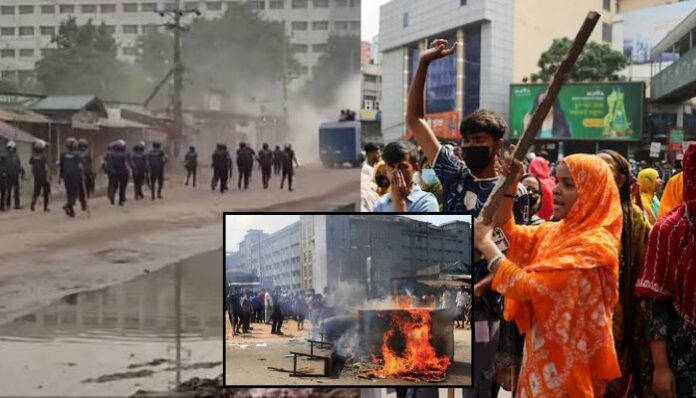
Demonstrators in Bangladesh blocked highways and clashed with police as protests in the ready-made garment (RMG) sector entered their third consecutive day on Monday, 2nd November. Demanding a substantial increase in their minimum wages, workers took to the streets across major industrial hubs, forcing several factories to suspend operations amid rising security concerns and fears of violent attacks.
protesters were prominently reported in Gazipur’s Konabari and Chandra areas near Dhaka, home to a massive concentration of garment manufacturing units. Fearing vandalism and arson, numerous factory owners proactively declared holidays, bringing production to a halt across key manufacturing belts.
Despite the government forming a new wage board on Sunday, 1st November, workers continued their agitation, insisting on a minimum monthly wage of Tk 30,000.
Bangladesh announces six-member wage board to review garment workers’ pay and urges employees to return to work, but protests demanding higher wages continue across major industrial areas, disrupting transport and factory operations https://t.co/2mv4R8x2gg
— TRT World Now (@TRTWorldNow) November 1, 2026
The violence and disruption were not confined to Monday alone; tensions had already flared over the weekend. On Sunday, 1st November, readymade garment workers staged protests across various areas of Savar and Gazipur on the outskirts of Dhaka, pressing their primary demand for a minimum monthly wage increase to Tk 30,000.
Local media reports indicated that at least 80 factories across these two districts declared holidays on Sunday to protect their facilities. While the situation appeared relatively normal on Sunday morning, it began to deteriorate rapidly in Savar by midday.
Dozens of garment workers in Bangladesh clashed with police in the capital Dhaka as they protested against low pay and the rising cost of living. The textile industry is the backbone of the country’s economy. https://t.co/9rXDQ6mSx4
— Al Jazeera English (@AJEnglish) November 1, 2026
More than 50 factories shut in Savar, police deployed
Police were heavily deployed at key transit points and outside factory gates to maintain law and order. Mohammad Mominul Islam Bhuiyan, superintendent of police of Ashulia Industrial Police-1, confirmed the extent of the disruption while speaking to Prothom Alo, “More than 50 factories in Savar declared holidays.” According to witnesses and officials from Ashulia Industrial Police-1, most factories had opened as normal in the morning. However, workers at Al-Muslim Apparels in Nishchintapur, alongside units belonging to the New Age Group and Trouser Line Ltd, stopped work and remained inside their workplaces, signalling growing internal solidarity with the movement.
The protests quickly turned destructive in several locations. In Gazipur’s Kaliakair upazila, a warehouse storing garment factory waste fabric and a pickup van were set on fire in the Chandra Palli Bidyut on Sunday. At least 30 garment factories in the immediate vicinity declared holidays as a direct consequence of the violence.
Warehouse and pickup van torched in Gazipur
According to a report by Prothom Alo, a warehouse of a readymade garment industry was set on fire in the Chandra Palli Bidyut area of Kaliakair upazila in Gazipur on Sunday. Earlier that morning, workers from several factories, including Korni Knit Composite and Knit Asia in Ratanpur, Kaliakair, refrained from starting their shifts. After marking their attendance inside their factories, they gathered on the highway near Shafipur Bazar to demonstrate, prompting neighbouring units to shut down for safety.
Shortly after, when a warehouse storing waste fabric belonging to Tropical Garments was set ablaze, a unit from the Kaliakair Fire Service attempted to respond but was actively obstructed by demonstrators.
To prevent further collapse of public order, five platoons of the Border Guard Bangladesh (BGB) were deployed to support police forces in controlling the situation. Meanwhile, in Dhaka, workers from several parts of Mirpur blocked a key arterial road, forcing the closure of local metro station gates as police rushed to secure the capital’s transport infrastructure.
Why are garment factory workers protesting?
At the centre of the ongoing unrest is the demand for a substantial increase in the minimum monthly wage for garment workers. The existing minimum wage stands at Tk 12,500, while workers are demanding that it be raised to Tk 30,000, more than double the present amount.
Workers argue that the current pay structure is completely inadequate to cover essential household expenses like food, housing, transport, and healthcare. Their demand has also gained momentum following the Bangladesh government’s recent announcement of a new pay scale for government employees, which is expected to substantially increase government salaries and benefits. Workers are now seeking a comparable revision in their own wages.
Factory owners, however, have voiced strong reservations about meeting such a steep pay raise. Manufacturers point to severe operational headwinds, citing a decline in international export orders, stagnant pricing from global buyers, and soaring costs for imported raw materials. They maintain that these combined financial pressures make a jump to BDT 30,000 virtually impossible without risking widespread factory.
Outstanding salaries and other workplace grievances
Apart from the minimum wage demand, the protesters have raised several other workplace grievances. These include the payment of outstanding salaries and dues, reinstatement of dismissed employees and an end to the practice of blacklisting workers who participate in labour movements. Workers have also complained that the actual take-home salaries in some factories do not adequately reflect the statutory minimum wage.
The current minimum wage of Tk 12,500 was established in December 2023. Under provisions in the Bangladesh Labour Act, sectoral wages are scheduled to be reviewed every three years to adjust for inflation, meaning the garment sector’s formal wage structure is technically due for its next legal review in December 2026. However, escalating inflation has forced workers to demand immediate relief rather than waiting for the standard statutory schedule.
As the unrest intensified, the situation took on a distinct political dimension. Law enforcement agencies alleged that leaders from ousted Prime Minister Sheikh Hasina’s Awami League, which was banned by the Muhammad Yunus-led interim government, had joined the protests in Dhaka and Gazipur. Affiliated groups like the Sramik League and Chhatra League were also accused of taking part in the workers’ demonstrations.
PM Tarique Rahman holds meeting amid unrest
Amid the escalating protests and clashes, Bangladesh Prime Minister Tarique Rahman held a meeting on Sunday, 1st November, with Home Affairs Minister Salahuddin Ahmed, Labour and Employment Minister Ariful Haque Choudhury and other relevant officials. The meeting took place in the Cabinet Division conference room at the Secretariat in the evening to review the deteriorating situation in the country’s garment industry.
The meeting came as protests, road blockades and incidents of arson were reported in Mirpur, Kaliakair, Savar and Ashulia. Around 300 factories in these areas had declared holidays amid the unrest, while production and transportation were affected.
Following the meeting, the government directed law enforcement agencies and other concerned authorities to take steps to protect garment workers, factories and public property while ensuring that industrial production and export activities continued without disruption. Concurrently, the administration appealed directly to factory owners to keep their units open and work out solutions with labour representatives through constructive dialogue.
Factory closures and supply Chain strains threaten Garment industry
With the latest protests, Bangladesh’s export engine faces severe economic fallout. The garment sector forms the backbone of the national economy, employing roughly four million workers, generating over 80% of Bangladesh’s export revenue, and contributing around 10% of total GDP.
Bangladesh serves as the world’s second-largest garment exporter after China. Representatives from both the BGMEA and the Bangladesh Knitwear Manufacturers and Exporters Association (BKMEA) have warned that extended unrest could force widespread, indefinite closures. Labour and Employment Minister Choudhury similarly cautioned that ongoing operational delays risk causing missed export deadlines and delayed payments from international buyers, placing immense pressure on both factory owners and daily wage earners.
Compounding these sector-wide troubles are major structural closures within top-tier manufacturing groups. Pacific Jeans Limited, the flagship unit of Pacific Group, one of Bangladesh’s premier readymade garment manufacturers and a leading denim supplier to the US and EU, is set to shut down permanently after its building was declared structurally unsafe on Saturday, 31st October, putting approximately 5,500 jobs at risk.
Violent protests rage as garment factories shut down in Bangladesh 🇧🇩 Latest being 5,500 jobs lost as Pacific Jeans, leading denim suppliers to US and EU, closes partially. By cheering the US-backed regime change in 2024, Bangladesh burned itself for decades to come. Everything America touches — Iraq, Libya, Syria, Ukraine — turn to ash. https://t.co/RyOSewqSnC
— Abhijit Majumder (@abhijitmajumder) November 1, 2026
The major closure of Pacific Jeans Limited occurs alongside broader systemic strains across the entire supply chain. In a move that poses severe risks to the national economy, the Bangladesh Textile Mills Association (BTMA) announced an indefinite operational shutdown of textile mills across the country from 1st February.
BTMA President Showkat Aziz Russell announced during a press conference at the association’s office in Dhaka on 22nd January this year, emphasising that the decision was based on necessity and was not intended as a threat. The association cited crippling financial losses and government inaction in safeguarding domestic yarn producers as the primary drivers behind the shutdown, pointing to a challenging period ahead for Bangladesh’s primary export sector.


